
Apex Trader Funding Review October 2026
Last Updated: July 7, 2026 Data verified Oct 20, 2026How we rate Apex Trader Funding
Composite 3.20/10, built from the components below. Each score shows the evidence behind it.
-
Payout evidence 8.5/10Published payout total grew to $887,870,000+ since Jul 2026.
-
Rule strictness 4.5/10Target-to-drawdown ratio up to 2.25 — strict relative to how much loss is allowed.
-
Pricing 7.8/10$1.76 per $1,000 funded — cheaper than 75% of 28 comparable firms.
-
Platform support 10/1014 supported platforms: NinjaTrader, Quantower, TradingView, Tradovate.
-
Transparency 4.2/108 of 19 firm-wide rules published.
Risk profile
On the strictest plan you must earn $2.25 for every $1.00 of drawdown you are allowed to lose.
What this drawdown type means for you
End-of-day trailing drawdown
Your loss limit moves up based on your closing balance each day, not on intraday spikes. Profit you take and hold to the close raises the floor; profit you win and lose back within the same session does not count against you. It is materially more forgiving than intraday trailing, but the floor still ratchets upward permanently and never falls back once it has moved.
Intraday trailing drawdown
Your loss limit follows the highest point your account reaches during the session, updating tick by tick on unrealised profit. If a trade runs $2,000 in your favour and you then give it all back, the limit has already moved up with that peak — so it is possible to breach the account on a day you finish flat. This is the least forgiving drawdown mechanic; treat open profit as if it were already banked.
Pricing position
Cost per $1,000 funded counts the evaluation plus any activation fee, then normalises across account sizes — the honest way to compare a cheap small account against a pricier large one. Prices shown before promo codes. See all 24 plans →
TRADERS AND AFFILIATES, BEWARE: As of 2026 Apex Trader Funding has been going down hill. If you are thinking about working with them on affiliate level, just don't. They have been screwing affiliates out of payouts and citing "This action is being taken pursuant to Section 10.2.3 of the Affiliate Marketing Agreement, Termination by Company, which permits Apex to terminate an affiliate relationship at any time, with or without cause." as the reason. And then saying that you will not get paid out, even though they never mention the reason.
Simply put, they backstabbed the people that helped the brand become as popular as they currently are. For Apex, it is a good business practice to stop paying reoccurring commission to the accounts that actually made the brand and vouched for it.
Apex Trader Funding Overview
Apex Trader Funding is well known for its crazy deals like 90% off, and nowadays it is also known for wilding out with suspensions of traders and affiliate partners that have helped Apex to become what they are now. As of recently Apex has been conducting major ban operations of their affiliate partners, which is really making the company look less and less legit. Imagine this, affiliate bring in traders and were promised 15% of lifetime commission, Apex now decides that they can just wipe out affiliate partners, so the payments to them stop, however, the traders that the affiliates brought in, continue paying into the system.
To spice things up more, Apex hasn't really only stopped at banning affiliates. If you look at the most recent Trustpilot reviews, you are continuing to see 1-star reviews rolling in with traders not receiving payouts. Here at Prop Firms Finder, we had big hopes for Apex after the rollout of Apex 4.0, but it just seems like things just have gotten worse, therefore we have downgraded Apex score from mid-9s to mid-6s.
Apex Trader Funding 4.0
You can choose from two main funding paths with Apex: Intraday Trail and EOD Trail. For both paths, Apex supports Rithmic, Tradovate, or Wealthcharts platforms.
As of March 2nd, 2026, the company completely revamped the program after pretending to hear what the traders want. The prop firm went from only providing intraday drawdown to now claiming to offer EOD drawdown option, with one-time fees, no monthly subscriptions, no payout denials (this one is very much in question as of recently), automated payout processing, no payout reviews, no video reviews of trading, no chart screenshots needed anymore, and much more. While having EOD and Intraday Trailing Drawdown account options is not news for prop firms such as Bulenox, it addressed one of the main complaints by traders that have used Apex. All of these changes have currently moved Apex Trader Funding by 6 spots in our Best Futures Prop Firms list. Read our full review and tests of Apex Trader Funding!
Apex Trader Funding Overview
Apex was founded by Darrell Martin in 2021 and is headquartered in Austin, Texas. The firm has grown to serve traders in over 100 countries and has reported more than $777.19 M million in total payouts since 2022, with an average monthly payout volume of almost $14.36 million. In the past 3 months alone, Apex has paid out $106.78M. Since we are keeping track of the data that the company shares publically, we noticed that since Apex rolled out the 4.0 version, the payouts haven't increased by much at all, making us believe that the traders are just getting more of the same.
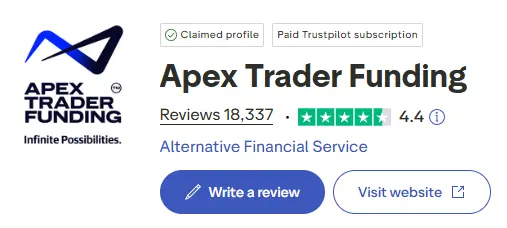
The company's Trustpilot rating could be better, currently hovering around 4.4 based on over 18K+ reviews. And we say it could do better because a lot of negative reviews come from people who could not pass the deal of 90% off, but then got hit with the notorious intraday trailing drawdown and got their account canned. So it is true, rules used to be very strict, but now with the new changes, they promise a different story.
Below, we will be going over the Apex Trader Funding program in greater detail: account types, evaluation rules, pricing, platform options, payout structure, PA (Performance Account) trading rules, and the consistency requirements that funded traders must follow. Here's all the data you need to decide whether Apex is the right fit for your trading style, experience level, and financial goals.
How Apex Trader Funding Works
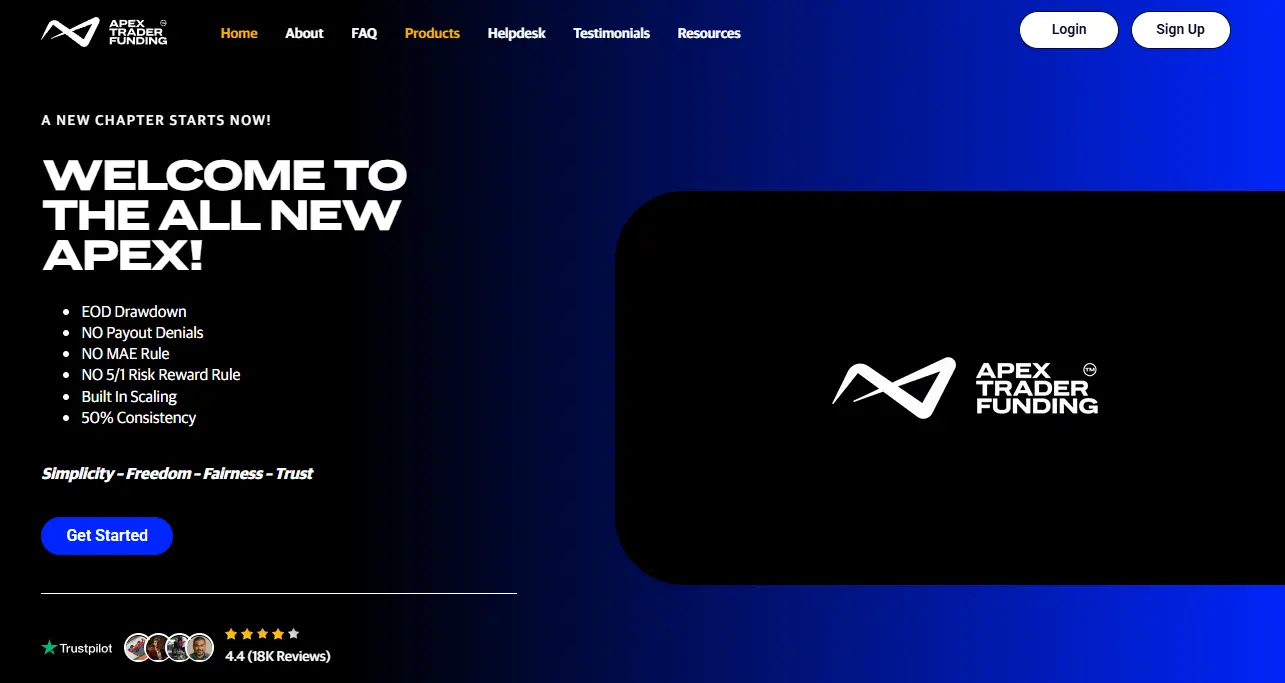
If you were familiar with Apex prior to March 1st, 2026, forget most of what you knew. The new system replaces the previous monthly subscription model with one-time evaluation fees, eliminates several controversial PA rules (the MAE rule, the 5:1 risk-reward rule), introduces EOD trailing drawdown as an option alongside intraday trailing, shifts the consistency rule from 30% to 50%, and removes payout denials entirely. Apex describes the philosophy behind the changes as: "Simplicity, Freedom, Fairness, Trust."
The core model remains the same:
- Purchase an evaluation account,
- Pass a single-step evaluation by hitting a profit target within defined risk parameters,
- Pay an activation fee, and then trade a Performance Account (PA) where you can earn real payouts on simulated profits.
However, nearly every detail of account pricing, rules, and payout structure has changed.
📌 Important: New vs. Legacy Accounts. The March 2026 changes apply only to new accounts purchased on or after March 1, 2026. Legacy accounts (purchased before that date) continue under their original rules with no changes. Legacy evaluations can still be reset, still progress into legacy PAs, and still operate on monthly recurring billing. Traders can hold a mix of legacy and new accounts simultaneously.
All evaluation and Performance Accounts remain simulated (SIM) accounts using live market data. PAs do not execute trades on actual exchanges, and traders who demonstrate consistent profitability may be invited to transition to a Live Prop Trading Account, though this is by invitation only.
Apex Trader Funding: New Account Structure From March 2026
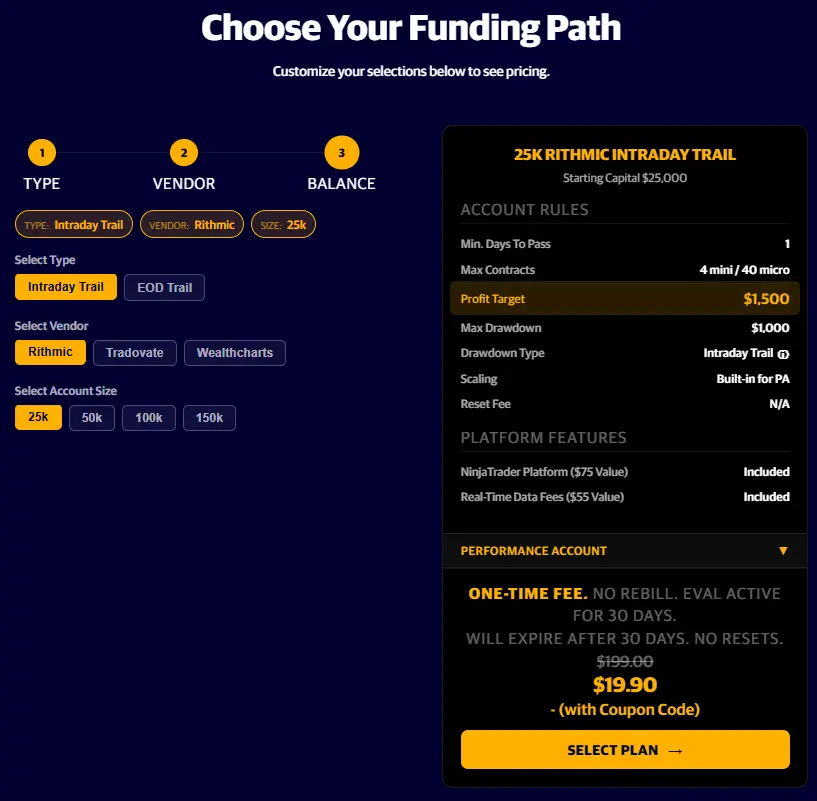
The new Apex offers two drawdown types across four account sizes ($25K, $50K, $100K, $150K) on three platforms (Rithmic, Tradovate, WealthCharts). Let's delve into each one of them:
🟡 Intraday Trailing Drawdown: the drawdown follows your highest equity tick-by-tick in real time (same mechanics as before, but with new account parameters)
🟡 EOD (End-of-Day) Trailing Drawdown: the drawdown only updates based on your end-of-day closed balance, not intraday equity swings. EOD accounts also include a Daily Loss Limit.
Remember that all new evaluations are one-time fees with no recurring billing. Evaluations don't have consistency rules; they are active for 30 days and expire after that period. There are no resets on new accounts.
📌 Very important to consider before investing: We noticed that for both accounts, there's a 6-payout cap. In other words, Performance Accounts may get a maximum of 6 approved payouts. Each payout has a ceiling, which scales up as you progress through the 6 slots. After payout number 6, the PA is closed, and you need to pass a new evaluation to get a fresh PA. However, from a logical standpoint, the chances of you not getting a funded account before the 6th payout are fairly slim.
All About Apex New Accounts: Account Sizes, Profit Targets, and Drawdowns
We reviewed and tested everything about the new accounts. Below, you will find all the information about account size, profit targets, and drawdowns summarized in tables. Scan and choose the right one for your needs. If you want to see an interactive Apex Trader Funding Challenges table, we have a page for that as well.
Intraday Trailing Drawdown Accounts
This account is best for high-frequency day traders. If you buy and sell assets in seconds and profit from fast and small price changes, this option might be for you.
Here, your drawdown floor follows your Peak Balance in real time, every tick. The moment your balance reaches a new high, the floor rises instantly. It is more aggressive and punishing if you let the winners reverse.
|
Account Size |
Max Contracts (Mini/Micro) |
Profit Target |
Max Drawdown |
Drawdown Type |
|
$25,000 |
4 / 40 |
$1,500 |
$1,000 |
Intraday Trail |
|
$50,000 |
6 / 60 |
$3,000 |
$2,000 |
Intraday Trail |
|
$100,000 |
8 / 80 |
$6,000 |
$3,000 |
Intraday Trail |
|
$150,000 |
12 / 120 |
$9,000 |
$4,000 |
Intraday Trail |
EOD Trailing Drawdown Accounts
This is the perfect account for positional traders. In this case, your drawdown floor is recalculated just once per trading day at market close.
|
Account Size |
Max Contracts (Mini/Micro) |
Profit Target |
Max Drawdown |
Daily Loss Limit |
Drawdown Type |
|
$25,000 |
4 / 40 |
$1,500 |
$1,000 |
$500 |
End of Day |
|
$50,000 |
6 / 60 |
$3,000 |
$2,000 |
$1,000 |
End of Day |
|
$100,000 |
8 / 80 |
$6,000 |
$3,000 |
$1,500 |
End of Day |
|
$150,000 |
12 / 120 |
$9,000 |
$4,000 |
$2,000 |
End of Day |
Key Changes from Legacy Accounts
Account sizes have been reduced from seven options ($25K–$300K plus $100K Static) to four ($25K–$150K). The $75K, $250K, $300K, and $100K Static accounts are no longer offered for new purchases. Contract limits have been adjusted; for example, the $50K account now allows 6 minis (previously 10), and the $100K allows 8 minis (previously 14). Max drawdowns are generally tighter: the $50K intraday account has a $2,000 drawdown (previously $2,500), while the $100K remains at $3,000 unchanged.
EOD trailing is entirely new to Apex’s product lineup. Legacy accounts only offered intraday trailing (plus one static option). EOD accounts now include a Daily Loss Limit that intraday accounts do not have. The minimum days to pass is now permanently 1 day across all accounts (previously 7 days, or 1 during promotional periods), and all accounts now include built-in scaling for the PA phase.
Evaluation Pricing of New Accounts
All new evaluations are one-time fees with no monthly recurring billing. If you fail the Evaluation, there are no reset fees, but you have to purchase a new one. To view all of the evaluation options at once, head on over to the Apex Trader Funding Challenges page.
Pricing is identical across all three platforms (Rithmic, Tradovate, WealthCharts) for the same size EOD Drawdown and Intraday Trailing Drawdown accounts. Each evaluation includes real-time Level 1 data, valued at $55, and a NinjaTrader platform license, valued at $75. Tradovate evaluations also include TradingView compatibility, browser/mobile access, and Mac support.
Intraday Trail Pricing
Take a look at the prices for the Intraday Trailing Drawdown with an average of 85% discount, since Apex seems to be running either 90% or 85% discounts year-round:
|
Account Size |
List Price |
With Coupon (~85% off) |
|
$25K |
$118.00 |
~$17.70 |
|
$50K |
$131.33 |
~$19.70 |
|
$100K |
$198.00 |
~$29.70 |
|
$150K |
$264.67 |
~$39.70 |
EOD Trail Pricing
EOD accounts cost more than intraday accounts at every size, reflecting the more trader-friendly drawdown mechanics. There are no more monthly subscriptions, no reset fees, and evaluations expire after 30 days with no option to reset. If you fail, you purchase a new evaluation. Aggressive promotional discounts continue, with up to 85–90% off during launch promotions
Here's a summary of the prices for the EOD Trailing Drawdown with an average of 85% discount:
|
Account Size |
List Price |
With Coupon (~85% off) |
|
$25K |
$177.00 |
~$26.55 |
|
$50K |
$197.00 |
~$29.55 |
|
$100K |
$297.00 |
~$44.55 |
|
$150K |
$397.00 |
~$59.55 |
The Drawdown Types in Apex
Using practical examples and case studies, we analyzed Apex's drawdown types. Read on to understand how it works.
Intraday Trailing Drawdown
The intraday trailing drawdown works the same as Apex's legacy trailing threshold: it follows your highest equity in real time, including unrealized open-trade profits. It never moves back down. If your account equity touches the trailing level at any point during the session, the account is breached.
Example ($50K account, $2,000 intraday trail):
1. Starting balance: $50,000. Breach level: $48,000.
2. You open a trade that reaches +$800 unrealized, and the breach level moves to $48,800.
3. Trade pulls back; you close at +$200, the balance is $50,200, but the breach level stays at $48,800 because it tracked the $50,800 equity peak.
4. If equity ever touches $48,800, the account fails.
EOD (End-of-Day) Trailing Drawdown
As we mentioned before, this is new to Apex's product lineup. The EOD trailing drawdown only updates based on your end-of-day closed balance, not intraday equity swings. This means unrealized profits during the trading session do not raise your breach level; only your balance at market close matters.
This is significantly more trader-friendly than intraday trailing. Traders can hold positions through intraday pullbacks without permanently raising their risk floor.
📌 EOD accounts also include a Daily Loss Limit (DLL): This is the maximum amount you can lose in a single trading day. If the DLL is hit, trading is stopped for the day. The DLL amounts are $500 (25K), $1,000 (50K), $1,500 (100K), and $2,000 (150K).
Drawdown Lock: The Safety Net on PA Accounts
In Performance Accounts, the trailing drawdown stops moving once the liquidation threshold reaches the starting balance plus $100. For a $50K PA account, the drawdown locks once the threshold reaches $50,100 (after sufficient profit is built). This "Safety Net" creates a permanent floor: once locked, the breach level never moves again, regardless of how high or low the balance goes afterward.
PA Activation and Fees After the Evaluation Stage
After passing the evaluation, traders pay an activation fee to receive their Performance Account. Apex's homepage indicates that the process follows a standard path: you pass the evaluation → pay the activation fee → move to a PA account.
Traders can activate up to 20 PA accounts in total, per household (across all personal accounts, business accounts, and platforms combined).
Payout Structure for New Accounts
The new payout structure represents the most significant change in Apex 4.0:
- 100% of requested rewards, no profit split on Sim Funded accounts. Traders keep 100% of their payouts on PA accounts. There is no 90/10 split. (Note that this applies to new products only.)
- No payout denials. Apex explicitly states: "No denied payouts. No payout reviews. No video reviews of trading. No chart screenshots needed."
- 5 trading days between payouts. Down from the legacy requirement of 8 trading days.
- 50% Consistency Rule. No single trading day can account for more than 50% of your total profit balance at the time of a payout request. This is significantly more relaxed than the legacy 30% rule.
- No MAE Rule. The 30% Negative P&L (Maximum Adverse Excursion) rule has been eliminated on new accounts.
- No 5:1 Risk-Reward Rule. The requirement that stop losses cannot exceed 5x the profit target has been removed on new accounts.
- Built-in Scaling. Contract scaling is built into the PA account structure rather than requiring traders to manually manage half-contracts until reaching a threshold.
Payout Summary: New vs. Legacy
Here's a comparison between the new Apex's product and the previous Legacy Accounts:
|
Feature |
New Accounts (March 2026+) |
Legacy Accounts (Pre-March 2026) |
|
Profit Split (Sim) |
100%, no split |
100% first $25K, then 90% |
|
Payout Denials |
None |
Possible (review-based) |
|
Days Between Payouts |
5 trading days |
8 trading days (5 profitable at $50+) |
|
Consistency Rule |
50% |
30% (expires after 6th payout) |
|
MAE / Negative P&L Rule |
None |
30% (increased to 50% after growth) |
|
5:1 Risk-Reward Rule |
None |
Required |
|
Payout Reviews |
None (no video, no screenshots) |
Subject to review |
PA Trading Rules for New Accounts
The new PA rule set is dramatically simplified compared to legacy accounts:
☑️ These are the rules removed on new accounts:
- No MAE (Maximum Adverse Excursion) / 30% Negative P&L rule
- No 5:1 risk-reward ratio rule
- No payout denial process
☑️ Rules that remain or are updated:
- 50% Consistency Rule: Your highest profit day cannot exceed 50% of your total profit balance when requesting a payout. This is the most relaxed consistency threshold of any major futures prop firm.
- Built-in Scaling: Contract scaling is integrated into the PA structure. Specific details on how the built-in scaling differs from the legacy manual scaling (half-contracts until Safety Net) should be verified on Apex's new FAQ pages.
- Market Close Rule: All trades must be closed and pending orders cancelled by 4:59 PM ET.
- No Hedging / One-Direction Rule: You may only hold positions in one direction at any time. Simultaneous long and short positions are prohibited.
- Automation Prohibition: AI trading, bots, algorithms, and fully automated systems remain prohibited on PA and Live accounts.
- Daily Loss Limit (EOD accounts only): EOD trail accounts have a DLL that caps single-day losses.
Trading Platforms: Rithmic, Tradovate, and WealthCharts
Apex continues to support all three platforms. However, you cannot convert between platforms after the purchase. See below some details about each one of them:
Rithmic
Professional-grade direct market access (DMA) execution known for low latency. Connect through NinjaTrader, Sierra Chart, Bookmap, or other compatible front-ends. Rithmic is a good choice for experienced traders and scalpers. It is not natively Mac-compatible and requires Windows VM.
Tradovate
Cloud-based all-in-one platform with desktop, web browser, mobile, and Mac support. It integrates with TradingView for charting with direct execution. It is ideal for beginners, mobile traders, and Mac users. All Tradovate evaluations include TradingView compatibility.
WealthCharts
This platform offers advanced scanning tools, AI-driven market analysis (InvestPulse), built-in trade copier, and live educational streams. SIt is a standalone platform, and cannot connect to other data sources.
📌 Note: Pricing is now identical across all platforms for the same drawdown type. Legacy accounts had a $20/month premium for Tradovate over Rithmic, but this platform pricing disparity no longer exists on new one-time-fee evaluations. However, the list prices for Rithmic, Tradovate and WealthCharts are the same within each drawdown tier (Intraday Trail vs. EOD Trail).
Instruments You Can Trade with Apex Trader Funding
Apex offers a wide range of CME Group futures contracts:
Equity Futures
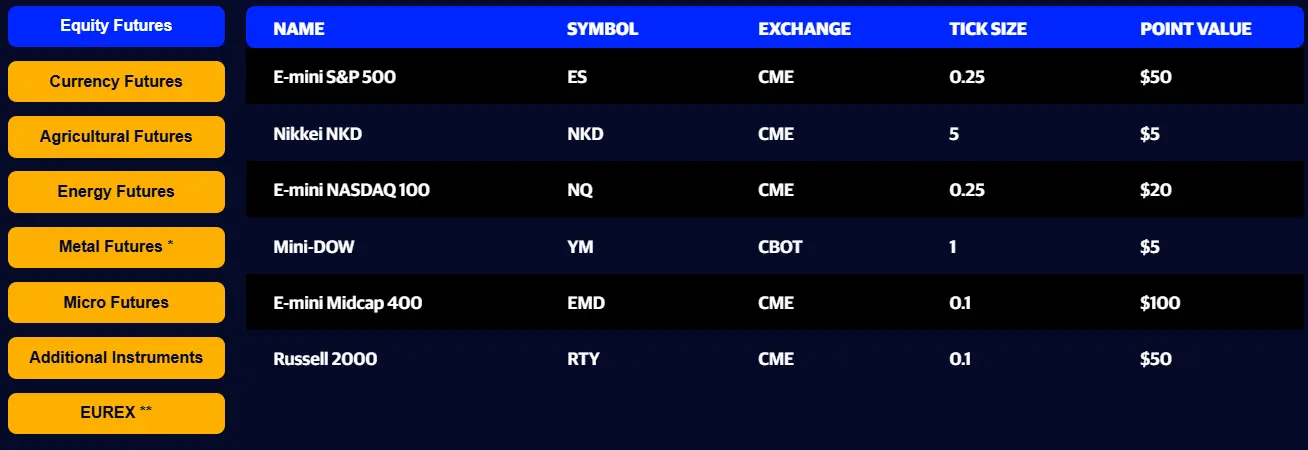
E-mini S&P 500 (ES), E-mini NASDAQ 100 (NQ), Mini-DOW (YM), E-mini Russell 2000 (RTY), E-mini Midcap 400 (EMD), Nikkei NKD
Currency Futures
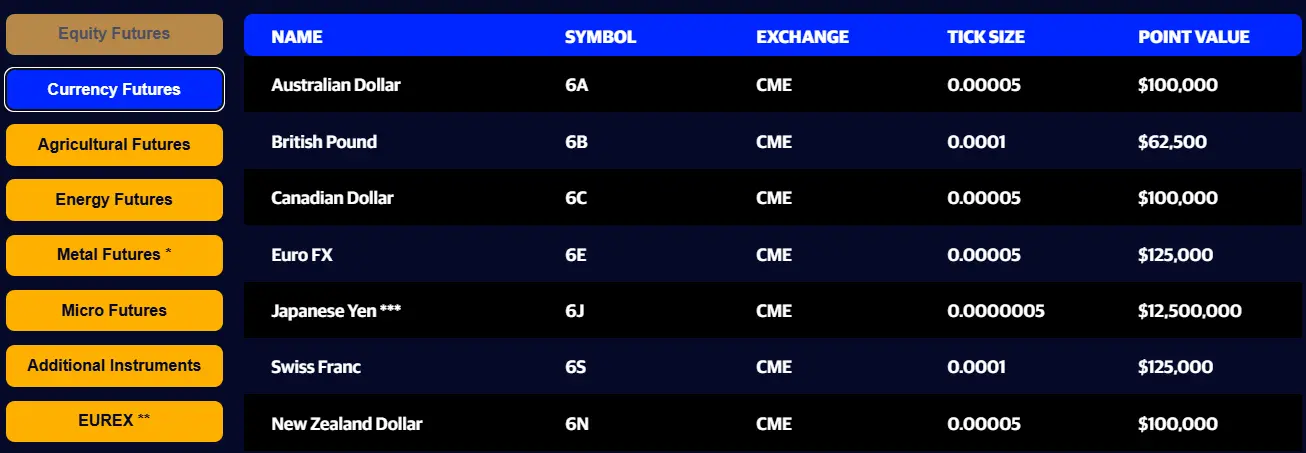
Australian Dollar, British Pound, Canadian Dollar, Euro FX, Japanese Yen (with restrictions), Swiss Franc, New Zealand Dollar.
Agricultural Futures
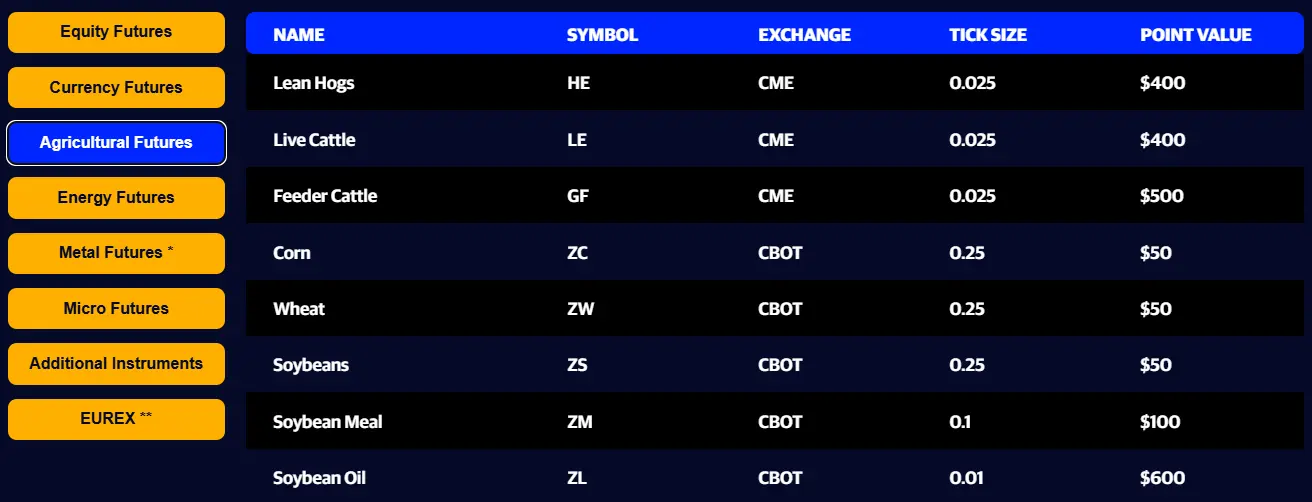
Available on CBOT: Lean Hogs, Live Cattle, Feeder Cattle, Corn, Wheat, Soybeans, Soybean Meal, Soybean Oil.
Energy Futures
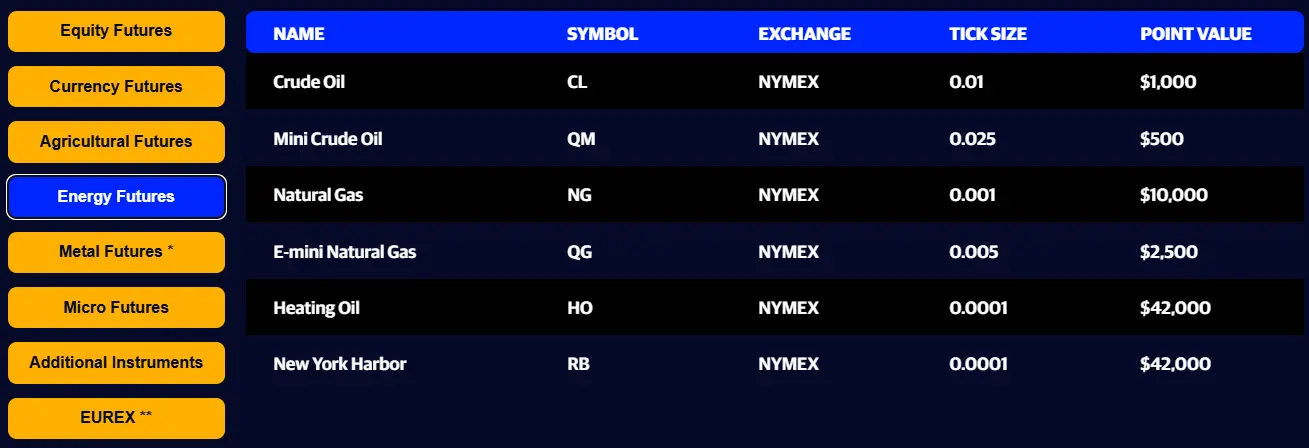
Available on NYMEX: Crude Oil, Mini Crude Oil, Natural Gas, E-mini Natural Gas, Heating Oil, New York Harbor.
Metal Futures
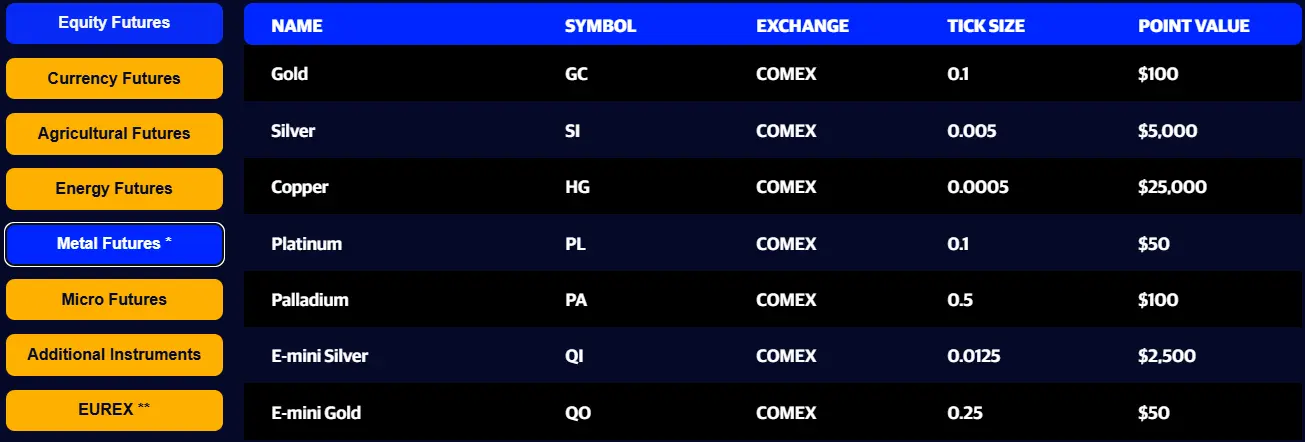
Currently restricted, COMEX and all metals are temporarily unavailable.
Micro Futures
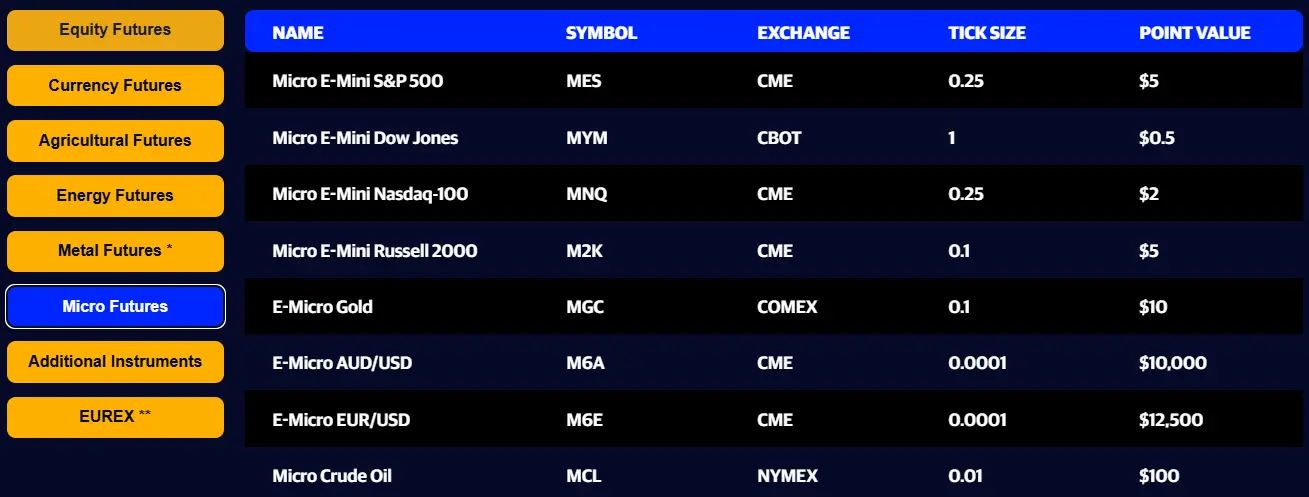
Micro E-Mini S&P 500, Micro E-Mini Dow Jones, Micro E-Mini Nasdaq-100, Micro E-Mini Russell 2000, E-Micro Gold, E-Micro AUD/USD, E-Micro EUR/USD, Micro Crude Oil.
EUREX
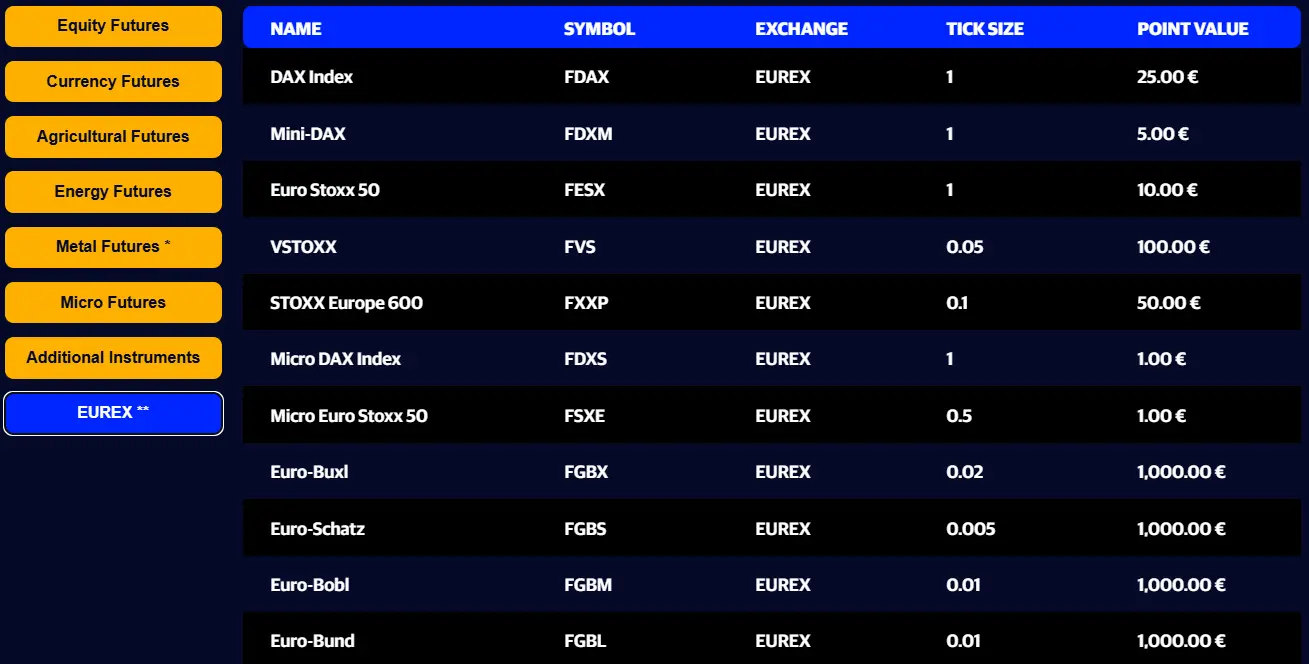
Certain exchanges available on Tradovate platform only. EUREX Instruments: DAX Index, Mini-DAX, Euro Staxx 50, VSTOXX, STOXX Europe 600, Micro DAX Index, Micro Euro Stoxx 50, Euro-Buxl, Euro-Schatz, Euro-Bobl, Euro-Bund.
Additional Instruments
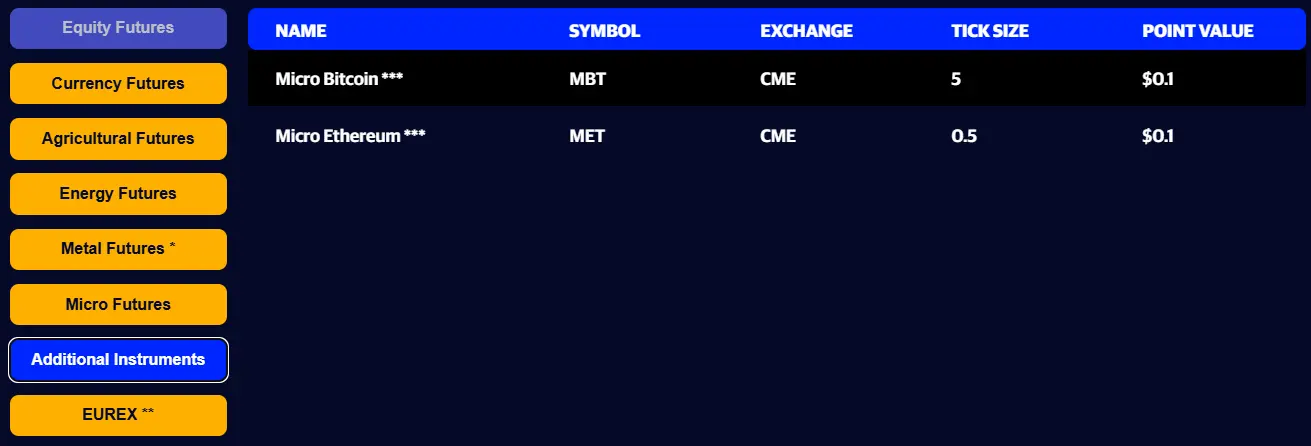
Micro Bitcoin and Micro Ethereum (restricted).
Legacy vs. New Accounts: Key Differences
|
Feature |
Legacy (Pre-March 1, 2026) |
New (March 1, 2026+) |
|
Fee Type |
Monthly subscription |
One-time fee (30-day expiry) |
|
Account Sizes |
$25K–$300K + $100K Static |
$25K, $50K, $100K, $150K |
|
Drawdown Options |
Intraday trailing + Static |
Intraday trailing + EOD trailing |
|
Daily Loss Limit |
None |
EOD accounts only |
|
Eval Minimum Days |
7 (1 during promos) |
1 |
|
Resets |
Available ($80–$100) |
Not available |
|
Eval Consistency Rule |
None (eval phase) |
None (eval phase) |
|
PA Consistency Rule |
30% |
50% |
|
MAE / 30% Negative P&L |
Yes |
No |
|
5:1 Risk-Reward |
Yes |
No |
|
Profit Split (Sim PA) |
100% first $25K, then 90% |
100% — no split |
|
Payout Denials |
Possible |
None |
|
Days Between Payouts |
8 (5 profitable at $50+) |
5 |
|
Contract Scaling |
Half-contracts until Safety Net |
Built-in |
|
Max PA Accounts |
20 |
20 |
|
Still Available? |
No (not for new purchase) |
Yes (current offering) |
|
Can Mix? |
Yes, legacy and new coexist |
Yes |
Account Types: Personal and Business
Apex allows one personal user account and one business user account per individual. Business accounts must be solely owned and operated by the trader (Sole Proprietorships, Single-Member LLCs, or S-Corps where the trader holds 80%+ ownership).
There are some key restrictions remain unchanged:
- Personal accounts cannot be converted to business accounts or vice versa.
- Payouts from a personal account cannot go to a business bank account, and vice versa.
- The 20 PA account limit applies across all accounts in the same household.
- Churches, charities, and non-profit organizations are not eligible.
Restricted Countries
Apex services traders in over 100 countries but maintains a restricted list that includes: China, Russia, Turkey, Nigeria, South Africa, Egypt, Pakistan, Vietnam, Bangladesh, Iran, Iraq, Saudi Arabia, and several dozen others.
Traders originally from restricted countries who now reside in an approved country may be eligible if they hold valid government-issued ID from the approved country and their residence, mailing address, and bank account are all based there.
A Summary of Prohibited Activities
As stated by Apex, all the following actions will result in account closure, fund forfeiture, or both:
- Trading without stop losses or risk management
- Using the trailing threshold as your stop loss
- High-risk gambling strategies with no sustainable edge
- Stockpiling discounted evaluations to cycle through blow-ups in pursuit of windfall payouts
- Allowing anyone other than the registered account holder to trade
- Sharing MAC addresses, computers, IPs, or credit cards between different traders
- Creating multiple personal or business user accounts
- Holding positions through market close (4:59 PM ET)
- Manipulation or exploitation of the simulation environment
- Using AI, bots, algorithms, or fully automated trading systems
- Hedging (holding long and short simultaneously, even across different instruments)
- Participation in copy trading services operating on your behalf
The Path to Live Trading: From Evaluation to Live
The more you trade in the simulated markets, the more experience you get. This progress is monitored by Apex to then decide if you are one of the best traders to be moved into a live trading account. This means, you will be using your skills and knowledge to trade real money.
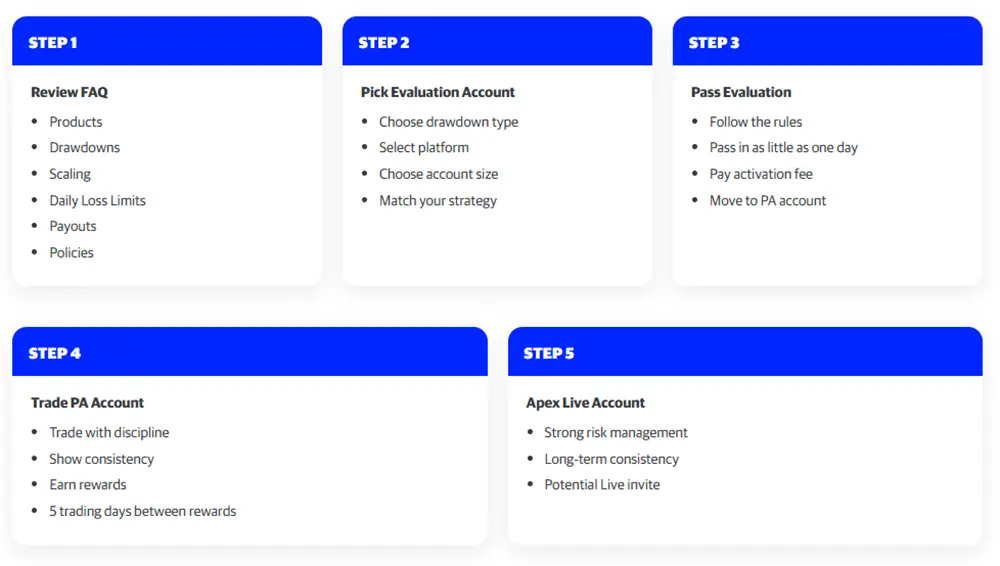
Apex outlines a five-step progression to get your Apex Live Account running:
Review FAQ: You must first understand products, drawdowns, scaling, daily loss limits, payouts, and policies.
Pick Evaluation Account: Then, you choose a drawdown type (intraday or EOD), platform (Rithmic, Tradovate, or WealthCharts), and account size.
Pass Evaluation: Follow the rules, pass the evaluation in as little as one day, pay the activation fee, and move to PA.
Trade PA Account: This is the moment when you show your skills, trade with discipline, show consistency, and earn rewards with 5 trading days between payouts.
Apex Live Account: After demonstrating strong risk management and long-term consistency, Apex can contact you to participate as an "Authorized Trader". So be ready for a potential Live account invitation.
Company Information
Before anything, we investigated the company. Check their background before investing.
|
Detail |
Information |
|
Company: |
Apex Trader Funding |
|
Founded: |
2021 |
|
Founder: |
Darrell Martin |
|
Location: |
Austin, Texas, USA |
|
Trustpilot Rating: |
4.4/5 (18,000+ reviews) |
|
Total Compensation to Customers: |
$729.49 million+ (since 2022) |
|
Average Monthly Compensation: |
$13.81 million (since January 2023) |
|
Last 90 Days Compensation: |
Over $92.34 million |
|
Platforms: |
Rithmic, Tradovate, WealthCharts |
|
Max Accounts: |
20 PA accounts per household |
Who Is Apex Trader Funding Best For?
Apex is a strong fit if you:
- Are a disciplined futures day trader who wants a dramatically simplified rule set (no MAE, no 5:1, 50% consistency)
- Want one-time evaluation fees with no monthly recurring charges
- Prefer EOD trailing drawdown (new option) to avoid intraday equity tracking
- Want 100% of your requested rewards with no profit split on PA accounts
- Value the guarantee of no payout denials, no payout reviews, no video/screenshot requirements
- Want the ability to pass the evaluation in a single day
- Want to scale up to 20 funded accounts
- Prioritize simplicity and transparency in trading rules
Apex may not be the best fit if you:
- Want account sizes above $150K (legacy $250K and $300K accounts are no longer available)
- Need static (non-trailing) drawdown (the $100K Static account is no longer offered)
- Want to reset failed evaluations (new accounts have no reset option, 30-day expiry)
- Trade strategies involving hedging, automation, or overnight positions
- Need metals/COMEX instruments (temporarily unavailable)
- Are in a restricted country
How Does Apex Compare to Other Prop Firms?
Apex's March 2026 overhaul positions it as one of the most simplified and trader-friendly programs in the futures prop space. The combination of 100% profit retention (no split), no payout denials, no MAE rule, no 5:1 rule, a 50% consistency threshold, EOD drawdown options, one-time fees, and the ability to pass in a single day is an aggressive value proposition. The main trade-offs are the loss of larger account sizes ($250K/$300K), the 6-payout cap, no reset options (evaluations simply expire after 30 days), tighter contract limits on some sizes, and the continued prohibition on automation and overnight holding.
|
Feature |
Apex 4.0 |
Top One Futures (Instant Sim) |
FundedNext Rapid |
Tradeify Select |
My Funded Futures |
|
Eval Steps |
1-Step |
None (instant) |
1-Step |
1-Step |
1-Step |
|
Fee Type |
One-time (30 days) |
One-time |
One-time |
Monthly |
Monthly |
|
$50K Price |
$131–$197 |
$679 |
$159.99 |
~$159/mo |
~$150/mo |
|
Min Days to Pass |
1 |
N/A |
1 |
3 |
4 |
|
Drawdown Options |
Intraday + EOD trail |
EOD trail only |
EOD trail only |
EOD trail |
EOD trail |
|
Daily Loss Limit |
EOD accounts only |
$1,250 (hard) |
None |
None (Select Flex) |
None |
|
Consistency (PA) |
50% |
20% |
40% |
None (Select Flex) |
40% (Starter/Core) |
|
Profit Split (Sim) |
100% |
90% |
80% |
90% |
100% first $10K, then 90% |
|
MAE Rule |
None |
N/A |
N/A |
N/A |
N/A |
|
5:1 Risk-Reward |
None |
N/A |
N/A |
N/A |
N/A |
|
Payout Denials |
None |
Possible |
Possible |
Possible |
Possible |
|
Days Between Payouts |
5 |
10 |
N/A |
Bi-weekly |
Weekly |
|
Max Accounts |
20 |
3 (Instant) |
Multiple |
Multiple |
5 |
|
EAs/Bots |
Not allowed |
Not allowed |
Not allowed |
Not specified |
Allowed |
|
Resets |
Not available |
N/A |
Available (12% discount) |
Available |
Available |
We have also covered the following comparisons of Apex:
- Topstep vs Apex Trader Funding: comparison of Apex vs the OG of the industry.
- Bulenox vs Apex Trader Funding: comparison of Apex vs lesser known prop firm that is just as good and has had EOD and Intraday drawdown options together before it was cool.
Final Ideas and Assessment
Would we recommend Apex Trader Funding to our trader community? In the current state of the prop firm, no. The company has turned its back on the community that helped build it, and is focusing on increasing profits. Until Apex gets their act in order, there are many other much more trustworthy prop firms, especially in the futures prop firms category.
Always verify current terms directly on the Apex Trader Funding website before making a purchase.
Apex Trader Funding firm-wide rules
Rules that apply to every account regardless of size. 8 of 19 published by the firm.
| News trading | Not published by firm |
|---|---|
| Holding overnight | Not published by firm |
| Holding over weekends | Not published by firm |
| Consistency rule | 50% (no single day can be 50%+ of total profit since last approved payout) |
| Scaling plan | None |
| Payout schedule | Up to weekly (after 5 qualifying trading days per cycle) |
| Minimum payout | $500 |
| First payout eligibility | Not published by firm |
| Payout processing time | 24-48 hours typical for US (ACH); 3-5 business days international |
| Payout methods | ACH, Plane |
| Reset cost | Not published by firm |
| Platform fees | Not published by firm |
| Data feed fees | Not published by firm |
| Account type | Not published by firm |
| Restricted countries | Not published by firm |
| Consequence of a breach | Not published by firm |
| Max funded accounts | Not published by firm |
| Minimum trading days | 5 days |
| Maximum funding offered | $150,000 |
Pros
- Profit Retention: Traders keep 100% of the first $25,000 earned per account before the standard 90/10 split begins.
- Up to 20 active Performance Accounts (PA) allowed simultaneously.
- The evaluation accounts have no daily drawdown cap, providing more breathing room for high-volatility trading styles.
- Frequent Discounts: Evaluations are often accessible at a fraction of the cost (often 80% OFF or more).
- Flexible Trading Hours: it is possible to trade through news events and holidays, with no restrictions on holding positions through high-impact data.
Cons
- Payout Requests must still adhere to specific minimum trading day requirements.
- 6-Payout Cap per Performance Account. Each PA has a maximum of 6 approved payouts.
- Larger withdrawals often trigger manual compliance reviews, which can lead to denials or delays if specific risk rules (like consistent sizing) are breached.
Payout evidence
Figure published by Apex Trader Funding, last verified October 20, 2026 (source). Compare all firms → Apex Trader Funding payout details →
Firms priced like Apex Trader Funding
Frequently asked questions
Apex Trader Funding details
- Headquarters United States 🇺🇸
- Founded 2021
- Years in operation 5
- Markets Futures
-
Trading platforms










- Brokers Tradovate, Rithmic
- Payment methods Credit Card, Debit Card
- Apex Trader Funding social links
Affiliate Disclosure: We may receive a commission if you sign up via our link.
Data verified October 20, 2026 against Apex Trader Funding's own website.