Topstep vs Apex Trader Funding: Which Futures Prop Firm Wins in 2026?
When I got into the prop trading industry back in 2021, I used to focus a lot on which brand gives you the best monthly price per evaluation account. But, that mindset quickly shifted after realizing that the better prop firm depends less on price and more on the firm’s rules that match how you trade. Topstep and Apex Trader Funding are the two biggest names in futures prop trading, and both made massive changes in early 2026. Apex rebuilt its entire product line with a March 2026 overhaul. Topstep rolled out new pricing, new funded account types, and locked traders into their proprietary TopstepX platform.
Since Apex started offering the option of EOD drawdown, most of the things that used to trip traders up, now are less impactful. Meanwhile TopStep introduced the TopstepX platform, which has not very favorable reviews by traders. As of the recent changes by both companies, the clear winner in this battle of two major prop firms is Apex Trader Funding.
In this comparison we try to cover every detail that matters: pricing, drawdown mechanics, evaluation rules, payout structures, platforms, and the fine print most articles skip. I have accounts at both firms, and so do my fellow traders, therefore a few years of information collection went into the process of writing this article.
Two Futures Prop Firms, Two Different Philosophies
Toptep Overview
 Topstep has been around since 2012 (originally TopstepTrader). They’re based in Chicago, and they built their reputation on trader education and structured risk management. Topstep used to offer Forex Evaluation accounts as well, but that was discontinued in 2022. It almost like Topstep team had an idea about what's going to happen in the Forex prop space and didn't want the headache. Currently, Topstep only offers futures evaluations accounts. They also have a waitlist for people that want to use their own money to trade with Topstep Brokerage firm, which is not yet available to general public. Topstep is more conservative and expensive prop firm out of the two.
Apex Trader Funding Overview

Apex Trader Funding launched in 2021 out of Austin, Texas. The prop firm grew fast by leaning into the deals that no-one seem to be able to pass on. They focused on fewer rules, cheaper evaluations, aggressive promo pricing (we’re talking 80-90% off sales every month), and a structure designed to get you funded quickly. Apex is now one of the most searched prop firms globally, and their March 2026 product overhaul addressed most of the complaints traders had about the old system.
As of this very moment both firms trade CME Group futures only. No forex, no crypto CFDs. ES, NQ, CL, MES, MNQ, and the rest of the CME product catalog. If you’re a futures trader these two companies are often mentioned as the main ones to start with early in your career. They are both great, so it is just a matter of what are your preferrences and trading style.
Pricing: One-Time Fee vs Monthly Subscription
This is where the two firms are very different. While Apex continues to offer unbeatable deals, Topstep seems to stand firm on their pricing and only provides two pretty expensive options.
Apex Trader Funding switched to one-time evaluation fees in March 2026. No monthly billing, no recurring charges. A 100K EOD account costs $297 at full retail, but Apex runs near-constant promotions. With a typical 80-90% off code, that same account drops to about $30. The 100K Intraday version runs around $20 on promo. There’s also an activation fee when you pass: $99 for EOD, $79 for Intraday. After that, you don’t pay Apex another dollar unless you fail and buy a new eval.
Topstep uses a monthly subscription model. As of February 2026, they offer two paths:
|
Account Size |
Standard Path |
No Activation Fee |
Activation Fee |
|
50K |
$49/month |
$109/month |
$149 (Standard only) |
|
100K |
$99/month |
$159/month |
$149 (Standard only) |
|
150K |
$149/month |
$209/month |
$149 (Standard only) |
Here’s the thing. If you pass your Apex eval on the first attempt, your total cost for a 100K account is roughly $130 ($30 eval on promo + $99 activation). However, Apex evaluations are only good for 30 days. If you do not pass the evaluation in those 30 days, your account is closed and you need to purchase another evaluation account. That being said, you should only sign up for Apex account if you are serious about using it, if you don't use it for 30 days, that account will be gone and you will have wasted your money. To see all of the available Apex Trader Funding Challenges, head down to our dedicated page.
With Topstep on the Standard Path, you’re paying $99/month until you pass, plus $149 when you do. If it takes you three months to pass, you’re at $446 total. And the subscription keeps billing if you don’t cancel. You can view all of the accounts availabe on the platform on our Topstep Challenges page.
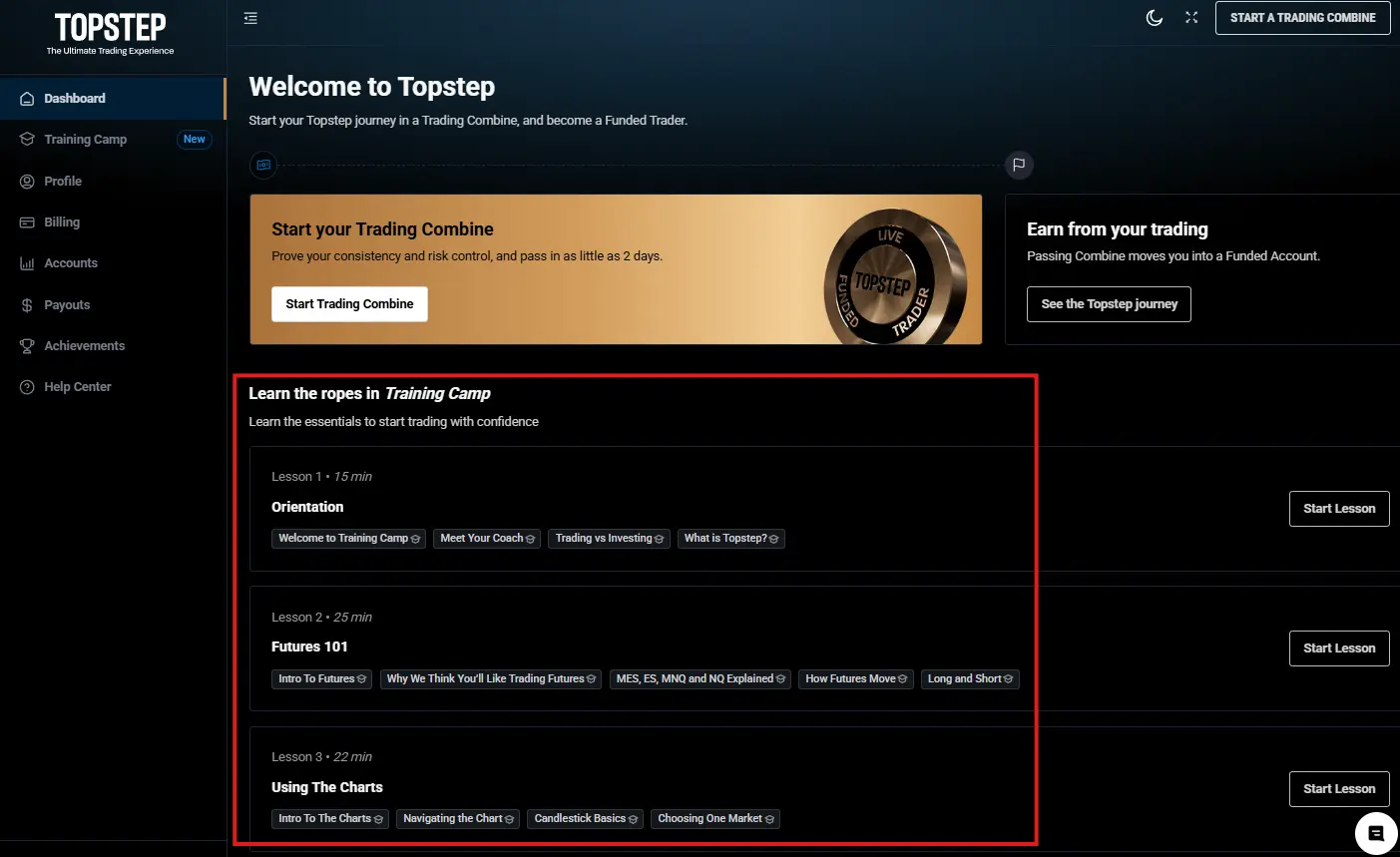
Opposite from Apex, Topstep account does not close after the first month, therefore you will get to keep it and keep getting billed for it. One company motivates traders to be active by the time limit on the account, and the other one by charging reoccurring fees that can add up over a few months. One bonus point to Topstep over Apex is that Topstep has a ton of resources for traders that are starting out to learn trading. Here is the first thing you see when you log in to the Topstep platform, a bunch of lessons for you:
For fast traders who know their strategy works, Apex’s pricing model is hard to beat. For traders who need time to develop, Topstep’s unlimited time frame (more on that below) offsets the monthly cost. It depends on how confident you are in your ability to pass quickly.
Evaluation Rules: Getting Funded
Profit Targets and Drawdown
Both firms use similar numbers here, which makes sense. They’re competing directly. What makes them both very different, however, is the fact that Apex Trader Funding offers two drawdown options: Intraday and EOD, and Topstep only offers EOD which is traders' favorite. Another distinct function is that Apex allows you to trade on Wealthcharts, Tradovate, and Rithmic, while Topstep has no other options but TopstepX, which hasn't been reviewed positively by most traders. It will take time for the firm to get the platform sorted, but I have high hopes for Topstep when they do.
|
Parameter |
Apex Trader Funding |
Topstep |
|
50K Profit Target |
$3,000 |
$3,000 |
|
100K Profit Target |
$6,000 |
$6,000 |
|
50K Max Drawdown |
$2,000 trailing |
$2,000 trailing (EOD) |
|
100K Max Drawdown |
$3,000 trailing |
$3,000 trailing (EOD) |
|
Drawdown Type |
EOD or Intraday (you choose) |
EOD only |
|
Daily Loss Limit |
EOD: Yes ($1,500 on 100K). Intraday: No. |
Optional (self-set on TopstepX) |
The profit-to-drawdown ratio is identical: 2:1 on the 100K ($6,000 target with $3,000 drawdown). Both firms use trailing drawdown that moves up with your equity high but never moves back down. And both trail based on end-of-day closing balance, at least on their primary products. Read our trailing drawdown vs EOD drawdown comparison for a deeper breakdown of how this works.
As mentioned previously, the biggest difference is that Apex gives you the option to buy an Intraday trailing account if you want it. The intraday variant has no daily loss limit, which some aggressive scalpers prefer. Once again, another thing to consider and how it aligns with your trading style.
Consistency Rules During Evaluation
This is a big one. Apex has no consistency rule during evaluation. You can hit the $6,000 profit target in one trade on one day, and you pass. No restrictions on how your profits are distributed across trading days. Consistency only shows up on a funded account, but the rules are not as strict as most of the other prop firms. Apex only wants you to comply with the 50% consistency rule, which means no single trading day can be 50% of your total profit.
Topstep has a 50% consistency target. Your best single trading day cannot account for 50% or more of your total profits. On a 50K account with a $3,000 target, that means your best day needs to stay under $1,500. If you blow past it, your profit target increases until your best day drops below 50% of the total.
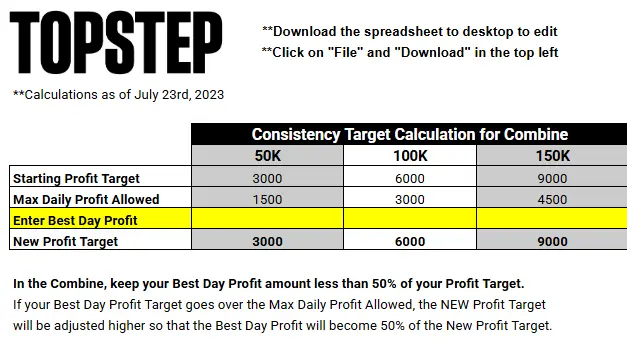 Practically, this means Topstep evaluations take longer. You need multiple winning days to distribute your profits. Apex evaluations are technically passable in a single session if you nail a big move and manage your drawdown.
Time Limits and Minimum Days
Apex: 30 calendar days. No extensions, no resets. If you don’t pass in 30 days, you buy a new evaluation. On promo pricing, that’s $20-30, so it’s not devastating, but it’s a hard deadline.
Topstep: No time limit. Your Trading Combine stays active as long as you maintain the monthly subscription. This is a genuine advantage for traders who need time to develop. You can take a slow, methodical approach without deadline pressure. This can serve as a good thing and a bad thing at once. Good thing is that there is no time limit, bad thing is that if you are not super motivated, you will continue bleeding money month over month.
Minimum trading days: Apex has none. Topstep technically has none either (you could pass in 2 days if your consistency stays clean), but the consistency rule creates a practical minimum of at least 2-3 days.
Drawdown Mechanics: The Rule That Matters Most
Both firms offer EOD trailing drawdown on their primary products. Your max loss threshold recalculates once per day, at market close. Intraday equity swings don’t touch it. This is a massive advantage over firms that use real-time intraday trailing (outside of the few cases where traders like intraday drawdowns). If you want the full technical breakdown, check our drawdown explained guide.
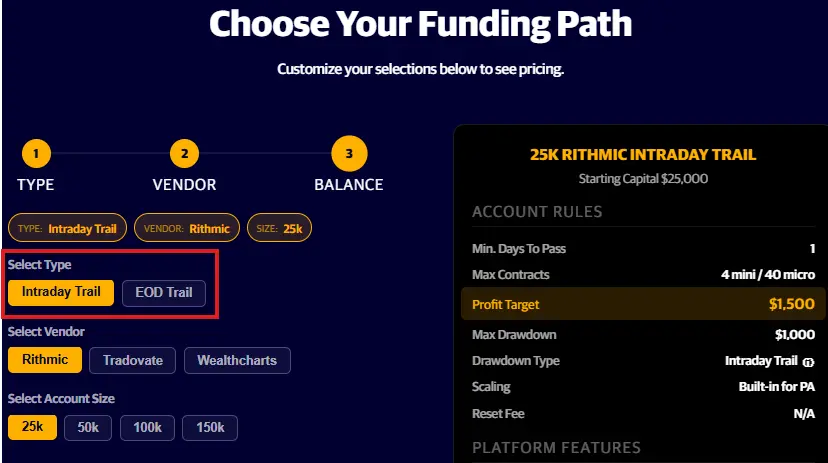
After the March update of Apex 4.0, the company still left the options for traders that do want intraday trailing with no daily loss limit accounts. On the intraday trailing evaluation accounts, the drawdown threshold follows your real-time equity, including unrealized P&L. If your position runs up $500 before pulling back, that $500 is permanently tracked. Your floor moved up and it’s not coming back.
Before March 2026, Apex offered only intraday trailing. It was the biggest complaint traders had as you can probably tell by Trustpilot reviews. The new EOD option fixes that. And here’s the reality: on promo pricing, the price difference between Apex’s EOD and Intraday account is about $10. Pay the extra $10 and get EOD, especially if you are just starting out.
Topstep has used EOD drawdown for years. They were one of the first firms to champion it publicly, and it’s a core part of their value proposition. Their drawdown locks at the starting balance once your high-water mark reaches starting balance + max drawdown, and stays there permanently. Same mechanic as Apex’s EOD product.
To quickly sum it up: if you’re comparing Apex EOD vs Topstep, the drawdown mechanics are functionally identical. Neither firm has an advantage here. The only edge Apex has is offering the Intraday option for scalpers who genuinely prefer no daily loss limit.
Payout Rules: Getting Your Money Out
Passing the evaluation is step one. Getting paid is step two. And this is where these firms get really different.
Getting to Your First Payout
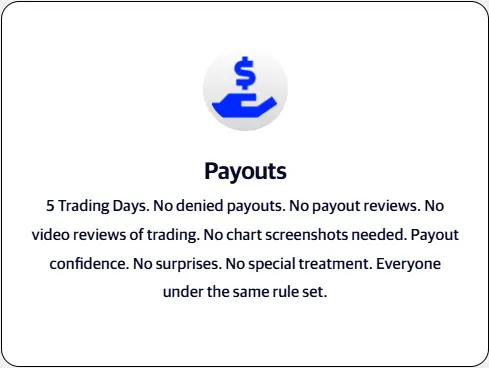
Apex Trader Funding: 5 qualifying trading days. A qualifying day on a 100K account means $250 or more in net profit for that session. Once you have 5 qualifying days, you submit a payout request. No buffer requirement on the first payout beyond maintaining the safety net (drawdown + $100).
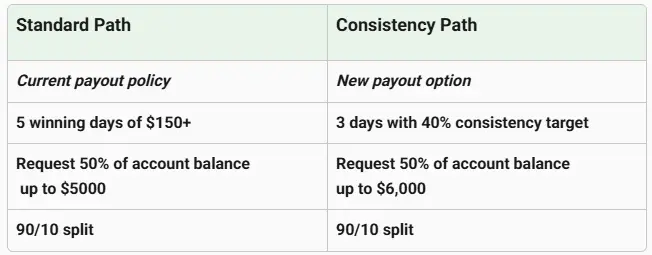
Topstep (Standard Path): 5 winning days of $150 or more. A winning day threshold is lower than Apex’s qualifying day requirement. Topstep also offers a Consistency Path where you only need 3 days but must keep a 40% consistency target on your profits.
Both firms get you to a first payout in roughly the same timeframe: 1-2 weeks of active trading. Topstep’s lower winning day threshold ($150 vs $250) makes it slightly easier to accumulate qualifying days, but the difference is marginal for any trader who’s consistently profitable.
Payout Caps and the Fine Print
This is where it gets interesting... Apex uses a 6-payout ladder system. Your maximum withdrawal amount increases with each payout. On a 100K EOD account, the first payout cap is relatively modest, and it scales up through the sixth payout. After 6 payouts, the Performance Account closes and you start a new one. Apex markets a 100% profit split, and that’s technically true for the first $25,000 you earn across accounts. After $25K, it shifts to 90/10 (you keep 90%), which is also amazing. The company clearly comes off as not one of the greedy ones.
The 6-payout cap is the most controversial part of Apex’s new system. You don’t get unlimited payouts from one account. After your sixth withdrawal, the account is done. The upside: Apex lets you run up to 20 funded accounts simultaneously, so the total earning potential across accounts is substantial. The downside: it’s a fundamentally different model than “get funded, trade forever.” On another hand, not going from a PA Account before your 6th payout to a live trading account doesn't sound like something that would happen.
Topstep caps Express Funded Account payouts at 50% of your account balance, up to $5,000 per request (or $6,000 on the Consistency path). There’s no limit on total payouts from an XFA. New traders (after January 12, 2026) get a 90/10 profit split on all payouts from day one. Topstep eventually moves successful XFA traders to a Live Funded Account, where you trade real capital with real market impact. At that point, the structure changes to a reserve-based system where capital unlocks as you perform.
Consistency Rules on Funded Accounts
Apex: 50% consistency rule on Performance Accounts. No single trading day can account for 50% or more of your total profit since your last payout. This is looser than the old 30% rule, but it still means you need distributed profits. One big winning day followed by small days will block your payout request.
Topstep (Standard XFA): No consistency rule. Just accumulate 5 winning days of $150+ and be profitable since your last payout.
Topstep (Consistency XFA): 40% consistency rule. Your best day cannot exceed 40% of total profits. Tighter than Apex, but you only need 3 days instead of 5.
If consistency rules frustrate you, Topstep’s Standard XFA is the cleaner path. No percentage calculations, no spreadsheet tracking. Apex’s 50% rule is workable, but it adds a layer of planning that some traders find annoying.
Platforms and Trading Experience
Apex supports Rithmic, Tradovate, and WealthCharts. You pick your platform when you purchase the evaluation. Rithmic connects to NinjaTrader, MotiveWave, Sierra Chart, Quantower, and others. Tradovate connects to TradingView. This gives Apex traders access to the full ecosystem of third-party futures platforms. NinjaTrader account comes free with a purchase of Rithmic or Tradovate evaluation account.
Topstep locked all new accounts into their proprietary TopstepX platform starting in 2025. If you have legacy funded accounts on NinjaTrader or Tradovate, those continue. But all new Trading Combines and Express Funded Accounts run on TopstepX exclusively. Topstep is working hard to get you to only stay in their ecosystem, which makes sense from a business standpoint.
TopstepX is a web-based platform with built-in TradingView charts, order flow tools, and a sentiment indicator called “The Tilt” that shows what other Topstep traders are positioned. Honestly, it’s not bad. The interface is clean and execution feels solid. But if you’ve spent years building a workflow around NinjaTrader or Sierra Chart with custom indicators and hotkeys, switching to TopstepX is a real adjustment. Topstep Trustpilot is literred with traders complaining about TopstepX issues.
My take: if platform flexibility matters to you, Apex wins this category by a wide margin. If you’re starting fresh and don’t have a platform preference, TopstepX is ok, but keep in mind that they used to have an incredible reputation before they migrated to TopstepX. Just to paint a better picture, before pushing traders to use TopstepX, Topstep Trustpilot page had 4.5/5 rating, after they moved traders to TopstepX, it dropped to 3.4/5, which is pretty bad. Some scammy prop firms might be ok with having 3.4/5, but we all know that Topstep is legit, and that's their rating too. Can't wait till they fix TopstepX.
Account Limits and Scaling Potential
Apex: Up to 20 funded Performance Accounts simultaneously. This is the single biggest structural advantage Apex has. Twenty accounts at $30 each on promo means $600 to set up a fleet of funded accounts. Even with the 6-payout-per-account cap, the combined earning potential across 20 accounts is significant.
Topstep: Up to 5 Express Funded Accounts. Eventually, you get called up to one Live Funded Account with up to $150,000 in capital that unlocks in stages based on performance. The Live path is more structured and institutional, but the total number of simultaneous funded accounts is capped lower.
Traders who want to run a high-volume operation with multiple accounts will prefer Apex. Traders who want one account, real capital, and a path toward institutional-style trading will prefer Topstep’s Live Funded Account progression.
Full Side-by-Side Comparison
|
Feature |
Apex Trader Funding |
Topstep |
|
Founded |
2021 (Austin, TX) |
2012 (Chicago, IL) |
|
Pricing Model |
One-time fee |
Monthly subscription |
|
100K Eval Cost (Promo) |
~$30 EOD / ~$20 Intraday |
$99/month + $149 activation |
|
Drawdown Type |
EOD or Intraday (your choice) |
EOD only |
|
Eval Consistency Rule |
None |
50% best day target |
|
Time Limit |
30 calendar days |
Unlimited |
|
Pass in 1 Day? |
Yes |
Technically 2+ days (consistency) |
|
Funded Consistency Rule |
50% on PA payouts |
None (Standard XFA) / 40% (Consistency XFA) |
|
Profit Split |
100% first $25K, then 90/10 |
90/10 from day one |
|
Max Payout Per Request |
Tiered ladder (6 payouts total) |
50% of balance, up to $5K-$6K |
|
Max Funded Accounts |
20 |
5 XFA (1 Live) |
|
Platforms |
Rithmic, Tradovate, WealthCharts |
TopstepX only (new accounts) |
|
Payout Method |
Deel |
Wise |
|
Trustpilot Rating |
4.4/5 (18K+ reviews) |
3.4/5 (13k+ reviews) |
Which Firm Should You Pick?
Pick Apex Trader Funding if:
You want the cheapest possible path to getting funded. On promo pricing, there is no firm in the industry that comes close to Apex’s cost. You’re a confident, experienced trader who passes evaluations quickly. A one-time $30 fee with no monthly drain is the best deal in prop trading. You want platform flexibility (NinjaTrader, TradingView via Tradovate, Sierra Chart). You want to run multiple funded accounts. The 20-account cap is enormous. You don’t want a consistency rule in the evaluation phase, and you’re fine managing the 50% rule on payouts.
Pick Topstep if:
You’re newer to prop trading and want a structured environment with coaching, community, and educational resources. TopstepTV, the community tools, and the integrated platform are genuine assets for developing traders. You want no time pressure on the evaluation. Unlimited duration means you can take your time. You want a path to live capital. Topstep’s Live Funded Account is one of the only true institutional-level progression paths in the prop firm space. You don’t want any consistency rule on funded account payouts (Standard XFA). You prefer one or two funded accounts rather than managing a fleet.
And for the record, you don’t have to pick one. Plenty of traders run both. An Apex account for the low-cost evaluation and multi-account potential, plus a Topstep account for the structured progression toward live capital. The costs are low enough that running both simultaneously is viable.
Check out our prop firm rankings to see how both firms stack up against every other prop firms we’ve reviewed.
Frequently Asked Questions
Is Topstep or Apex better for beginners?
Topstep used to generally be better for beginners, before switching to TopstepX platform. The educational resources, community, and unlimited evaluation time gave newer traders room to learn without financial pressure, but now things got a bit tricky. If you put technical issues aside, Topstep would be considered better and I'm sure they will continue improve their platform. Apex’s 30-day deadline and lack of built-in education make it better suited for traders who already have a strategy.
Does Apex still use intraday trailing drawdown?
Apex now offers both EOD and Intraday trailing drawdown. The EOD option, introduced in March 2026, recalculates once per day at market close. The Intraday option still tracks real-time equity. For most traders, the EOD account is the better choice.
Does Topstep have a consistency rule on funded accounts?
On the Standard Express Funded Account, no. There is no consistency rule. You need 5 winning days of $150+ and positive P&L since your last payout. The Consistency XFA has a 40% rule but only requires 3 days.
How fast are payouts at each firm?
Apex processes payouts through Deel. Topstep uses Wise. Both typically take 3-7 business days. Apex allows payout requests every 5 qualifying trading days. Topstep allows requests after every 5 winning days (Standard) or 3 days (Consistency).
Can I use NinjaTrader with Topstep?
Not for new accounts. All new Topstep Trading Combines and Express Funded Accounts are TopstepX-only as of 2025. If you need NinjaTrader, Apex supports it through the Rithmic data feed.
Can I hold trades overnight at either firm?
Neither firm allows overnight holds. Apex auto-closes positions at the 4:59 PM ET session break (though you can opt to re-enter at the 6 PM open). Topstep requires all positions closed before session end. Both are day-trading-only firms.
Which firm has paid out more money?
Apex reports over $721 million in total payouts since launch. Topstep has a longer track record (since 2012) and has funded thousands of traders, but doesn’t publish a comparable aggregate number. Both firms have well-documented payout histories.
Are there better alternatives to both?
My Funded Futures is a strong third option, especially if you want EOD drawdown without the payout ladder cap. MFF is actually ranked as #2 prop trading firm in our rankings, right after Apex, so we would recommend them over Topstep as well.