What Is Drawdown in Trading? Everything Traders Need to Know
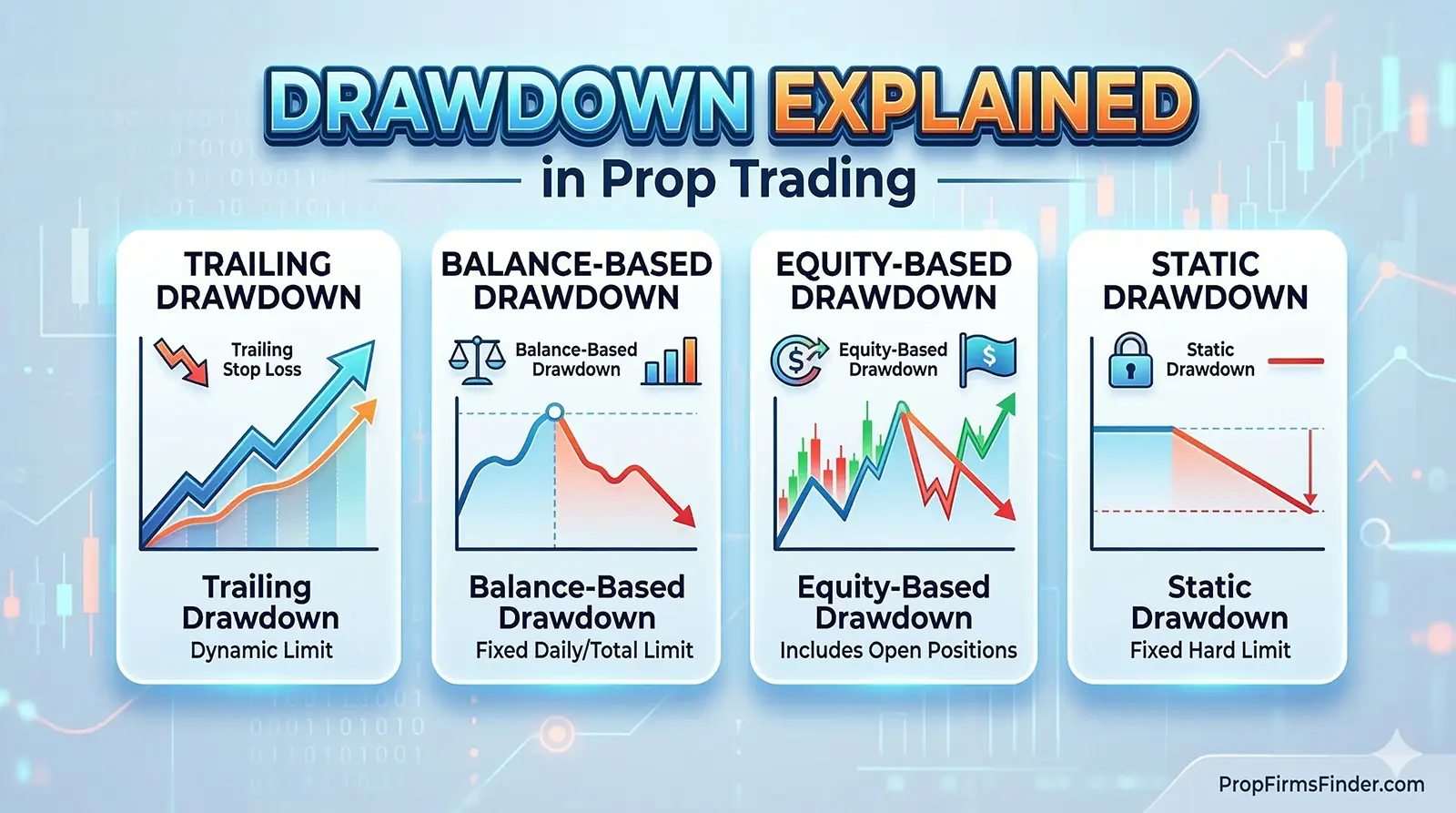
Drawdown is the decline from a peak balance to a subsequent low in a trading account. If an account grows to $12,000 then falls to $10,500, the drawdown is $1,500 or 12.5%. Prop firms use drawdown limits to cap how much a funded trader can lose before the account closes.
What Is Drawdown in Trading?
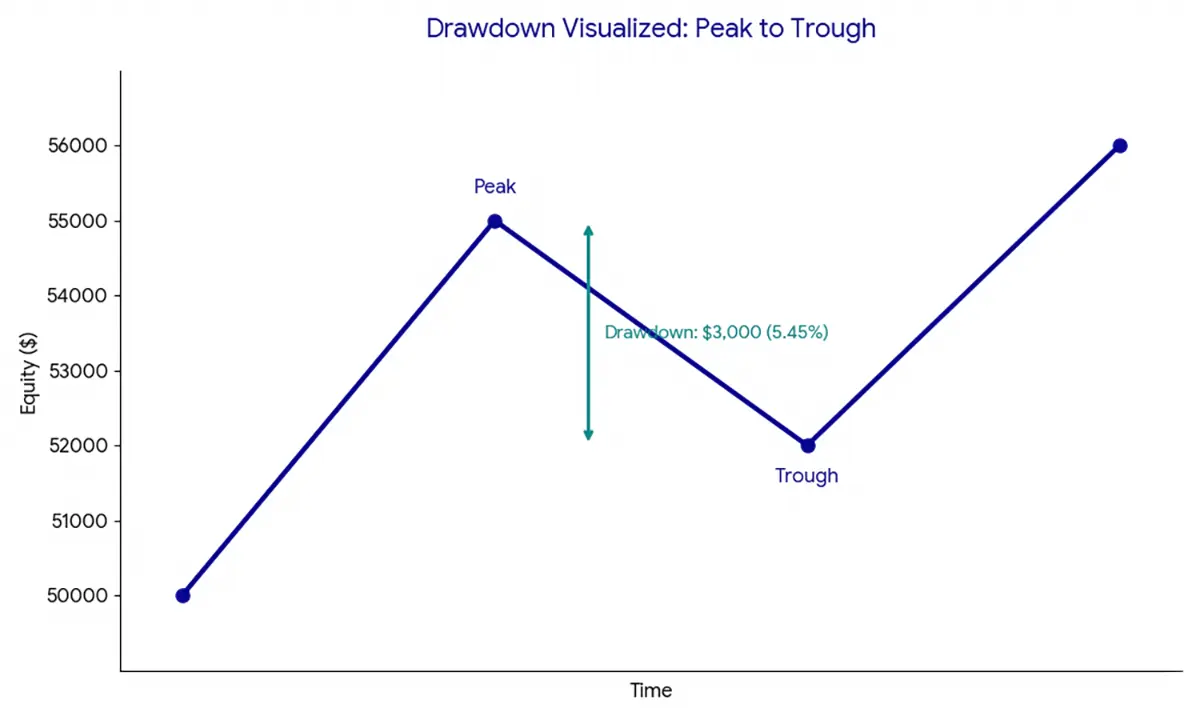
Drawdown measures how far your trading account falls from its highest point before recovering. It's the distance between a peak and the subsequent trough.
Every trader experiences drawdown. If your account reaches $55,000 and then drops to $52,000 before climbing again, you experienced a $3,000 drawdown (5.45%). The account didn't "lose" $3,000 permanently. It dipped, then recovered. The drawdown is the size of that dip.
Drawdown matters because it quantifies risk in a way that win/loss ratios alone don't. A trader with a 70% win rate who experiences 25% drawdowns is taking more risk than a trader with a 55% win rate who never drops below 8%. Drawdown tells you how bumpy the ride is, and whether you (or your prop firm) can tolerate the bumps.
How Drawdown Is Calculated
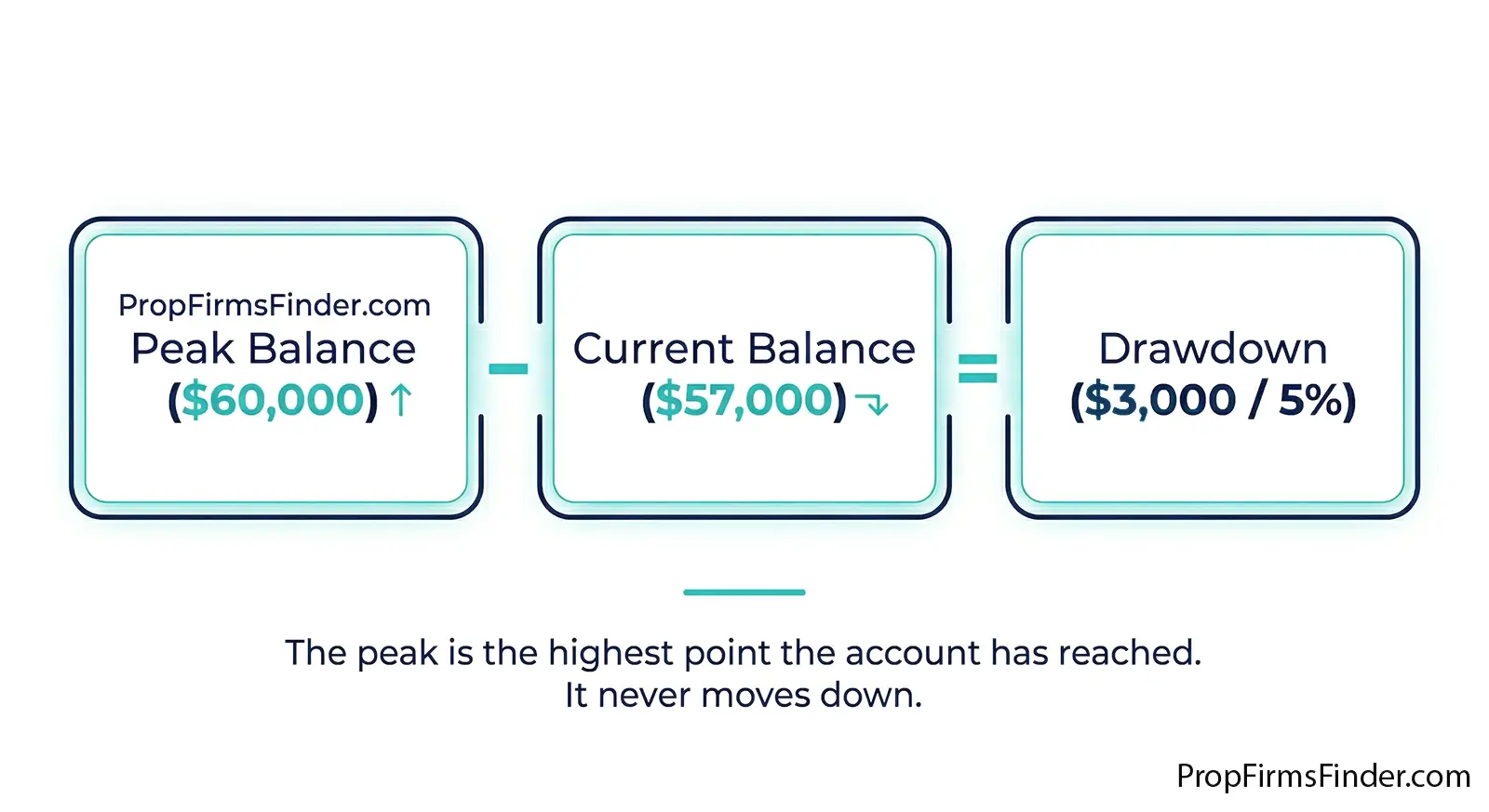
The Formula:
- Drawdown = Peak Balance - Current Balance
- Drawdown % = (Peak Balance - Current Balance) / Peak Balance x 100
If your peak was $60,000 and your current balance is $57,000, your drawdown is $3,000 or 5%. The formula is simple. What makes drawdown complicated in practice is when and how the "peak" is measured.
Percentage vs. Dollar Drawdown
Drawdown is expressed in either dollars or percentage. Prop firms typically enforce both. A firm might set a maximum drawdown of $3,000 (dollar amount) on a $50,000 account, which is equivalent to 6%. Breaching either threshold (hitting $47,000 or falling 6% from peak) triggers account termination.
Peak Tracking: When the Peak Updates
This is where drawdown gets tricky. The "peak" used to calculate drawdown can update at different times depending on the firm:
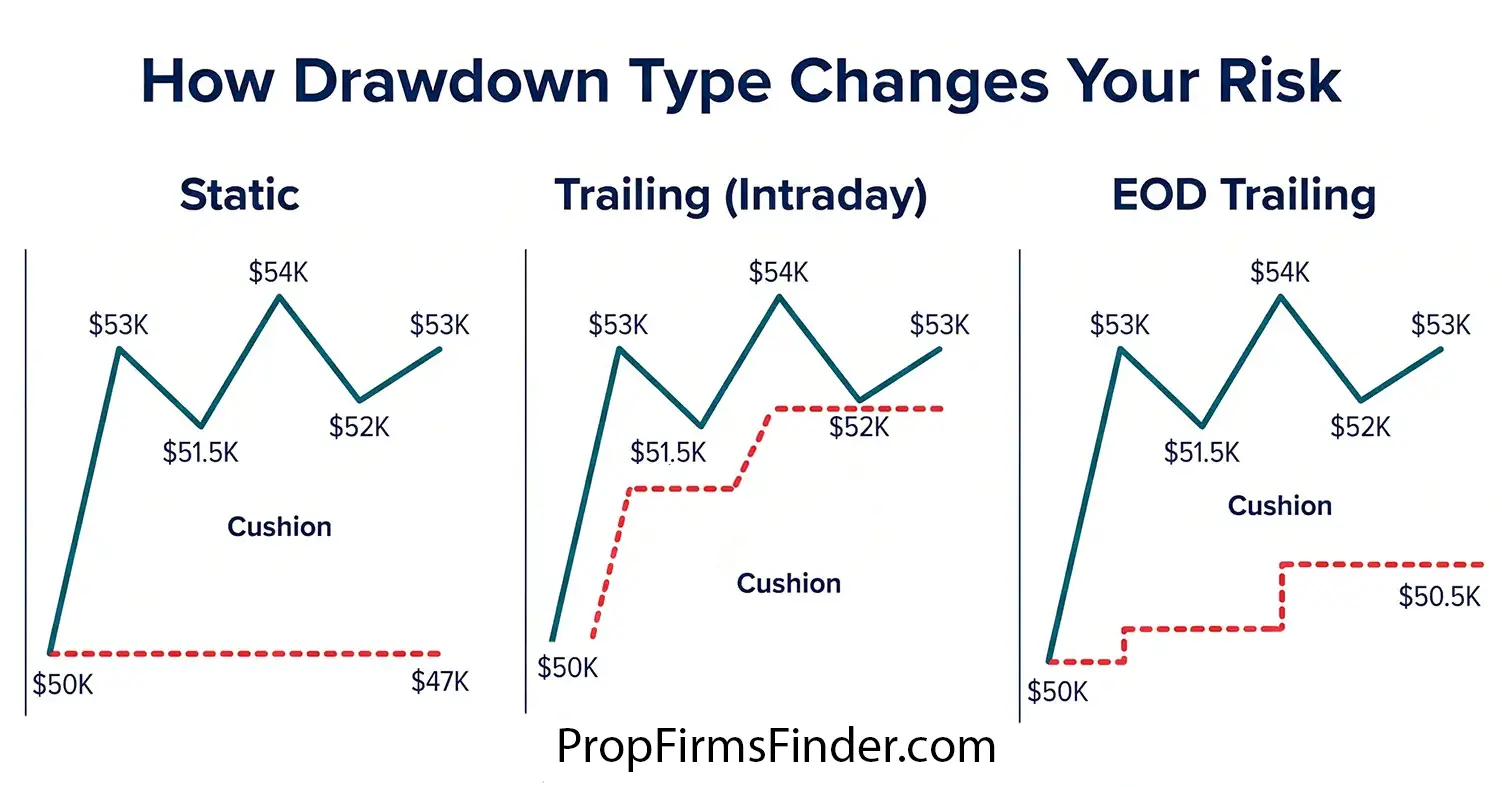
Continuously (intraday): The peak updates in real time as your equity increases, including unrealized gains from open positions. If your equity touches $53,000 at 11:15 AM, even for a moment, $53,000 becomes the new peak.
End-of-day: The peak updates only at market close (typically 4:59 PM ET for futures). Your intraday equity swings don't affect the peak. Only your closing balance matters.
Never (static): The peak is your starting balance and it never moves. Drawdown is measured from day one, regardless of how much your account grows.
These three peak-tracking methods create fundamentally different trading experiences, even if the drawdown dollar amount is identical.
Balance-Based vs. Equity-Based Calculation
This distinction catches many traders off guard.
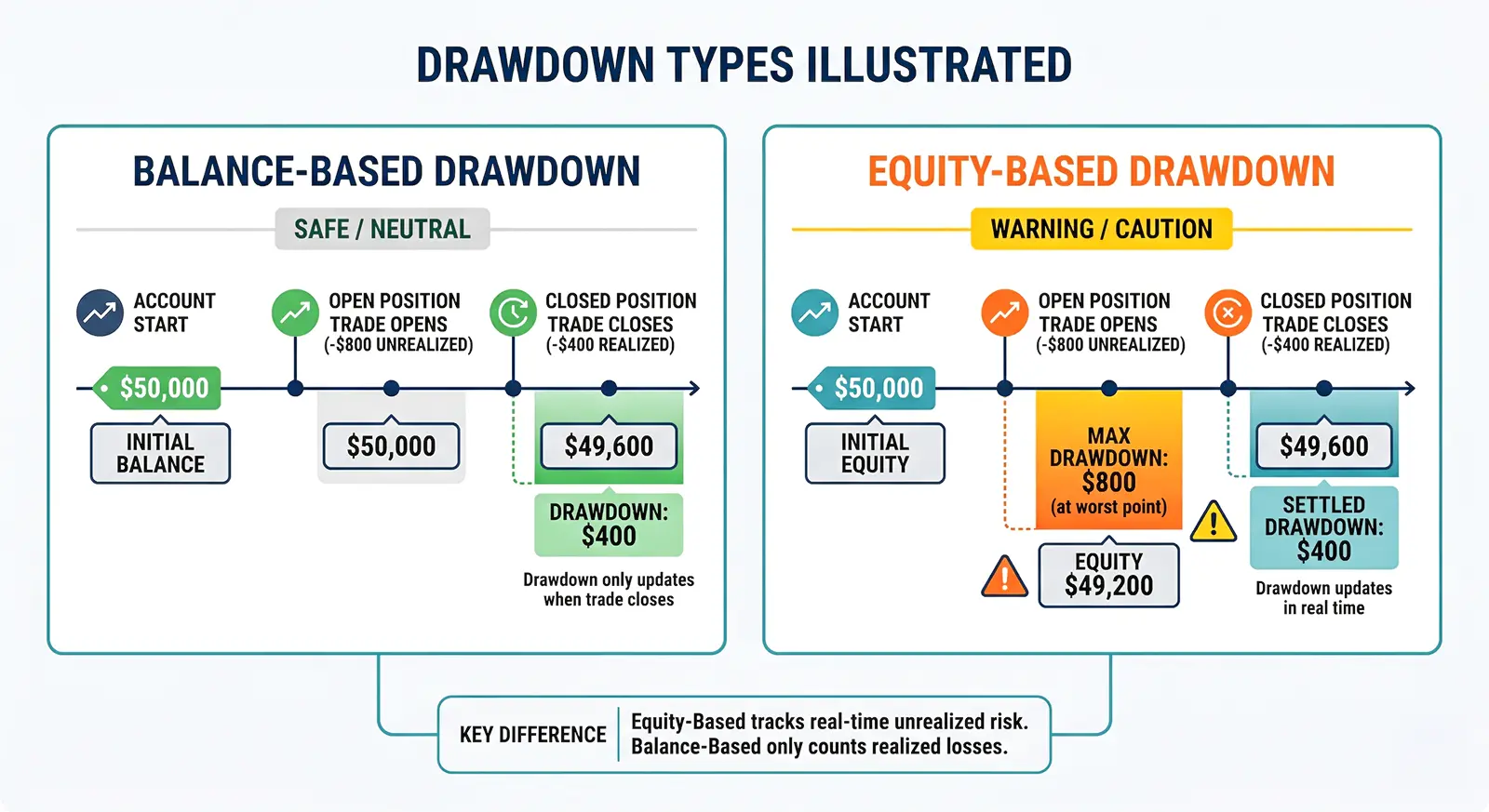
Balance-based drawdown counts only closed trades. If you have a $500 open loss but haven't closed the trade, your drawdown hasn't changed. The moment you close the losing trade, the drawdown updates.
Equity-based drawdown includes unrealized P&L from open positions. If your open trade is $500 in the red, your equity drops by $500 and your drawdown increases by $500, even though you haven't closed anything. This is more restrictive because floating losses can trigger a breach.
Most prop firms in 2026 use equity-based drawdown. This means your open positions directly affect your drawdown calculation in real time. Leaving a losing trade open doesn't protect you from a breach.
The Main Types of Drawdown
Maximum Drawdown
The total amount your account is allowed to decline from its peak (or starting balance, depending on the type) before the account is terminated. This is the most important number at every prop firm. Typical ranges: 4% to 12% of account balance, or $2,000 to $6,000 on a $50,000 to $100,000 account.
Daily Drawdown
A separate limit on how much you can lose in a single trading day. Daily drawdown resets at the start of each new session. Typical daily limits: 2% to 5% of starting daily balance. Hitting the daily limit pauses trading for the day at some firms or fails the account at others. Daily drawdown and maximum drawdown run simultaneously. You need to stay within both.
Trailing Drawdown
The drawdown threshold moves up as your account grows, but never moves down. If your account peaks at $53,000 with a $3,000 trailing drawdown, your floor is $50,000. If you make another $1,000 and peak at $54,000, your floor moves to $51,000. It follows you up but never follows you back down.
Trailing drawdown is the most aggressive type because profits reduce your available cushion. You can be profitable overall and still breach the trailing floor.
Static Drawdown
The drawdown floor is fixed at a set amount below your starting balance and never moves. On a $100,000 account with 10% static drawdown, your floor is $90,000 for the entire life of the account. Even if your balance grows to $120,000, the floor stays at $90,000. Your cushion gets larger as you profit.
End-of-Day (EOD) Drawdown
A trailing drawdown that recalculates only at market close. Your intraday equity swings don't move the floor. If you peak at $55,000 during the day but close at $52,000, only the $52,000 close is used to calculate the new floor. This is significantly more forgiving than intraday trailing for traders who experience large swings during the session.
Intraday Drawdown
A trailing drawdown that updates in real time, tick by tick. If your equity touches $55,000 for even one second, the floor moves immediately. This is the strictest form of drawdown because unrealized gains (that you may never lock in) permanently raise the floor.
Drawdown in Retail Trading vs. Prop Firm Trading
Retail Drawdown is a risk metric:
When you trade your own account, drawdown is a number you track voluntarily. If your personal account drops 15%, nobody closes it for you. You choose whether to keep trading, reduce size, or stop. Drawdown in retail trading is a measurement tool for evaluating strategy performance.
Prop Firm Drawdown is a hard rule
When you trade a funded trading accounts, drawdown is enforced by the firm's system. Hit the floor and the account is terminated. Positions are liquidated automatically. There is no warning, no second chance, and no manual override. The system closes you out instantly.
This is the single most important distinction to understand. In retail, drawdown is information. In prop firms, drawdown is law.
How Prop Firm Drawdown Limits Work
Evaluation Phase vs. Funded Phase
Some firms use different drawdown parameters in the evaluation vs. the funded phase. Drawdown type may change (EOD during eval, intraday when funded). Dollar amounts may change. Daily loss limits may be added or removed. Always check both sets of rules before purchasing an evaluation.
Soft Breaches vs. Hard Breaches
A hard breach terminates the account. Hitting the maximum drawdown floor is always a hard breach. A soft breach pauses your trading without ending the account. Hitting the daily loss limit at Apex Trader Funding's EOD accounts, for example, pauses trading for the day but the account survives.
Do Commissions and Fees Count Toward Drawdown?
Yes. Commissions reduce your account balance and equity, which means they bring you closer to the drawdown floor. Swap fees on overnight forex positions also count. On a tight drawdown like $2,500 on a $50K account, a few days of commissions and swaps can eat $50 to $100, reducing your real cushion before you've taken a single losing trade.
Practical Examples: Drawdown in Action
We created some scenarios and practical examples so you can visualize how the drawdown rule works.
Example 1: A Safe Trading Day
$100K account, $3,000 trailing drawdown (intraday), no daily loss limit.
You enter a trade at 10:00 AM. It goes $800 in your favor. Your peak is now $100,800, floor moves to $97,800. You close the trade at +$600. Account balance: $100,600. Floor stays at $97,800 (highest peak was $100,800). Remaining cushion: $2,800. Safe.
Example 2: A Losing Day That Stays Within Limits
Same account. You take two trades. First loses $400. Second loses $300. Total day: -$700. Account balance: $99,300. Floor is still $97,000 (from starting peak of $100,000). Remaining cushion: $2,300. Within limits. Come back tomorrow.
Example 3: The Trailing Drawdown Trap
$50K account, $2,500 intraday trailing drawdown. You take a trade that runs $1,500 in your favor. Your peak is $51,500. Floor moves to $49,000. The trade reverses and you close at +$200. Account balance: $50,200. But your floor is $49,000 (from the $51,500 peak). You've used up $1,300 of drawdown cushion from a trade you made $200 on. Remaining cushion: $1,200.
This is the trap. The intraday trailing drawdown consumed $1,300 of cushion from a trade that only netted $200. On an EOD account, the floor would have moved to $48,200 ($50,200 close minus $2,000 drawdown), giving you $2,000 of cushion instead of $1,200.
Example 4: A Breach by Narrow Margin
$100K account, $5,000 static drawdown (floor at $95,000), $2,500 daily loss limit.
You're up $3,000 on the account (balance: $103,000). You take a trade that loses $2,400. Daily loss: $2,400. Within the $2,500 daily limit. But then commissions of $120 post. Daily loss: $2,520. The daily limit is breached by $20. Trading pauses (or account fails, depending on the firm). Commissions pushed you over.
Trailing vs. Static Drawdown: Which One Is Safer?
Let's explore the core difference between the different types of drawdown:
The Static drawdown gives you more room as your account grows. The Trailing drawdown keeps the pressure constant (or increases it). On a static account, going from $100K to $110K means your cushion grew from $10K to $20K. But on a trailing account, going from $100K to $110K means your cushion stayed at $10K because the floor moved up to $100K.
When to Choose Static
If your strategy has large intraday swings, static is safer. If you swing trade and hold overnight, static is safer. If you want the cushion to compound as you profit, static is better.
When to Choose Trailing
If your strategy produces small, consistent daily gains without large swings, trailing is manageable. If the firm offers EOD trailing (not intraday), the risk is moderate. Intraday trailing is the most punishing version and requires tight stop losses and fast exits.
📌 For a detailed side-by-side comparison with real trade examples, see our trailing drawdown vs EOD drawdown guide.
How Drawdown Interacts With Other Rules
Drawdown and Daily Loss Limit
These are two separate limits that run at the same time. You need to stay within both. Your daily loss limit might be $1,500, but if you've already used $4,500 of your $5,000 max drawdown, you only have $500 left. The effective limit is always the tighter of the two. Check both numbers at the start of every session.
Drawdown and Consistency Rule
The consistency rule doesn't directly affect drawdown. But large winning days that trigger consistency concerns also create trailing drawdown problems: a big win raises the trailing floor, and the consistency rule then blocks you from withdrawing until you've earned more profit (which means more trading, which means more drawdown risk).
Drawdown and Scaling Plans
When your account scales from $50K to $62.5K, does the drawdown grow proportionally ($2,500 to $3,125) or stay fixed ($2,500)? This determines whether scaling makes your account easier or harder to maintain. Proportional is trader-friendly. Fixed makes every tier progressively riskier.
Drawdown Across the Prop Firm Industry
Data reflects publicly stated terms as of April 2026. Always verify current terms on each firm's website.
|
Firm |
Max DD % |
Daily DD % |
DD Type |
Calculation |
Breach Result |
|
FTMO (2-Step) |
10% |
5% |
Static |
Equity-based |
Account closed |
|
FTMO (1-Step) |
10% (trailing EOD) |
3% |
EOD Trailing |
Equity-based |
Account closed |
|
Apex (EOD) |
Varies (e.g. $2.5K on $50K) |
Yes (e.g. $1K on $50K) |
EOD Trailing |
Equity-based |
DD: closed. DLL: pauses day. |
|
Apex (Intraday) |
Varies |
None |
Intraday Trailing |
Equity-based |
Account closed |
|
Topstep |
$2K-$4.5K |
Varies |
EOD Trailing |
Equity-based |
Account closed |
|
My Funded Futures |
Varies by plan |
Varies |
EOD (eval), Intraday (Rapid funded) |
Equity-based |
Account closed |
|
The 5%ers |
4-6% |
3-4% |
Static |
Equity-based |
Account closed |
|
FundedNext |
10% |
5% |
Static |
Equity-based |
Account closed |
The most forgiving drawdowns belong to FTMO 2-Step and FundedNext (10% static). Apex and Topstep sit in between with trailing models that are moderate in dollar terms but more restrictive in practice because the floor moves.
📌 Compare all of these firms on our best prop firms rankings page.
How to Manage Drawdown on a Funded Account
Position Sizing for Drawdown Compliance
The simplest formula: never risk more than 1% of your remaining drawdown cushion on a single trade. If your cushion is $3,000, your maximum risk per trade is $30. At 1 ES contract ($50/point), that's a 6-tick stop. If that's too tight, use micro contracts. At 1 MES ($5/point), that's a 60-tick stop, which is much more workable.
Setting a Personal Drawdown Buffer
Don't trade all the way to the floor. Set a personal threshold at 50-60% of the maximum drawdown. If your max drawdown is $5,000, stop trading when you've lost $2,500 to $3,000. This gives you time to reassess without the pressure of being one trade away from account termination.
When to Stop Trading for the Day
If you've lost 50% of your daily loss limit, stop. If you've lost 30% of your remaining drawdown cushion, stop. If you're trading to recover losses rather than because you see a setup, stop. These hard rules prevent the cascading losses that cause most drawdown breaches.
For more tactical advice on surviving evaluations, see our how to pass a prop firm evaluation guide.
Common Drawdown Misconceptions
"Drawdown Is Just Losses"
Incomplete. Drawdown is peak-to-trough decline, which includes both realized losses and unrealized losses (at equity-based firms). It also includes commissions and swap fees that erode your balance. A trade that you close for break-even can still increase your drawdown if the equity dipped below the prior peak during the trade.
"Trailing Drawdown Is Always Worse Than Static"
Usually, but not always. EOD trailing drawdown is much more forgiving than intraday trailing because it ignores intraday peaks. And trailing drawdown eventually locks at some firms (e.g., the floor stops moving once it reaches the starting balance). After locking, it behaves like static. The version of trailing matters more than whether it's trailing at all.
"I'll Recover From Drawdown With More Trades"
The most dangerous mindset in prop trading. When you're deep in drawdown, every additional trade adds risk to a diminished cushion. A $500 loss when you have $5,000 of cushion is manageable. The same $500 loss when you have $800 of cushion left is catastrophic. Reduce size or stop trading when deep in drawdown. Don't try to trade out of it at full size.
"Drawdown Resets at the End of the Day"
Daily drawdown resets. Maximum drawdown does not. Maximum drawdown is lifetime. If you use $2,000 of your $5,000 max drawdown on Monday, you start Tuesday with $3,000 remaining, not $5,000. The only thing that rebuilds max drawdown cushion is making profit.
"All Firms Calculate Drawdown the Same Way"
They don't. Static vs trailing vs EOD. Balance-based vs equity-based. Drawdown that locks vs drawdown that doesn't. The same $3,000 drawdown number at two different firms can mean completely different levels of risk depending on how it's calculated. Read the rules page, not just the headline number.
Frequently Asked Questions
What is a good drawdown percentage?
In prop trading, you don't choose your drawdown. The firm sets it. Across the industry, 6-10% max drawdown is the most common range. For personal trading, most professional traders target a maximum drawdown of 10-20% of their account as a risk management guideline.
Does drawdown include open positions?
At most prop firms, yes. Equity-based drawdown includes unrealized P&L from open positions. A few firms use balance-based drawdown that only counts closed trades. Check your firm's specific calculation method.
What's the difference between drawdown and loss?
A loss is the result of a single trade. Drawdown is the cumulative decline from a peak balance, which can span multiple trades and multiple days. You can have 10 individual losses of $100 each, creating a drawdown of $1,000. The losses are the cause. The drawdown is the effect.
Can you recover from a drawdown breach?
No. At nearly every prop firm, breaching the maximum drawdown terminates the account permanently. There is no recovery, no reset, and no appeal. You purchase a new evaluation to start over.
Does drawdown reset overnight?
Daily drawdown resets at the start of each new trading session (typically at a set time like 5:00 PM or 6:00 PM ET). Maximum drawdown never resets. It is a lifetime measurement for the account.
Why do prop firms use trailing drawdown?
Trailing drawdown protects the firm from scenarios where a trader profits early, then gives it all back. Without trailing, a trader could make $5,000 on day one and then lose $5,000 on day two, and the firm would have an account that's made zero net profit but experienced $5,000 in peak-to-trough volatility. Trailing drawdown prevents that by raising the floor with early gains.
Can commissions cause a drawdown breach?
Yes. Commissions reduce your balance and equity, bringing you closer to the floor. On tight drawdown accounts, accumulated commissions over many trades can push you into a breach even if your net trade P&L is marginally positive. Factor commissions into your risk calculation.
Does drawdown grow with my account in a scaling plan?
It depends on the firm. Some scale drawdown proportionally (a 10% drawdown on a $100K account is $10K, and when the account scales to $125K, drawdown becomes $12.5K). Others keep drawdown fixed at the original dollar amount. Fixed drawdown at higher tiers makes the account progressively harder to maintain.
How do I track my drawdown in real time?
Most prop firm dashboards show your current drawdown, remaining cushion, and floor price. If your firm doesn't show this in real time, track it manually: record your highest balance, subtract the firm's drawdown amount, and that's your floor. Check your equity against this floor before and during every trade