Trailing Drawdown vs EOD Drawdown Comparison
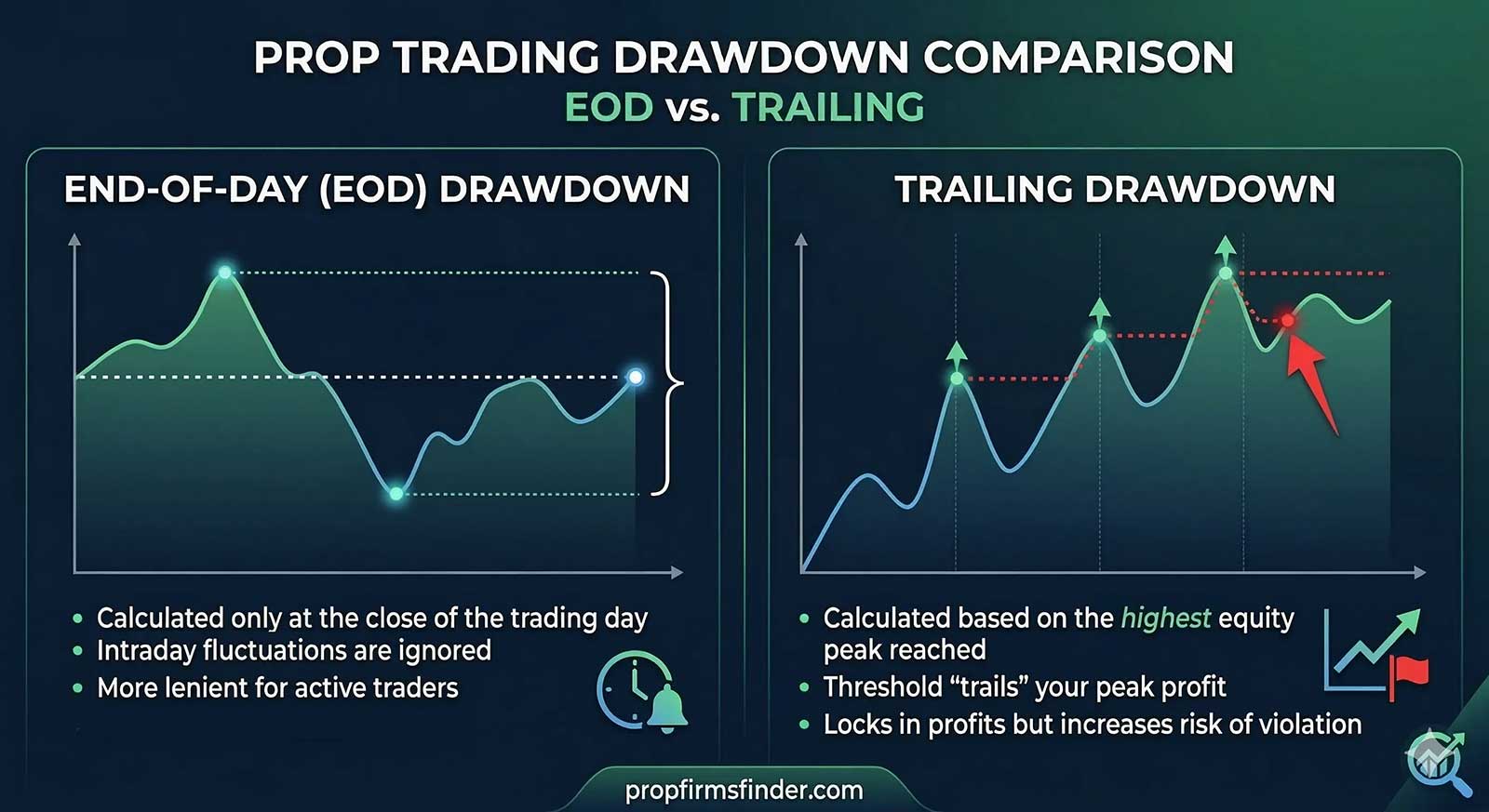
Trailing Drawdown vs EOD Drawdown: Which One Costs Traders More Money?
Here’s a stat that should make you uncomfortable: most traders who fail prop firm evaluations would have passed under a different drawdown rule. Not a different strategy. Not a different market. Just a different way of calculating the same number.
I know that sounds dramatic, but I’ve lived it. A couple of years back, I failed an evaluation on a day I finished up $1,200. My account was green. My trades were solid. But because the firm used intraday trailing drawdown, a mid-session equity spike I barely noticed had already raised my floor, and a normal pullback tapped it out. Account done. If that same firm had used EOD drawdown, I’d have passed comfortably.
That experience is why I think the decision between trailing drawdown and EOD drawdown is the single most important choice you’ll make when picking a prop firm. More important than price. More important than the profit split. More important than which platform they support. Because if the drawdown model doesn’t match your trading style, none of the rest matters - you’ll never get to a payout.
So let’s break this down properly. Real numbers. Real scenarios. And my honest opinion on which one will cost you more money in the long run.
A Quick Refresher: What Trailing Drawdown Actually Means
Before we get into the comparison, let’s make sure we’re on the same page about what “trailing” means in this context. If you already know this cold, skip ahead.
A trailing drawdown is a maximum loss limit that moves up as your account reaches new highs - but it never moves back down. Your floor ratchets upward with your profits, permanently.
Say you’re on a $50,000 account with a $2,500 trailing drawdown. Your starting liquidation level is $47,500. You make some good trades and your account peaks at $53,000. Your floor has now risen to $50,500. Even if your account balance drops back to $51,000, that floor stays at $50,500. You’ve lost $2,000 of breathing room permanently just because your account was higher at some point.
The concept is the same regardless of the calculation method. What changes everything is when and how that peak gets measured. And that’s where EOD and intraday trailing diverge.
How Intraday Trailing Drawdown Works
Intraday trailing drawdown tracks your account’s high-water mark in real time. Every single tick. Including unrealized, open-position profits.
Let me walk you through a scenario that plays out hundreds of times a day across the prop firm industry.
The setup: $50,000 account, $2,500 trailing drawdown, liquidation starts at $47,500.
9:35 AM: You enter a long on NQ. It runs in your favor. Your unrealized equity hits $52,800. Your liquidation level has now silently trailed up to $50,300.
10:15 AM: The trade pulls back. Normal stuff - NQ does this all morning. Your equity is now $50,600. You’re still up $600 on the day. But your cushion between your balance and your liquidation level is just $300.
10:22 AM: Another small dip. Equity touches $50,250. You’re breached. Account over.
Read that again. You made money on the day. Your trade was right directionally. You just happened to let your unrealized profit run to $2,800 before it pulled back - perfectly normal behavior on a volatile instrument like NQ - and the trailing floor ate your entire cushion.
This is the core problem with intraday trailing. It doesn’t care about your closed P&L. It doesn’t care about your end-of-day result. It cares about the highest tick your equity touched at any point during the session, and it locks that in permanently.
Who gets hurt most: Swing-style intraday traders, anyone who holds through pullbacks, runners who trail stops, and frankly, most traders who aren’t pure scalpers closing out within seconds of entry.
How End-of-Day (EOD) Drawdown Works
EOD drawdown calculates your high-water mark once per day, at market close. At Apex Trader Funding, that’s 4:59:59 PM ET. At other firms, it’s usually 5:00 PM ET. The principle is the same: only your closing balance matters for the trailing calculation.
Let’s run the exact same scenario.
The setup: $50,000 account, $2,500 trailing drawdown, liquidation starts at $47,500.
9:35 AM: Same NQ long. Unrealized equity peaks at $52,800. Under EOD rules, this peak is irrelevant. It doesn’t affect your floor because the session hasn’t closed yet.
10:15 AM: Trade pulls back. Equity sits at $50,600.
3:30 PM: You close out your remaining position. Final balance for the day: $51,200.
4:59 PM (market close): EOD drawdown calculates. Your highest EOD balance is now $51,200. Your new floor moves to $48,700 ($51,200 minus $2,500). You still have the full $2,500 cushion from your closing balance.
Same trade. Same entry. Same pullback. Under intraday trailing, you’re dead. Under EOD, you’re up $1,200 with a healthy cushion.
That’s the difference. And honestly, it’s not even close.
The Real Cost: Same Trade, Two Different Outcomes
I want to put concrete numbers next to each other because this comparison gets abstract fast. Here’s a typical day of futures trading on a $50,000 account with $2,500 trailing drawdown.
|
Event |
Intraday Trail |
EOD Trail |
|
Session open |
Floor: $47,500 |
Floor: $47,500 |
| Equity peaks at $52,800 |
Floor moves to $50,300 |
No change (unrealized) |
|
Pullback to $50,600 |
Only $300 cushion left |
Still $3,100 cushion |
| Close at $51,200 |
Account blown on further dip |
Healthy — $2,500 cushion |
|
New floor |
$50,300 (from unrealized peak) |
$48,700 (from closing balance) |
The intraday trail consumed $2,800 of the drawdown cushion from a peak the trader never locked in. The EOD trail only consumed $1,200 - the actual realized profit. That’s a $1,600 difference in available cushion from one trade on one day.
Why Intraday Trailing Costs Traders More Money
Let me be direct: intraday trailing drawdown kills more accounts than EOD drawdown. And it’s not a marginal difference.
Phidias, a futures prop firm that offers both models, claims their EOD accounts have an 83% higher pass rate than intraday trailing accounts. I don’t have independent verification of that specific number, but the direction matches everything I’ve seen and heard from traders across the industry. EOD is dramatically easier to survive.
Here’s why, broken down into the specific mechanics that eat your money:
1. Phantom drawdown consumption. Every time your equity spikes during a trade - even for a few seconds - the intraday trail locks in that high. You might not even see it happen on your chart if you’re watching price and not your account equity. But the firm’s system sees it. And now your floor is higher permanently. With EOD, those intraday spikes simply don’t count.
2. It punishes letting winners run. Good trade management often means trailing a stop and giving a position room to breathe. On NQ, a winning trade might go +$2,000, pull back $800, and then continue to +$3,500. Under intraday trailing, that $800 pullback consumed the drawdown cushion - the floor moved up to the $2,000 peak and never came back. Under EOD, only your closing balance matters. You can manage the trade properly without worrying about every tick against you.
3. It forces conservative behavior that reduces profits. Traders on intraday trailing accounts learn to take profits early. Way too early. They scalp 4-6 ticks on ES and close, terrified of giving back unrealized gains. That’s rational behavior given the rules, but it caps your upside dramatically. I’ve watched traders leave thousands of dollars on the table because they were so scared of the trail eating their cushion. EOD traders don’t have this problem. They can hold their positions through normal volatility and capture the full move.
4. Compounding reset fees and evaluation costs. Because intraday trailing blows more accounts, traders buy more evaluations. At $100-200 per reset or new eval, that adds up fast. I’ve talked to traders who’ve spent $500+ in resets on intraday accounts before switching to EOD and passing on their first try. The “cheaper” intraday evaluation can end up being the most expensive path to funding.
To Be Fair: When Intraday Trailing Makes Sense
Look, I’m clearly an EOD advocate. But I’d be dishonest if I didn’t acknowledge the cases where intraday trailing works fine - or even has advantages.
Tight scalpers: If your strategy involves entering and exiting within 30-60 seconds, your unrealized equity peak is nearly identical to your closed P&L. The trailing drawdown difference between EOD and intraday is negligible. And intraday evaluations are cheaper - at Apex, a 25K Intraday Trail eval runs about $12 with promo codes vs. ~$18 for EOD.
Micro contract traders: On MES or MNQ, the dollar moves are small enough that the unrealized-to-realized gap rarely causes blowups. A 10-tick MES move is only $50. The trail isn’t going to eat you alive on those numbers.
Budget-conscious first-timers: If you’re genuinely just testing whether you can trade prop firm rules at all, an intraday eval at ~$12-18 is a low-risk experiment. Fail fast, learn the mechanics, then upgrade to EOD when you’re ready to seriously pursue funding.
No daily loss limit: One genuine advantage of intraday accounts at some firms (including Apex’s new product line) is that they have no daily loss limit (DLL). EOD accounts at Apex come with a DLL - for example, $1,500 on the 100K plan. If you hit that intraday, your trades get flattened and you’re done for the day. Some aggressive traders prefer the freedom of no DLL, even though the trailing is tighter.
Apex’s March 2026 Overhaul: Finally, a Real Choice
The reason I keep bringing up Apex Trader Funding is because their March 2026 product overhaul is genuinely the most trader-friendly structural change I’ve seen from a major firm. They rebuilt everything. It seems like Apex team really listened to its traders and what the community was asking for.
Before March 2026, Apex used intraday trailing on all evaluations. You didn’t get a choice. If you wanted Apex’s pricing, community, and payout speed, you accepted the intraday trail.
Now? Two distinct product lines:
EOD Trail accounts: Drawdown calculated once per day at 4:59:59 PM ET based on closing balance. Includes a daily loss limit as a session-level circuit breaker. The 100K EOD eval runs around $30 with promo codes (one-time fee, no subscription). Safety net locks your floor at starting balance + $100 once you’ve built enough profit buffer.
Intraday Trail accounts: Real-time trailing on peak balance including unrealized. No daily loss limit. Cheaper - a 100K Intraday eval is roughly $20 with promo codes. Same safety net mechanic.
Both are one-time purchases (no monthly fees during eval), both have no evaluation consistency rule, and both can be passed in one day. The new products also completely eliminate payout denials - no video reviews, no screenshot requirements, no manual approval. Payouts process automatically when criteria are met.
For most traders, I’d recommend the EOD option. The extra $10 in eval cost is nothing compared to the increased pass rate. But the point is that you actually get to choose now, and both options have clear, simple rules. That’s a huge improvement over the old system.
You can read our full Apex Trader Funding review for a detailed breakdown of both account types, payout caps, and the consistency rules that kick in on Performance Accounts. [Link: /prop-firm/apex-trader-funding]
Other Firms Worth Considering for EOD Drawdown
Apex isn’t the only option if you want EOD drawdown. Here’s a quick rundown of the main alternatives:
Topstep has used EOD drawdown for years and was one of the first firms to champion it publicly. Their Marketing has leaned hard into the messaging that intraday trailing is unfair. Solid platform support, well-established brand.
My Funded Futures (MFFU) uses EOD trailing on their evaluation across all plans (Rapid, Flex, Pro). Notably, the Rapid Plan switches to intraday trailing in the sim-funded stage, so read the rules carefully. Flex and Pro stay on EOD throughout. No activation fees on any plan. We’ve got a detailed review on MFFU if you want the full breakdown. [Link: /prop-firm/my-funded-futures]
Lucid Trading runs an EOD drawdown model and has built a reputation for allowing normal trading behavior - news trading, scalping, and holding through volatility are all permitted. They restructured their product lineup in early March 2026, so make sure you’re looking at the current rules.
Elite Trader Funding offers dedicated EOD drawdown evaluations with a straightforward structure. Their EOD threshold trails the highest end-of-day balance and locks once you’ve earned realized profits equal to the max drawdown plus $100.
Tradeify uses EOD trailing on their SELECT, Growth, and Lightning plans. They’re a newer firm but have been gaining traction specifically because of the EOD model and clean rules.
How to Pick: A Decision Framework
Forget the marketing. Forget the price comparisons (the difference is usually $10-20). Ask yourself these questions:
Do you hold trades for more than 5 minutes? If yes, go EOD. The longer your average hold time, the more exposed you are to intraday equity peaks that the trail will lock in.
Do you trade NQ or other volatile instruments? NQ can swing 50+ points in minutes. That’s $1,000+ per contract in unrealized P&L movement. Under intraday trailing, those swings directly eat your drawdown cushion. EOD protects you from this.
Do you trail stops or manage partials? If your strategy involves trailing a stop up as a position moves in your favor, intraday trailing is going to punish you every time the market pulls back to your stop. EOD doesn’t care about that intraday noise.
Are you a pure scalper taking trades under 60 seconds? Intraday trail is probably fine. Your unrealized peaks are close to your closes, so the difference is minimal. Save the money on the cheaper eval.
Do you need a daily loss limit as a guardrail? Some traders (honestly, including me on bad weeks) benefit from a forced stop after a certain amount of loss. EOD accounts at Apex include a DLL. Intraday accounts don’t. If you have even a slight tendency to revenge trade, the DLL could save your account.
Practical Tips for Surviving Either Model
Regardless of which drawdown type you end up trading under, here are the habits that keep accounts alive:
Track your floor manually. Platforms can lag, display incorrectly, or round differently than the firm’s system. I use a simple spreadsheet that I update after every trade. Peak equity, current floor, available cushion. Takes 30 seconds. Prevents account-ending surprises.
Front-load caution until the safety net locks. On a $50K Apex account, your trail stops moving when your peak balance hits $52,600 (EOD) or $52,600 (intraday). Everything before that point is the danger zone. Trade smaller. Take profits sooner. Don’t swing for the fences until you’ve locked the floor.
Set a personal walk-away threshold at 80% of your daily loss limit. If the DLL is $1,500, stop at -$1,200. The last $300 is your emergency buffer, not your revenge trading budget.
Close positions before walking away from your screen. I’ve said this before and I’ll keep saying it because overnight moves through your trailing drawdown are one of the most common - and most preventable - ways to lose an account. Futures markets don’t sleep. Your drawdown threshold doesn’t take breaks either.
If you’re on intraday trailing, think about your equity peak, not just your P&L. Before you enter a trade, ask: “If this runs $2,000 in my favor and then reverses $1,500, where does my floor end up?” If the answer puts you in danger, size down or tighten your stop.
Frequently Asked Questions
What’s the main difference between trailing drawdown and EOD drawdown?
Both are trailing drawdowns - the floor moves up and never comes back down. The difference is timing. Intraday trailing updates your floor in real time based on your highest equity at any tick during the session (including unrealized profits). EOD trailing only updates once per day at market close, based on your closing balance. EOD ignores intraday spikes entirely.
Can you blow an EOD drawdown account during the trading day?
Yes. The EOD calculation happens at market close, but the enforcement is real-time. If your balance touches or crosses below the current EOD threshold at any point during the session, you’re done. The threshold itself just doesn’t move until close.
Which drawdown type has a higher pass rate?
EOD drawdown, and it’s not close. Every data point I’ve seen - from firms that publish stats and from community discussions - suggests significantly higher eval completion rates on EOD models. The logic is straightforward: EOD accounts don’t penalize you for unrealized intraday equity peaks, so normal trade management doesn’t eat your cushion.
Does Apex Trader Funding offer both types?
Yes. Since March 2026, Apex offers separate EOD Trail and Intraday Trail product lines. Both are one-time purchases with no monthly subscription. EOD accounts include a daily loss limit; intraday accounts do not. Both have the same safety net mechanic and the same payout structure.
Is intraday trailing ever the better choice?
For pure scalpers who close trades within seconds and rarely accumulate large unrealized P&L swings, intraday trailing is fine - and cheaper. It’s also a reasonable choice if you specifically want to avoid the daily loss limit that comes with some EOD accounts. But for the majority of trading styles, EOD provides more margin for error and a better chance of reaching a payout.
Does the trailing drawdown ever stop trailing?
At most reputable firms, yes. Apex’s trailing drawdown (both EOD and intraday) stops moving once your peak balance reaches the starting balance plus the drawdown amount plus $100. On a $50K account, that’s $52,600. After that, your floor locks at $50,100 and acts like a static drawdown. This safety net mechanic is a genuine game-changer.
The drawdown model you trade under shapes every decision you make - when to enter, when to exit, how long to hold, how much to risk. Getting this choice wrong means paying for evaluations over and over, burning time and money on accounts you were never going to survive. If you want the simplest path to a funded account, go EOD. And if you want to see how the top firms compare on drawdown rules, pricing, and payouts, check out our prop firm comparison tool.