Consistency in Prop Trading Explained (2026 Guide)

The consistency rule is the reason a lot of profitable traders don't get paid. However, many prop trading firms do not make consistency rules clear for their traders.
You pass the evaluation, hit the profit target, respect the drawdown, and otherwise follow all of the rules. Then you submit a payout request and the system blocks it because 50% of your profits came from one trading day. That's the consistency rule doing its job. Now you will need to "dilute" your trades to make sure that your profits come from more than one big trade.
If you're trading with a prop firm (or thinking about it), understanding how consistency rules work, when they apply, and how they differ across firms is very important to understand.
What Is the Consistency Rule in Prop Trading?
The consistency rule limits how much of your total profit can come from a single trading day. It's expressed as a percentage. If a firm uses a 50% consistency rule, no single day can account for 50% or more of your total net profit when you request a payout.
The formula is simple:
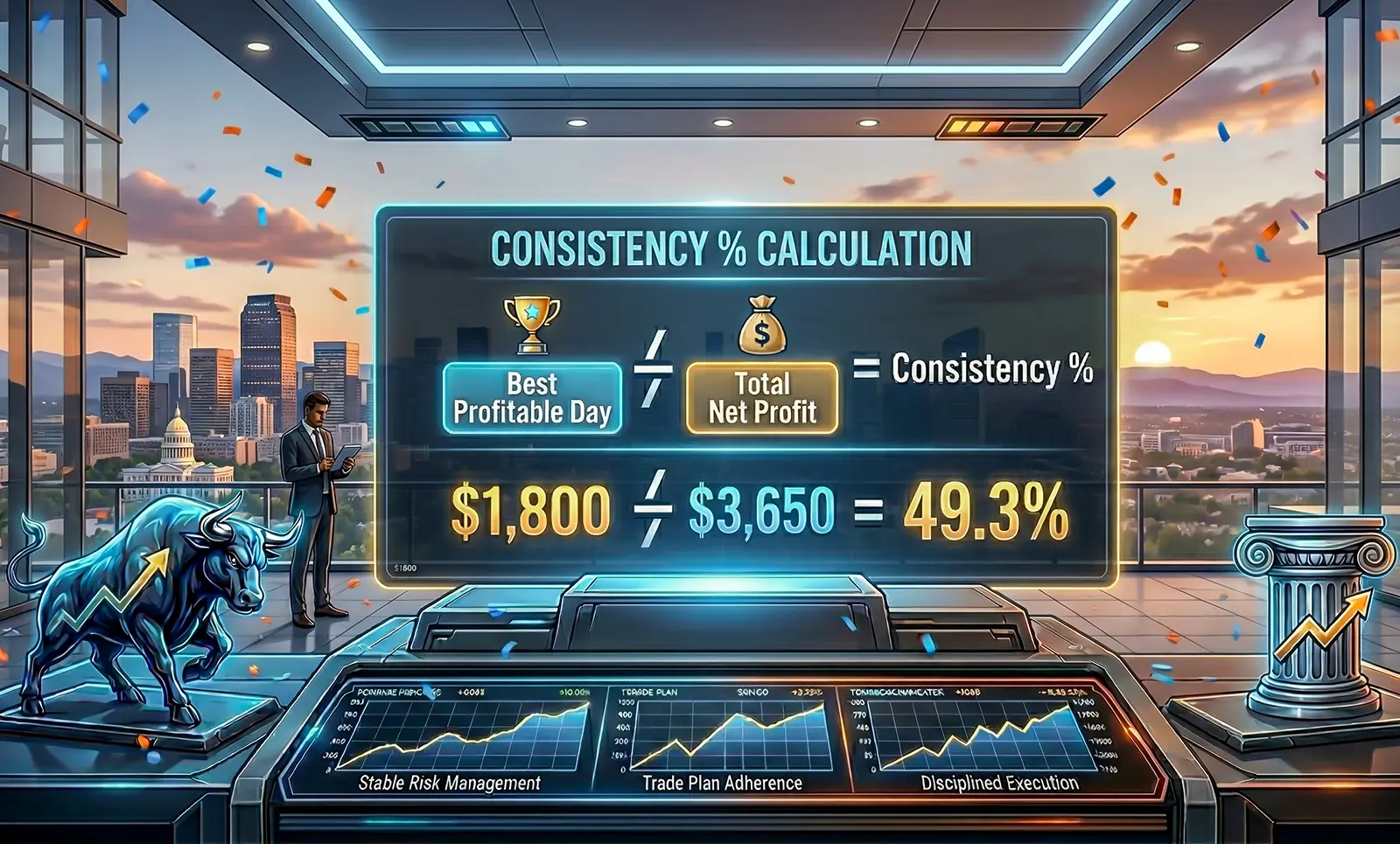
Consistency % = Best Profitable Day / Total Net Profit
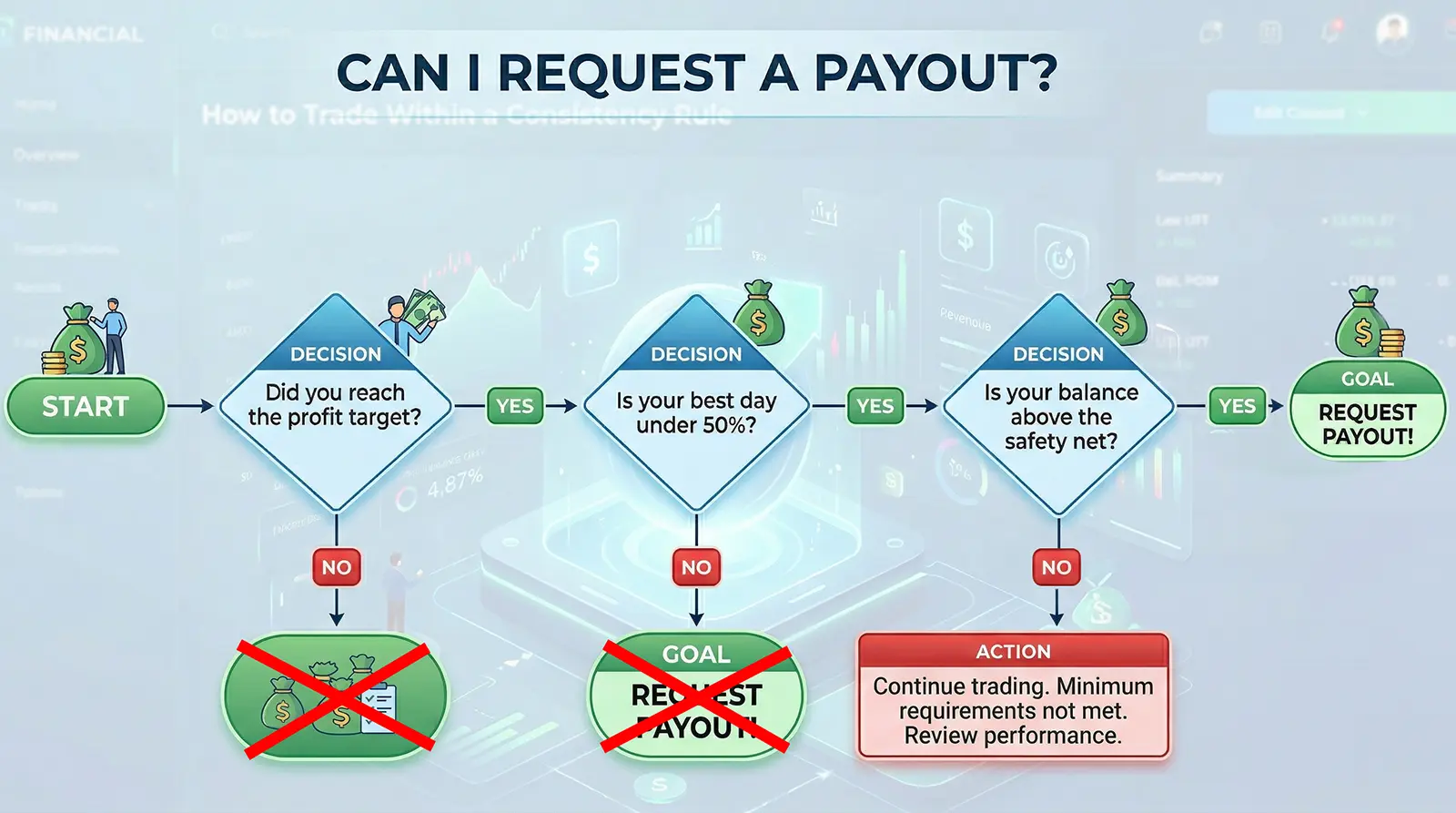
If that number is at or above the firm's threshold, your payout request gets blocked. Your account stays active, you keep trading, and once you've earned enough on other days to bring the ratio below the threshold, you can withdraw.
An important distinction: at most firms, breaching the consistency rule does not fail your account. It delays your payout. That's a meaningful difference from hitting a drawdown limit, which typically ends the account entirely. For a full breakdown of how drawdown rules work, check out our drawdown explained guide.
A Quick Example With Real Numbers
You're on a $100,000 account with a 50% consistency rule. Over five trading days, here's your P&L:
|
Day |
Net Profit |
Running Total |
Best Day % |
|
Monday |
$1,800 |
$1,800 |
100% |
|
Tuesday |
$400 |
$2,200 |
81.8% |
|
Wednesday |
$350 |
$2,550 |
70.6% |
|
Thursday |
$500 |
$3,050 |
59.0% |
|
Friday |
$600 |
$3,650 |
49.3% |
You made $3,650 total. Your best day was Monday at $1,800. That's 49.3% of total profit. Under a 50% rule, you're clear. Under a 30% rule (which some firms still use), you'd need $6,000 in total profit before that Monday stopped blocking your payout.
Notice how many days of decent trading it took to "dilute" one strong day. That's the core tension with consistency rules: the better your best day, the more additional trading you need to do before you can withdraw.
When Does the Consistency Rule Apply?
This varies a lot by firm. The rule can show up in three places:
During the Evaluation
Some firms enforce consistency during the challenge phase. This means you can't pass by making 80% of your profit target on one trade. Firms like Earn2Trade and TradeDay use a 30% consistency rule during evaluations. FTMO's 1-Step Challenge has a "Best Day" rule where no single day can account for too large a share of your profits.
Other firms have zero consistency requirement during evaluation. At Apex Trader Funding, you can pass the evaluation in a single day, making 100% of your profit on one trade, and that's perfectly fine. The consistency rule only kicks in later in the PA account, and even then it is not bad at all, 50%.
During the Funded Phase (for Payouts)
This is where most firms apply the rule. You're already funded, you've made money, and you want to withdraw. The firm checks whether your profit distribution is even enough before approving the request.
Apex Trader Funding uses a 50% consistency rule at this stage. No single day can be 50% or more of your net profit since your last approved payout. The old Apex rule was 30%, which was much more restrictive. The March 2026 overhaul relaxed it significantly. You can read our full Apex Trader Funding review for a complete breakdown of their current rules.
Not at All
Some firms don't use a consistency rule in any phase. Topstep has no consistency rule on payouts. The 5%ers doesn't enforce one either. If consistency rules stress you out, these firms are worth a look. We cover Topstep in our Topstep review.
How Major Prop Firms Handle Consistency (2026)

As you see in the image above, Apex Trader Funding has a 50% consistency rule, this is for PA accounts. Evaluation accounts do not have a consistency rule for this prop firm. However, the 50% consistency rule was not always the case, it only came in after Apex 4.0 was launched. It used to be 30% which many traders were not fans of.
|
Firm |
Consistency % |
When It Applies |
Breach = Fail? |
|
Apex Trader Funding |
50% |
Performance Account (payout requests only) |
No, delays payout |
|
FTMO (1-Step) |
Best Day rule |
Evaluation + Funded |
No, delays payout |
|
FTMO (2-Step) |
None |
N/A |
N/A |
|
Topstep |
None |
N/A |
N/A |
|
My Funded Futures |
Varies by plan |
Evaluation (removable on Pro) |
No, extends target |
|
Tradeify |
Varies by plan |
Evaluation + Funded |
No, delays payout |
|
Earn2Trade |
30% |
Evaluation |
No, extends target |
|
The 5%ers |
None |
N/A |
N/A |
Firms update rules frequently. Always verify current terms on the firm's website before purchasing an evaluation.
The higher the consistency percentage, the easier it is for traders. A 50% threshold means your best day can be almost half your total profit. A 20% or 30% threshold is much tighter and requires many more "average" days to balance out any strong sessions.
Compare all of these firms side by side on our prop firm rankings page.
Why Do Prop Firms Use Consistency Rules?
Risk Management Across the Trader Pool
Prop firms fund thousands of traders at the same time. If a large portion of those traders make all their money on one big trade and then request immediate payouts, the firm's cash flow becomes unpredictable. The consistency rule smooths out payout requests by ensuring traders have demonstrated repeatable performance before withdrawing.
Separating Skill From Luck
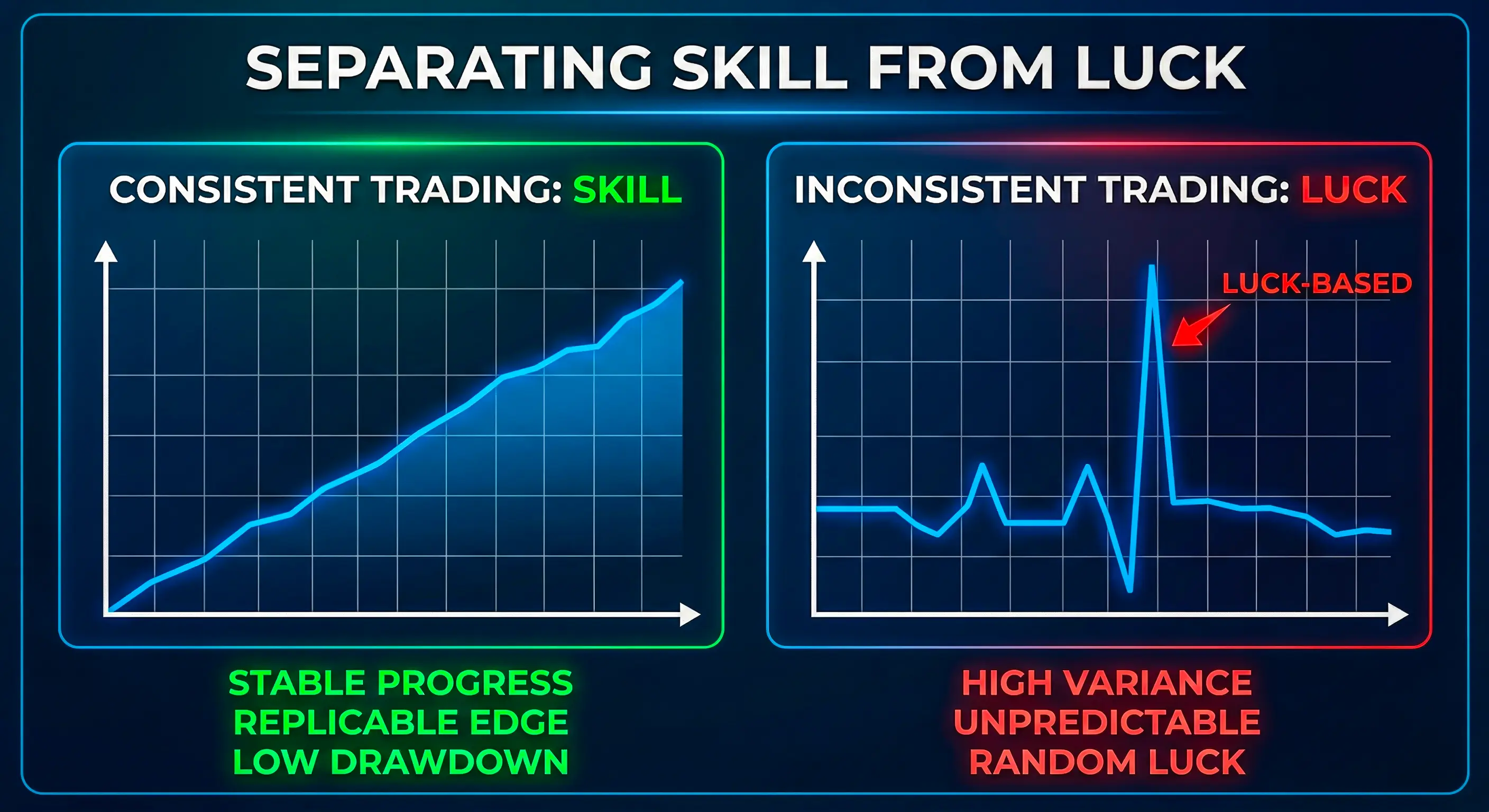
A trader who makes $500 per day for 10 days has demonstrated a process. A trader who makes $5,000 on one NFP trade and nothing else has demonstrated that they can trade news. The firm can't tell from one data point whether that trader can do it again.
From the firm's perspective, consistent daily profits are a stronger signal of long-term profitability than one home run trade. The consistency rule is a statistical filter that favors repeatable edge over one-time events.
The Business Reality
There's a less-discussed reason too. Consistency rules keep payouts spaced out and predictable for the firm's cash flow. A firm that lets every trader withdraw after one big day faces lumpier outflows than a firm that requires 5-10 days of distributed profits first. The rules serve the firm's financial planning as much as they serve risk management.
How to Trade Within a Consistency Rule
Cap Your Daily Gains
If your firm uses a 50% rule and your profit target is $6,000, your single best day should stay under $3,000. In practice, aim lower. If you're up $2,000 by lunchtime, consider stopping for the day. Banking a $2,000 day and trading again tomorrow is better than pushing to $3,500 and creating a consistency problem.
Trade Every Day You Can
Under a consistency rule, a small $100 profit day is better than not trading at all. Every profitable day dilutes your best day's share. If you only trade 3 days per week but one of those is a big winner, you'll struggle to meet the threshold. Trading more sessions, even with small gains, keeps the ratio in check.
Don't Chase Losses to "Dilute"
The most dangerous situation is having a big winning day early in the payout cycle and then needing to trade more days to bring the ratio below the threshold. Every additional trade adds risk to the account. If you're trading for the sole purpose of meeting consistency, you're more likely to force trades, take bad setups, and potentially breach the drawdown.
The better approach: trade your normal strategy at your normal size. The ratio will come down naturally over time.
Track the Math Yourself
Most firms don't show a real-time consistency meter on the dashboard. You need to track your daily P&L, know your best day, and calculate the percentage manually before submitting a payout request. A simple spreadsheet works. Some third-party tools (like FundedMath) offer free calculators for specific firms.
5 Things Traders Get Wrong About Consistency Rules
1. "It applies during the evaluation." Not always. At Apex Trader Funding, the consistency rule applies only during the Performance Account phase when requesting payouts. You can pass the evaluation in a single day with all your profit from one trade. Each firm is different, so check the rules before assuming.
2. "Breaching it fails my account." At most firms, no. Breaching the consistency rule blocks your payout request but does not terminate the account. You keep trading until the ratio drops below the threshold. This is fundamentally different from hitting the drawdown limit, which typically ends the account.
3. "I need every day to be profitable." The consistency rule only looks at profitable days. Losing days are excluded from the calculation. A day where you lost $200 doesn't count against your consistency, and it doesn't help it either.
4. "A lower percentage is better for me." It's the opposite. A higher threshold is more trader-friendly. A 50% rule means your best day can be nearly half your total profit. A 20% rule means your best day can only be one-fifth. The lower the percentage, the harder it is to comply.
5. "The calculation carries over after a payout." At most firms (including Apex), the consistency calculation resets to zero after each approved payout. Your previous best day no longer counts. Only new profits after the payout are measured.
How Consistency Rules Shape Your Trading Strategy
The consistency rule has real implications for the kind of strategy you run. Traders who rely on catching one big move per day (like a trend-following approach that aims for 40-50 point moves on NQ) will have a harder time staying consistent than traders who take 3-4 smaller trades per session.
Scalpers and high-frequency day traders tend to have more evenly distributed daily P&L. Their best day might be $800 and their average day might be $400. That's a natural fit for consistency rules.
Swing traders who hold positions overnight face a different challenge. A position that runs for two days and closes for a $3,000 gain on Tuesday creates a spike in Tuesday's P&L that throws off the consistency math, even though the trade was planned and disciplined.
If your strategy naturally produces uneven daily returns, look for firms without consistency rules (like Topstep or The 5%ers) or firms that apply it generously (Apex at 50%). If your strategy produces small, steady daily gains, the consistency rule won't bother you regardless of the threshold.
For a broader look at strategies that work well for evaluations, see our how to pass a prop firm evaluation guide.
Consistency Rules vs. Drawdown Rules
These are related but separate concepts. Drawdown rules protect the account from large losses. Consistency rules prevent profits from being concentrated in a single session. You can respect the drawdown perfectly and still get blocked by the consistency rule.
Think of drawdown as the floor (how much you can lose) and consistency as the shape of your gains (how evenly you earned). Both need to be managed, but they require different approaches. Drawdown is managed through position sizing and stop losses. Consistency is managed through trade frequency and gain distribution.
We compare trailing drawdown and EOD drawdown in detail in our trailing vs EOD drawdown comparison.
Frequently Asked Questions
What is the consistency rule in prop trading?
The consistency rule limits how much of your total profit can come from a single trading day. If your best day accounts for too large a share of your profits (above the firm's threshold), your payout request gets blocked until you've earned enough on other days to bring the ratio down.
Does the consistency rule fail my account?
At most firms, no. It blocks your payout, not your account. You can keep trading and bring the ratio below the threshold. Drawdown breaches end accounts. Consistency breaches delay payouts.
Which prop firms don't have a consistency rule?
Topstep, The 5%ers, and FTMO's 2-Step Challenge don't enforce a consistency rule on payouts. If consistency rules are a concern for your trading style, these firms are worth considering. Compare them on our best forex prop firms or best futures prop firms pages with side-by-side comparison data tables.
What is Apex Trader Funding's consistency rule?
As of March 2026, Apex uses a 50% consistency rule on Performance Account payouts only. No single day can account for 50% or more of your total net profit since your last approved payout. The rule does not apply during evaluations. This is more relaxed than the old 30% rule that was in place before March 2026.
Does the consistency calculation reset after a payout?
Yes, at most firms. After an approved payout, the calculation starts fresh. Only profits earned after the payout count toward the next consistency check.
Is a higher or lower consistency percentage better for traders?
Higher is better. A 50% threshold lets your best day be almost half your total. A 20% threshold means you need five times your best day in total profit before you can withdraw. Always look for the highest percentage or no consistency rule at all.
The Bottom Line
The consistency rule is one of those things that doesn't seem important until it blocks your first payout. Understanding how your firm calculates it, when it applies, and what the threshold is will save you frustration down the line.
The practical takeaway: if your firm enforces a consistency rule, cap your best days, trade regularly, and track the math. If consistency rules don't fit your trading style, pick a firm that doesn't use them.
If you're looking for current discounts on evaluations, our prop firm deals page tracks the latest offers