How to Pass a Prop Firm Evaluation: Practical Tactics That Work
Most traders who attempt a prop firm evaluation don't pass. The data backs this up. Industry-wide pass rates sit somewhere between 5% and 15%, depending on the firm and the evaluation type. And here's the thing that trips people up: the majority of failures aren't from bad trading. They come from rule violations, poor risk management, or emotional decisions made under pressure.
If you're about to take your first evaluation, or you've already failed a couple and want a different result, this guide covers the stuff that moves the needle. Simple tactics you should start with, advanced approaches for when you're ready, and the specific rules and traps you need to watch out for.
Understand What the Evaluation Is Testing
Before you open a single trade, get clear on what prop firms want from you. They're not looking for the next trading genius. They're looking for someone who:
✔️ follows rules,
✔️ controls risk,
✔️ and grows an account steadily.
The profit target is a filter, not the point. A $6,000 target on a $100,000 account is only 6%. That's not a high bar for a competent trader with 30 days to work with. The real test is whether you hit that number without breaching the drawdown, blowing through a daily loss limit, or doing something the firm's rules prohibit.
Think of it this way: the evaluation measures discipline first, skill second. Plenty of traders have the skill to make $6,000 in a week. Far fewer have the discipline to do it without putting the entire account at risk along the way.
Start with the Basics: 6 Tactics Every Trader Should Follow
1. Read the Rules Before You Trade
This sounds obvious. It's not. A study from Funded Trading Plus found that 43% of first-time evaluation failures were caused by traders breaking a rule they didn't fully understand. Drawdown calculation is the most common blind spot.
Every firm runs drawdown differently. These are fundamentally different mechanics, and mixing them up will cost you an account. Your main objective is to understand the drawdown mechanisms:
- Some firms use trail intraday: your drawdown threshold moves up in real time as your equity increases.
- Some use trail end-of-day: it only updates at market close.
- And a few use static drawdown: a fixed floor that never moves.
If you're trading futures, Apex Trader Funding now lets you choose between EOD trailing and intraday trailing drawdown on all of their new evaluations (as of their March 2026 product overhaul). That choice alone changes how you need to manage every trade. We break down the differences in detail in our trailing drawdown vs EOD drawdown comparison.
⚠️ Before you buy any evaluation, open the firm's rules page and read every line. Look for: drawdown type and calculation, daily loss limits, minimum trading days, consistency rules, restricted trading hours, news trading restrictions, position size limits, and close-of-session requirements.
2. Size Down From Your Normal
If you normally trade 4 ES contracts on a $100K account, trade 2 during the evaluation, or trade micros. This is the single easiest adjustment you can make, and it has the biggest impact on your pass rate.
Why? Smaller position sizes give you more room to be wrong. If your drawdown limit is $3,000 and you're trading 2 ES contracts, a 15-point move against you costs $1,500. That's half your drawdown gone on one trade. Drop to 1 contract (or 10 MES), and that same 15-point move costs $750. You still have $2,250 of breathing room.
⚠️ During our tests, we discovered that the evaluation doesn't reward you for being aggressive. It rewards you for being alive at the end. Trade small enough that no single loss threatens your account.
3. Set a Personal Daily Loss Limit
Most firms have a daily loss limit built into the rules, some don't. Either way, set your own, and make it tighter than whatever the firm requires.
On a $50,000 account with a $2,500 trailing drawdown, a reasonable personal daily cap might be $500. That gives you five full losing days before you breach. If the firm's official daily loss limit is $1,500, great. Your personal limit is still $500.
When you hit your daily cap, close the platform. Don't "take one more look." Don't switch to a different instrument. Close it. Walk away. Come back tomorrow.
This single habit prevents the most common failure pattern: a trader takes a normal loss, gets frustrated, revenge trades, takes a bigger loss, and either blows through the drawdown or goes on tilt for the rest of the week.
4. Trade One Setup
During an evaluation, you don't need five strategies. You need one. Pick the setup you know best, the one you've traded enough times that you trust it, and trade only that.
If you're a breakout trader, trade breakouts. If you trade VWAP reversals, trade VWAP reversals. If you scalp the opening range, do that. Don't suddenly add trend-following on NQ because you saw a good setup on Twitter. The evaluation is not the time to experiment.
Consistency in your approach is what lets you trade with confidence, and confidence is what keeps you from making emotional decisions under pressure.
5. Don't Rush the Profit Target
On a 30-day evaluation with a $6,000 target, you need $200 per trading day (assuming about 22 trading days). On the E-mini S&P 500, that's 4 points. On the Micro E-mini, that's $200 across however many contracts you're using.
$200 per day is not a lot. It's one or two decent trades. The problem starts when traders try to make $2,000 on day two and "get ahead." That kind of thinking leads to oversized positions, wide stops, and the exact kind of volatile P&L curve that triggers drawdown violations.
Target small, consistent daily gains. $200-$400 per day on a $100K account. If you have a great day and make $800, take it and stop. Don't push for $1,200 just because the market is moving.
6. Close Positions Before the Deadline
Almost every prop firm requires you to flatten all positions before market close. For futures firms, that's typically 4:59 PM ET. Forgetting to close a position is one of the dumbest ways to fail an evaluation, and it happens all the time.
Set an alarm for 4:45 PM ET every day. No exceptions. And if your firm has rules about trading during economic releases (like the 2-minute news restriction on FTMO Standard funded accounts), put those on your calendar too.
Advanced Tactics: Level Up Your Pass Rate
Being informed is the key. Read our list of advanced tactics to pass your evaluation.
Use Micros to Manage Your Drawdown Precisely
Micro contracts (MES, MNQ, MYM, M2K) give you granular control over position sizing that full-size contracts don't. Instead of jumping from 1 ES ($50/point) to 2 ES ($100/point), you can scale from 10 MES ($50/point) to 12 MES ($60/point).
This matters during evaluations because precise sizing lets you keep your risk per trade within a tight band. If your rule is "never risk more than 1% of the drawdown on a single trade," micros let you dial that in. With full contracts, you're stuck making bigger jumps.
📌 Firms like Apex Trader Funding, Topstep, and My Funded Futures all allow micro contract trading during evaluations. At Topstep, for example, each full contract counts as 10 micros toward the position limit.
Build a Buffer Before You Push
Here's a tactic that we use in this process: spend the first 5-10 trading days building a profit buffer, then trade slightly more aggressively once you have cushion.
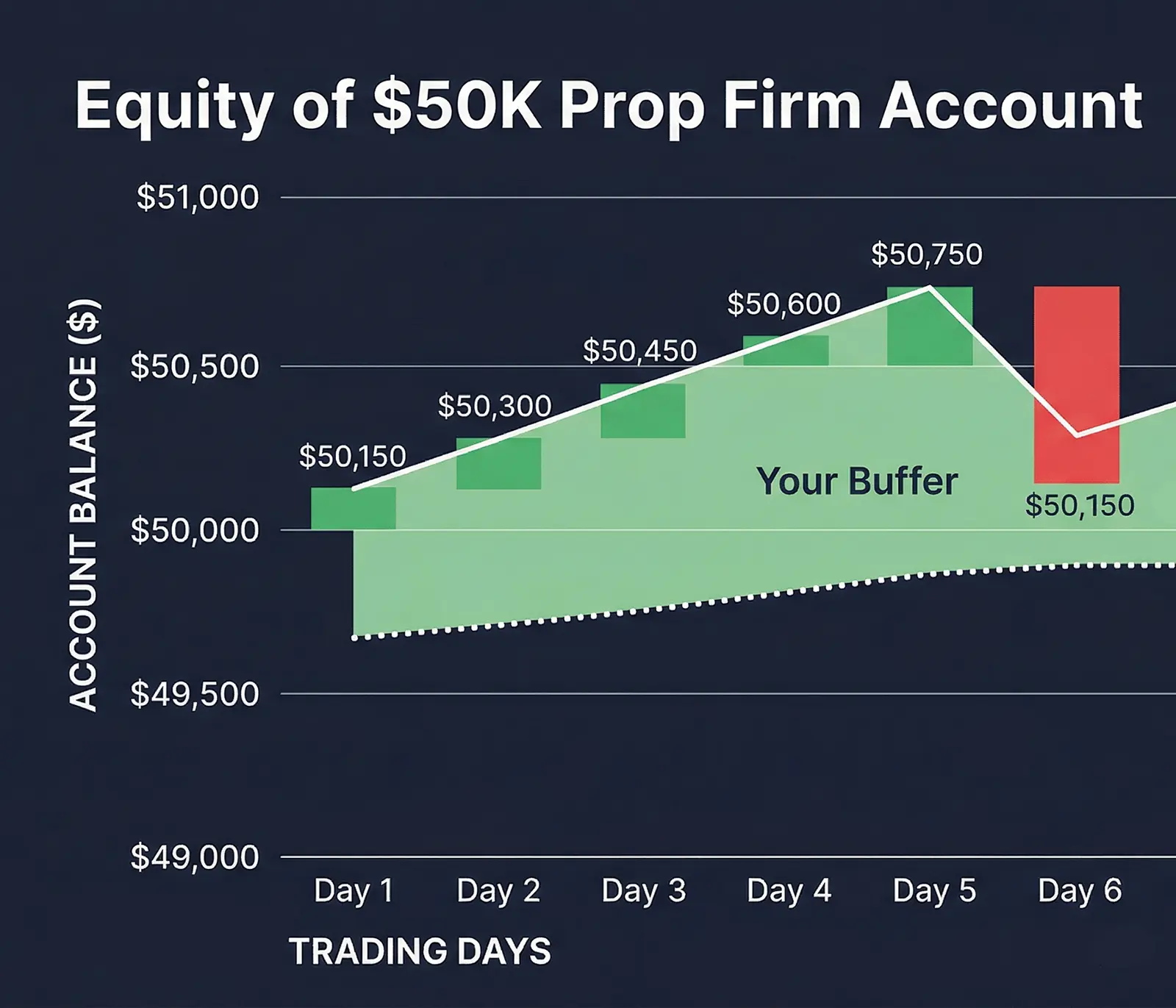
On a $50K account with a $2,500 trailing drawdown and a $3,000 profit target, spend the first week making $100-$200 per day. After 5 days, you might have $750 in profit. Your trailing drawdown floor has moved up, but you now have $750 in realized gains sitting above that floor.
Now you have room. If you take a $400 loss on day 6, you're still up $350 net. You haven't breached anything. You haven't panicked. You can keep trading normally.
Without that buffer, a $400 loss on day 6 would eat into your original drawdown cushion, and psychologically, that feels much worse.
Understand How Trailing Drawdown Eats Your Cushion
This is where most evaluation failures come from, and most guides don't explain it clearly enough.
With intraday trailing drawdown, your threshold moves up with your equity in real time, including unrealized gains. If you enter a trade and it goes $500 in your favor, your drawdown floor moves up $500. If that trade then reverses and comes back to break-even, you've lost $500 of drawdown cushion even though your P&L is flat.
This is why intraday trailing is so much harder than EOD trailing. EOD only recalculates at the end of the day. If your account closes the day at $51,000 on a $50K evaluation, your threshold moves up by $1,000. But during the day, you could have been at $52,000 and pulled back to $51,000 and it wouldn't matter.
📌 We have a full breakdown of how this works with real trade examples in our prop firm drawdown explained guide.
Match Your Drawdown Type to Your Trading Style
- If you're a scalper who takes a lot of trades and sees big intraday equity swings, EOD trailing drawdown is a better fit. Your peaks and valleys during the session won't eat into your cushion.
- If you're a patient trader who takes one or two setups per day and holds for defined targets with tight stops, intraday trailing is manageable because your equity swings tend to be smaller.
This choice alone affects your pass rate more than almost any other variable. Choosing the wrong drawdown model for your style is like running a marathon in basketball shoes. You might finish, but you're making it way harder than it needs to be.
Use a Trading Journal to Spot Patterns
Not a vague "write down your feelings" journal. Use a data-driven log of every trade: entry, exit, position size, R-multiple, time of day, setup type, and outcome.
After 5-10 trading days, patterns start showing up. You might notice that your win rate drops below 30% on afternoon trades. Or that trades taken during the first 15 minutes of the session have a 2:1 reward-to-risk ratio, while trades after 11 AM barely break even.
These patterns tell you where your edge is. During an evaluation, you want to trade in your edge zone and avoid everything else.
Rules and Traps to Watch Out For
Consistency Rules
Some firms enforce a consistency rule that limits how much of your total profit can come from a single day. At Apex Trader Funding, the 50% consistency rule applies only during the Performance Account phase (not during evaluation). At FTMO, the 1-Step Challenge has a "Best Day" consistency rule where no single day can account for more than a certain percentage.
If your firm has a consistency rule during the evaluation, plan for it. Making 80% of your profit target in one big day might feel great, but it could lock you out of requesting a payout later, or even fail the evaluation at firms that enforce it earlier.
News Trading Restrictions
This varies a lot by firm. FTMO's Standard 2-Step funded accounts have a 2-minute restriction around Tier 1 news events (no positions or orders 2 minutes before and after). Their 1-Step and Swing accounts don't have this restriction. My Funded Futures has specific restrictions around T1 economic data releases too.
Apex Trader Funding's new evaluations don't restrict news trading during the evaluation phase. But that doesn't mean you should trade every NFP and CPI release. High-impact news creates the kind of volatility that chews through trailing drawdown in seconds. If you do trade news, size down and use tight stops.
Watch the News Calendar
Even if your firm doesn't restrict news trading, you should be aware of what's on the economic calendar. FOMC days, Non-Farm Payrolls, CPI releases, and surprise geopolitical events can create moves that blow through any stop loss.
The safest approach during an evaluation: go flat 5-10 minutes before a major release and wait for the initial volatility to settle. You're not missing out. You're protecting the account.
Position Close Requirements
Most futures firms require all positions to be flat by 4:59 PM ET. Some forex firms have different close times. Tradeify also requires flattening by 4:59 PM ET and has a microscalping rule (over 50% of trades must be held longer than 10 seconds). My Funded Futures has a similar close requirement.
⚠️ Missing the close deadline is an automatic violation at most firms. It doesn't matter if the position is profitable. Set a hard alarm and respect it.
The "One Big Day" Trap
Here's a scenario we see all the time: a trader is at 70% of the profit target with 10 days left. Instead of sticking with the same $200-$300/day approach that got them there, they size up to "finish it today." They take a big loss, panic, size up again to recover, and blow through the drawdown.
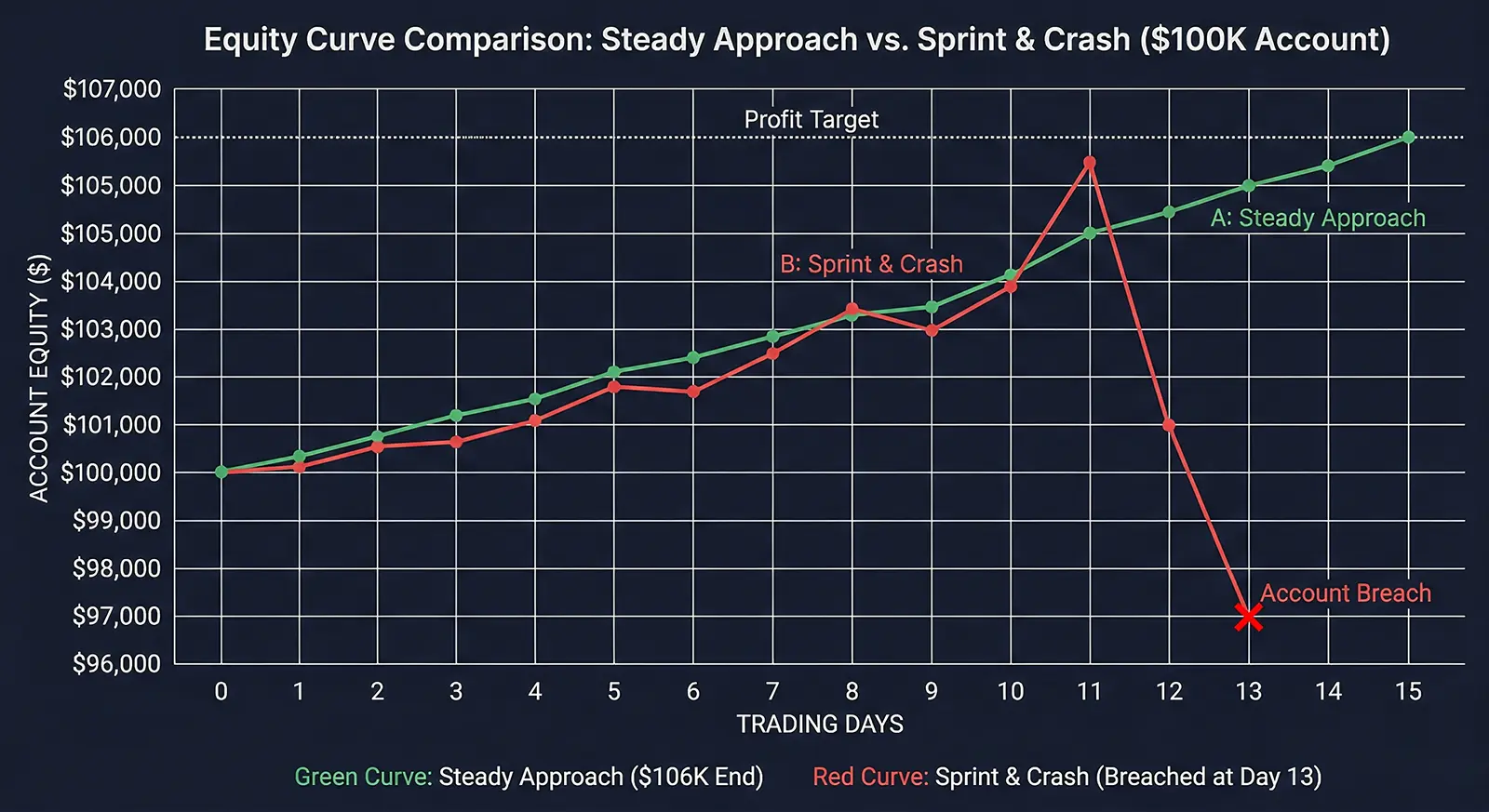
The closer you get to the target, the more important it is to trade normally. If anything, trade smaller near the finish line. You've already done the hard work. Don't throw it away trying to sprint the last 100 meters.
Metals Restrictions
If you trade gold futures (GC) or silver (SI), check whether they're available. As of early 2026, Apex Trader Funding suspended all metals futures due to extreme market volatility. If your strategy depends on metals, you'll need to use a different firm or adapt to other instruments.
Picking the Right Firm for Your First Evaluation
The firm you choose affects your pass rate almost as much as your trading. Here are some factors to compare accross some famous companies:
|
Factor |
Apex Trader Funding |
Topstep |
FTMO |
|
Evaluation Type |
1-step |
1-step (Trading Combine) |
1-step or 2-step |
|
Drawdown |
EOD trailing or Intraday trailing (your choice) |
EOD trailing |
EOD trailing (1-step) or Static (2-step) |
|
Min Trading Days (Eval) |
None (pass in 1 day) |
2 days |
4 days (1-step), 4 days (2-step Phase 1) |
|
Eval Consistency Rule |
None |
None in evaluation |
Best Day rule (1-step only) |
|
Fee Structure |
One-time fee (no monthly) |
Monthly subscription |
One-time fee |
|
Markets |
CME Futures |
CME Futures |
Forex, Indices, Commodities (no futures) |
For futures traders who want simplified rules and a one-time fee (no monthly subscription during evaluation), Apex Trader Funding is worth a close look. Their March 2026 overhaul eliminated a lot of the complexity that used to trip traders up.
📌 You can read our full Apex Trader Funding review for a detailed breakdown.
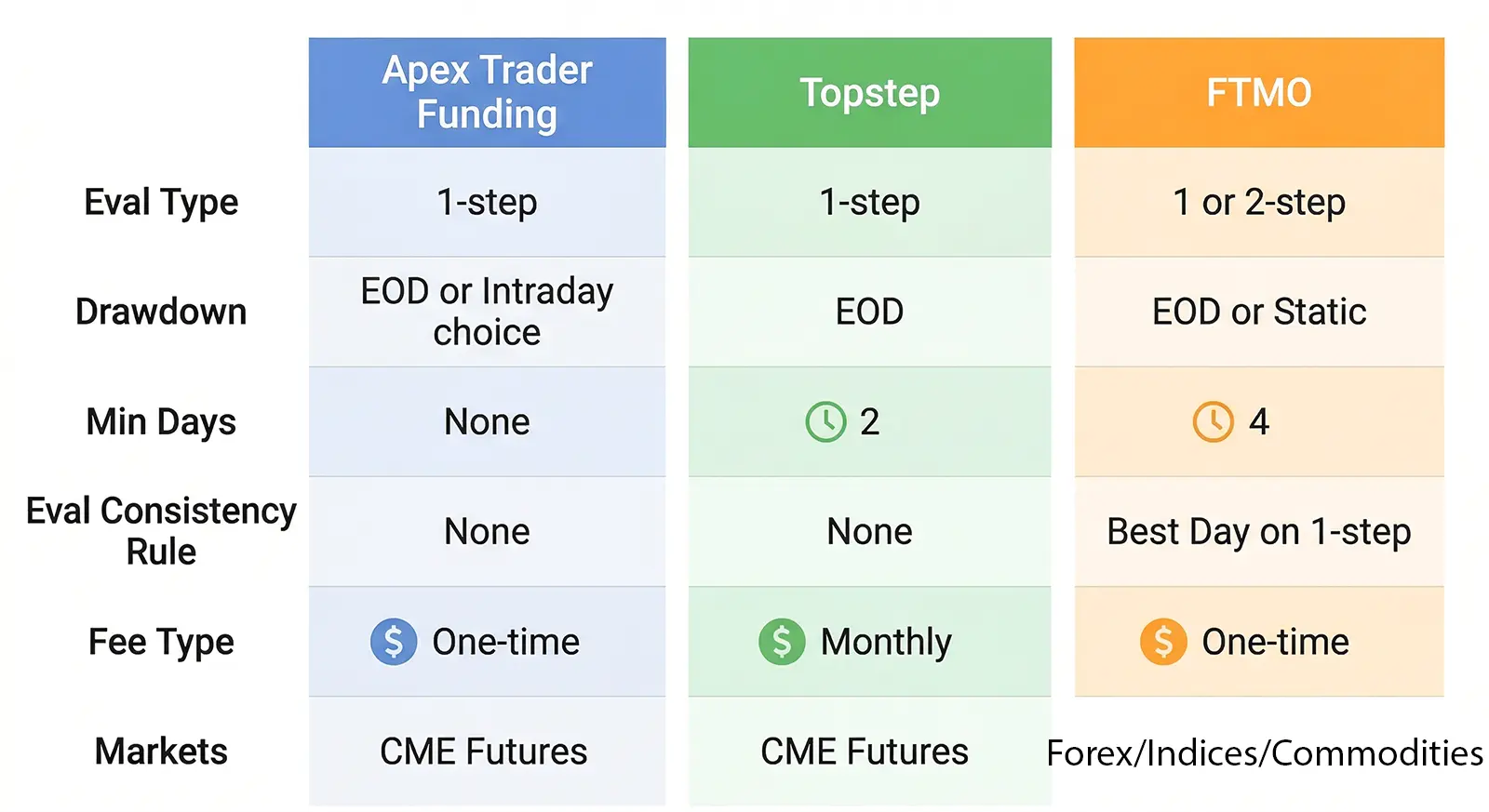
If you prefer EOD trailing drawdown without having to choose, Topstep has been using that model for years. We have tested the brand and created a Topstep review if you want to compare.
Forex traders should look at FTMO, which offers both 1-step and 2-step paths with a proven track record going back to 2015. Check out our FTMO review for full details.
📌 Compare all the firms side by side on our prop firm rankings page.
The 5 Most Common Evaluation Mistakes
|
Mistake |
What to Do Instead |
|
1. Trading too large from day one |
Start at 50% of max position size. Scale up only after building a profit buffer. |
|
2. Not understanding the drawdown type |
Read the firm's drawdown rules page. Paper trade for 2-3 days to see how the threshold moves. |
|
3. Revenge trading after a loss |
Set a personal daily loss cap. When you hit it, you're done for the day. No exceptions. |
|
4. Switching strategies mid-evaluation |
Pick one setup before you start. Trade only that setup for the entire evaluation period. |
|
5. Sizing up near the profit target |
Trade the same size (or smaller) as you approach the target. The last 20% of the target is where most accounts die. |
Your Pre-Evaluation Checklist
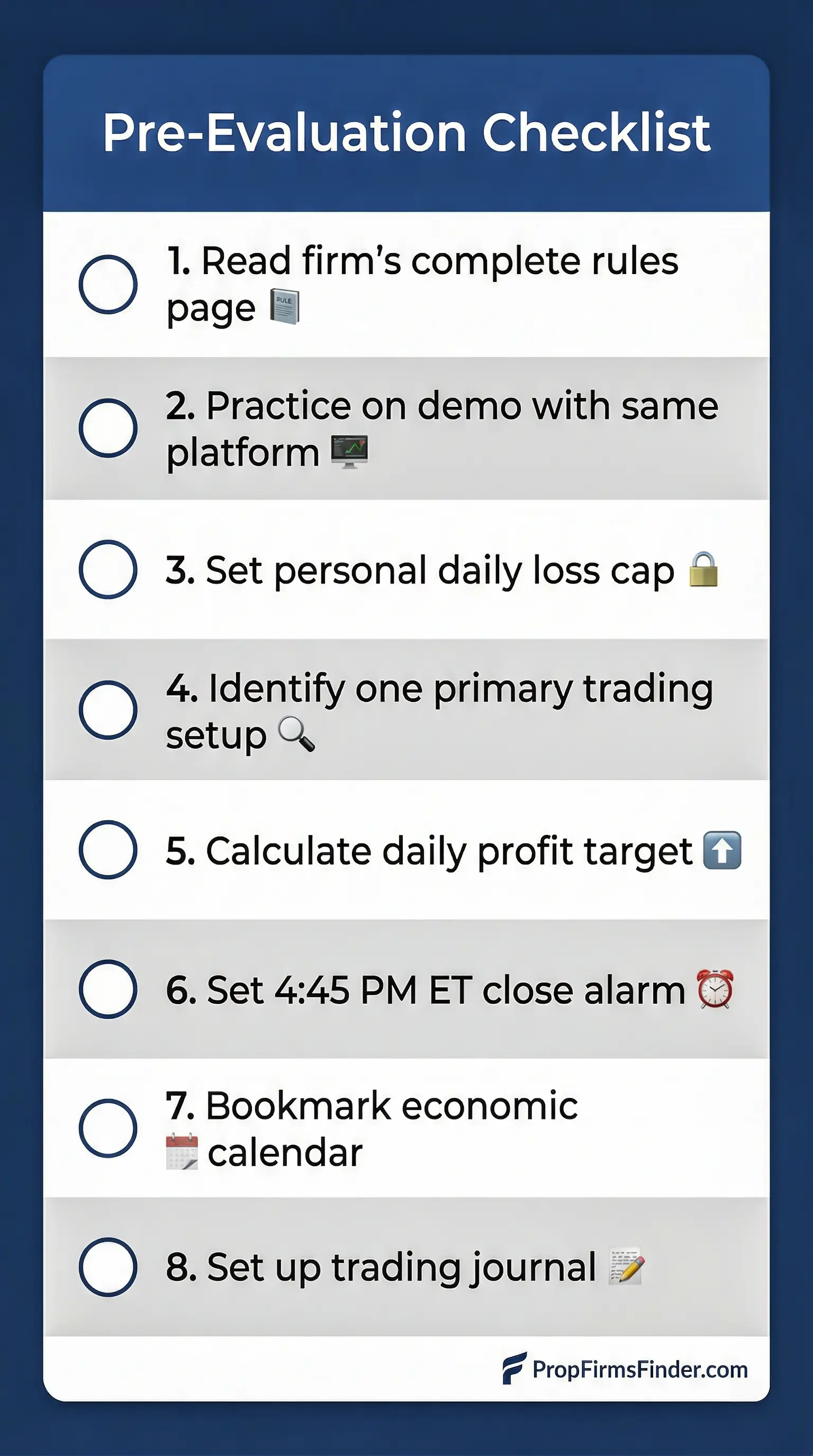
Before you pay for any evaluation, run through this, you can download the image above with the checklist we have done for you:
|
Done? |
Item |
|
🔲 |
Read the firm's complete rules page (drawdown type, daily loss limit, trading hours, position limits) |
| 🔲 |
Practiced on a demo/sim account using the same platform (NinjaTrader, Tradovate, TradingView, MT5, etc.) |
| 🔲 |
Set personal daily loss cap (tighter than the firm's limit) |
| 🔲 |
Identified your one primary trading setup |
| 🔲 |
Calculated daily profit target ($target / 22 trading days = daily goal) |
| 🔲 |
Set 4:45 PM ET alarm for position close (futures) or relevant close time for your market |
| 🔲 |
Bookmarked the economic calendar for the evaluation period |
| 🔲 |
Set up a trading journal (spreadsheet or platform-based) |
Frequently Asked Questions About Evaluations
How long does it take to pass a prop firm evaluation?
It depends on your daily profit target and consistency. On a $100K account with a $6,000 target and 30-day window, making $300/day would get you there in 20 trading days. Some firms (including Apex Trader Funding) allow you to pass in a single day if you hit the target without breaching any rules. But data from Funded Trading Plus suggests that evaluations completed in 45-60 days show lower subsequent failure rates than those passed in under 30 days.
Do I need a lot of experience to pass?
You need enough experience to have a consistent setup and reliable risk management. If you're still experimenting with strategies, spend more time on a demo account first. An evaluation is not the place to learn. It's the place to prove what you already know.
Should I trade during high-impact news events?
Check your firm's rules first. Even if they allow it, news events create the kind of fast moves that can eat through trailing drawdown in seconds. During an evaluation, the safe play is to go flat before major releases.
Is trailing drawdown or EOD drawdown better for evaluations?
EOD drawdown has a meaningfully higher pass rate. Phidias, a futures prop firm, reported that their EOD accounts pass at an 83% higher rate than intraday trailing accounts. That tracks with what we've seen across the industry. EOD is more forgiving because intraday equity swings don't affect your threshold.
What happens if I fail?
At most firms, you buy a new evaluation and start over. There are no resets or second chances within the same evaluation. Some firms offer discounted retries or promotional pricing for returning traders. The cost of failing is real, so treating the evaluation with the right amount of seriousness from day one saves money in the long run.
What is a prop firm evaluation?
A prop firm evaluation is a structured test where you trade a simulated account under specific rules (profit targets, drawdown limits, position size caps). If you pass, the firm gives you access to a funded account where you trade with their capital and keep a share of the profits. Want to learn more about how prop firms work? Check out our what is a prop firm guide.
The Short Version
Passing a prop firm evaluation is about discipline, not brilliance. Size down. Set personal limits. Trade one setup. Don't rush the target. And read the rules before you do anything else.
The traders who pass aren't usually the ones with the best strategies. They're the ones who treat the evaluation like a job, show up every day with a plan, and don't deviate from it when things get uncomfortable.
If you're looking for the right firm to start with, you can check out our best futures prop firms and forex prop firms comparisons pages, where we line the companies up side-by-side.