What Is a Prop Firm? A Complete Guide to Proprietary Trading Firms
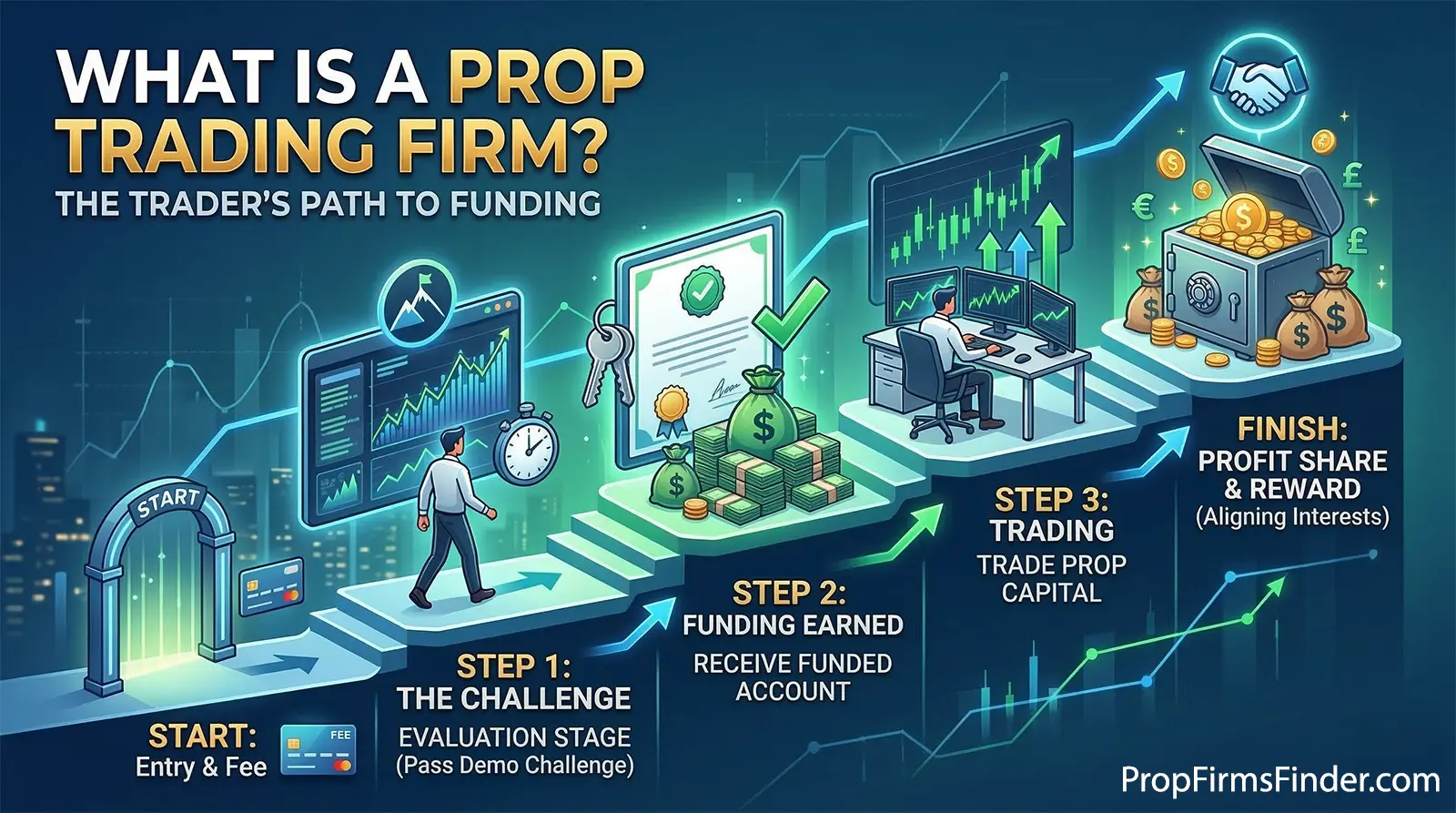
A prop firm, short for proprietary trading firm, is a company that funds traders with its capital in exchange for a share of the profits. Traders pass an evaluation to access a funded account and keep 70 to 90 percent of their gains.
What Is a Prop Firm?
A proprietary trading firm (prop firm) is a company that provides its own trading capital to individual traders. This means that the firm puts up the money needed to invest, and the trader provides the skill. The profits made are split between both of them, typically 70% to 90% in the trader's favor.
The term "proprietary" means the firm trades with its own capital, not client funds. This is the key legal and structural distinction between a prop firm and a broker. Brokers execute trades on behalf of clients using client money. Prop firms allocate their capital to traders who have demonstrated the ability to manage risk.
The modern retail prop firm model works differently from traditional institutional prop trading. Institutional firms like Jane Street or Citadel hire traders as employees, give them access to advanced technology, and trade strategies like high-frequency trading and statistical arbitrage. Retail prop firms open the door to anyone who can pass an evaluation challenge. You pay a fee, prove your trading ability on a simulated account, and earn access to a funded account if you pass.
This retail model is what most traders mean when they say "prop firm" in 2026. The industry has grown rapidly. Google Trends data shows that search interest in "prop firm" grew over 600% between 2020 and 2024. An estimated 2,000+ prop firms operate globally, with the industry valued at roughly $20 billion.
How Do Prop Firms Work?
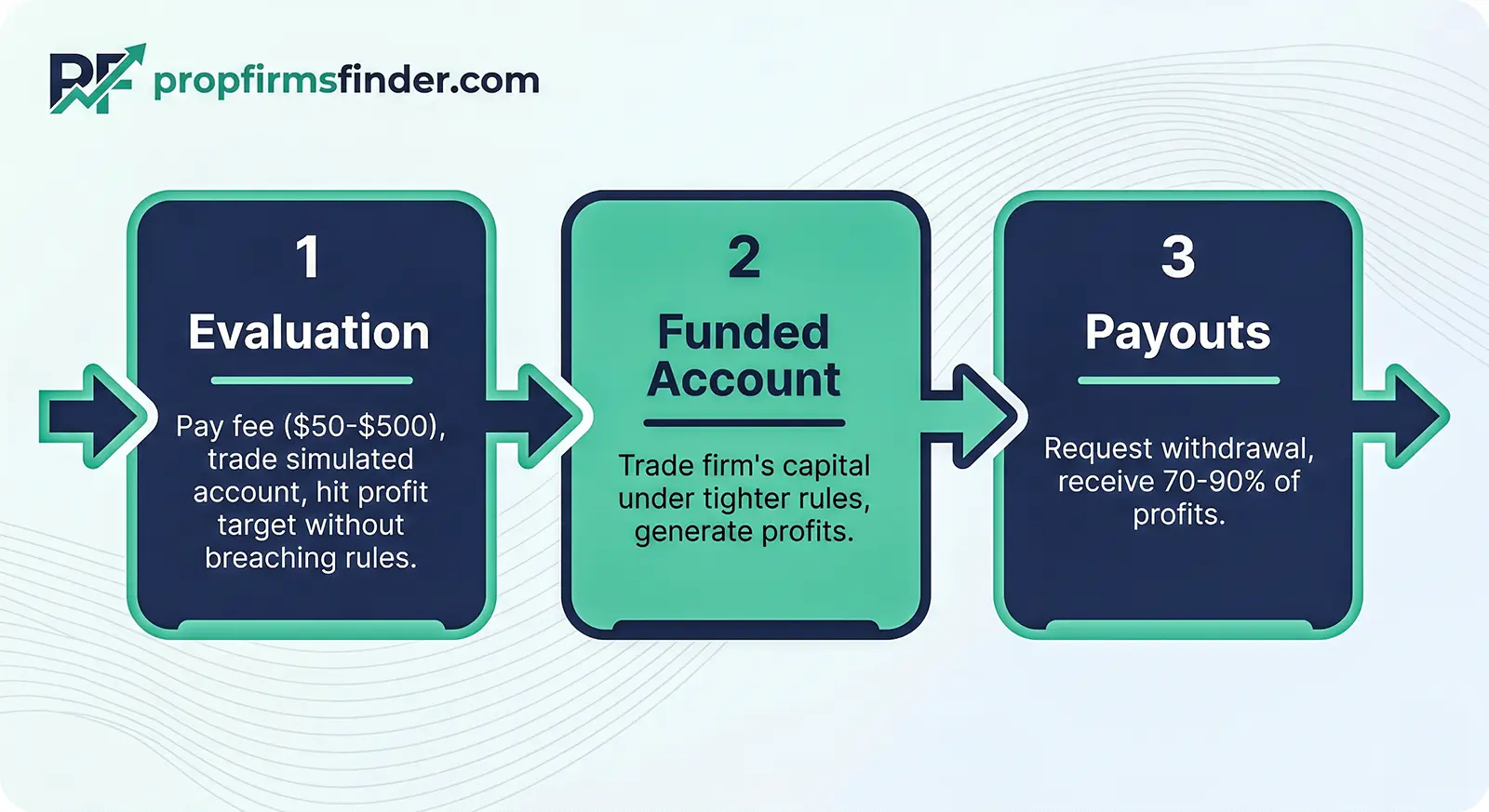
In this section, we explain how the Prop Firms work. The standard prop firm model has three stages: evaluation, funded trading, and payouts.
The Evaluation Phase
This phase consists of paying a fee of typically $50 to $500, depending on the account size, to attempt a trading challenge. Once you buy the challenge or evaluation, the firm gives you a simulated account with a set balance, usually $25,000 to $200,000.
There's a wide variety of account sizes depending on the firm's plans. Some companies offer accounts with set balances of $2,000, $ 5,000, and $10,000.
Objective: Your job is to hit a profit target (commonly 6-10% of the account balance) without breaching the firm's risk rules.
Risk rules during evaluations typically include a maximum drawdown limit and sometimes a daily loss limit. Some firms add a minimum number of trading days, while others let you pass in a single session.
Evaluations come in different structures. One-step evaluations have a single phase, and Two-step evaluations split the test into a challenge phase and a verification phase with different profit targets. Some firms offer instant funding with no evaluation at all, though these tend to have stricter rules once you're funded.
⚠️ Note on pricing: Evaluations and Challenges can have a one-time fee or a monthly fee. Your choice will depend on what's most convenient for you.
The Funded Phase
At this stage, you have already passed the evaluation and will have a funded account in your hands to start trading. You trade the firm's capital under a specific set of rules: drawdown limits, position size caps, and sometimes consistency requirements that govern how evenly your profits must be distributed.
Funded accounts are where payouts come from. The rules are often tighter than during the evaluation phase, for example: contract limits may be reduced, daily loss limits may change, new rules like payout ladders or scaling plans may apply.
✅ Pro Tip: Before investing, make sure you understand the rules during challenges and how these rules change once funded. Make sure the program matches your trading needs in both phases.
The Profit Split: A Deal Between You and The Firm
When you generate profit on a funded account, the money is split between you and the firm. The standard range is 70% to 90% in the trader's favor, with some firms offering 100% on the first portion of profits. For example, Apex Trader Funding offers 100% on the first $25,000 per account.
What happens when it's time to withdraw?
Payouts happen on a set schedule. Some firms pay weekly, and others pay bi-weekly or monthly. The minimum payout amounts vary ($200 to $1,000 at most firms).
Regarding the payment methods, they vary across firms but in general, they include bank transfer, Deel, Rise, PayPal, and cryptocurrency.
Prop Firms vs. Brokers vs. Hedge Funds
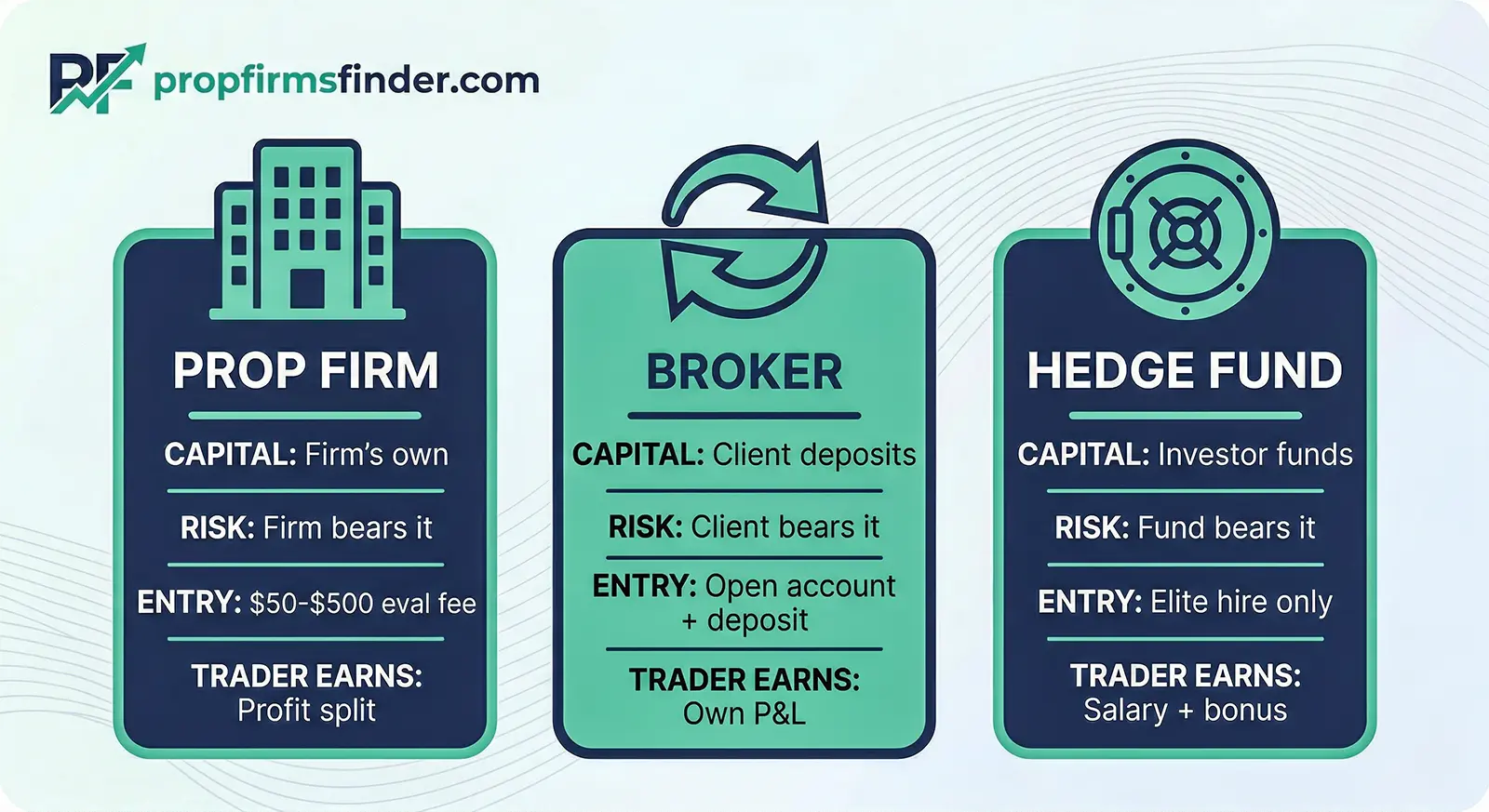
These three are often confused. Here's how they differ:
|
Factor |
Prop Firm |
Broker |
Hedge Fund |
|
Capital source |
Firm's own capital (or simulated equivalent) |
Client deposits |
Investor funds (LPs) |
|
Who takes market risk? |
The firm |
The client |
The fund (and investors) |
|
How the trader earns |
Profit split (70-90%) |
Own P&L minus fees |
Salary + performance bonus |
|
Entry requirement |
Pass evaluation ($50-$500 fee) |
Open account, deposit funds |
Hired as employee (elite credentials) |
|
Regulation |
Minimal (most are unregulated) |
Heavily regulated (FCA, CFTC, ASIC, etc.) |
Regulated (SEC, FCA) |
What's the critical difference? When you trade with a broker, you risk your own money. When you trade with a prop firm, you risk the firm's capital or a simulated version of it. That's the core value proposition of prop trading.
Types of Prop Firms
The type of Prop Firm depends on the assets available. In each of our reviews, we have dedicated sections and descriptions so you know the tradable instruments they have. Now, read on about each type of Prop Firms available.
Futures Prop Firms
These firms fund traders to trade CME Group futures contracts: equity indexes (ES, NQ), commodities (crude oil, natural gas), bonds, and currencies. Futures prop firms are the largest segment of the retail prop industry by trader volume.
The accounts typically range from $25,000 to $300,000. Major firms in this space include Apex Trader Funding, Topstep, My Funded Futures, Tradeify, and Earn2Trade.
📌 See our full futures prop firms comparison for detailed breakdowns.
Forex Prop Firms
Forex prop firms fund traders on currency pairs, indices, commodities, and sometimes crypto CFDs. They typically use MetaTrader 4/5, cTrader, or DXtrade.
The account sizes range from $10,000 to $200,000. FTMO, The 5%ers, and Alpha Capital Group are among the most established in this space.
Check some of our reviewed companies:
- E8markets: It offers a forex account called E8 Signature.
- FTMO: It offers 3 accounts to trade forex and 44+ currency pairs including majors, minors, and exotics.
- Funded Trading Plus: It is major Forex Prop Firm where the profit split reaches 100%.
Stock Prop Firms
These firms are part of a smaller segment. Some firms offer funded accounts for stock trading, though the model is less standardized than futures or forex. Trade the Pool is one example that focuses on equities.
Crypto Prop Firms
A few firms offer evaluations specifically for cryptocurrency trading. Breakout is one of the better-known options. Just take into consideration that this segment is newer and less established than futures or forex.
Some alternatives we reviewed for you:
- Crypto Fund Trader: It offers over 715 crypto pairs and Bybit integration.
- Goat Funded Trader: Cryptos are offered along with FX pairs, CFD indices, metals, commodities, stocks, and ETFs.
Multi-Asset Prop Firms
Some firms offer access to multiple asset classes on a single account. FTMO, for example, supports forex, indices, commodities, and crypto. This gives traders flexibility to trade across markets without separate evaluations for each.
How Much Does a Prop Firm Cost?
The price of plans and programs depends very much on the firm. In our research, we found affordable plans and other more expensive options. Take a look at our list of firms and compare the starting prices:
- Apex Trader Funding fees start at around $180.
- Plans at Maven start at $15, and the Instant funding alternative is $62.
- At FTMO, fees start at $69 for a $10K account.
✅ Check our promo codes and discounts page. You can buy challenges and get funded for less.
Evaluation Fee
The evaluation fee is the upfront cost to attempt a challenge. Across the firms in our database, evaluation fees for a $50,000 account range from about $150 to $350. For a $100,000 account, fees range from $200 to $550.
📌 What's important to notice is that some firms charge a one-time fee and others charge a monthly subscription that recurs until you pass or cancel.
Activation Fee
Some firms charge a separate fee when you pass the evaluation and activate your funded account. This ranges from $0, because several firms have eliminated activation fees, to $130, depending on the firm and account size.
📌 Note: This is a cost that many traders overlook when comparing firms. Check our full list of prop firms, compare prices, and activation fees before investing. Don't forget to read the full reviews too; this will help you understand the offers, prices, and values.
Data and Platform Fees
Futures traders need real-time market data, which costs $55 to $135 per month, depending on the platform (NinjaTrader, Tradovate, Rithmic). Some firms include data in their evaluation fee. Others charge it separately. Forex traders using MT4/MT5 or cTrader generally don't pay separate data fees.
Total Cost of Funding
The true cost of getting funded is not the evaluation fee alone. It's the evaluation fee + activation fee + data fees + failed attempts. If you fail an evaluation twice before passing on the third try, your total cost is three evaluation fees plus one activation fee plus ongoing data costs.
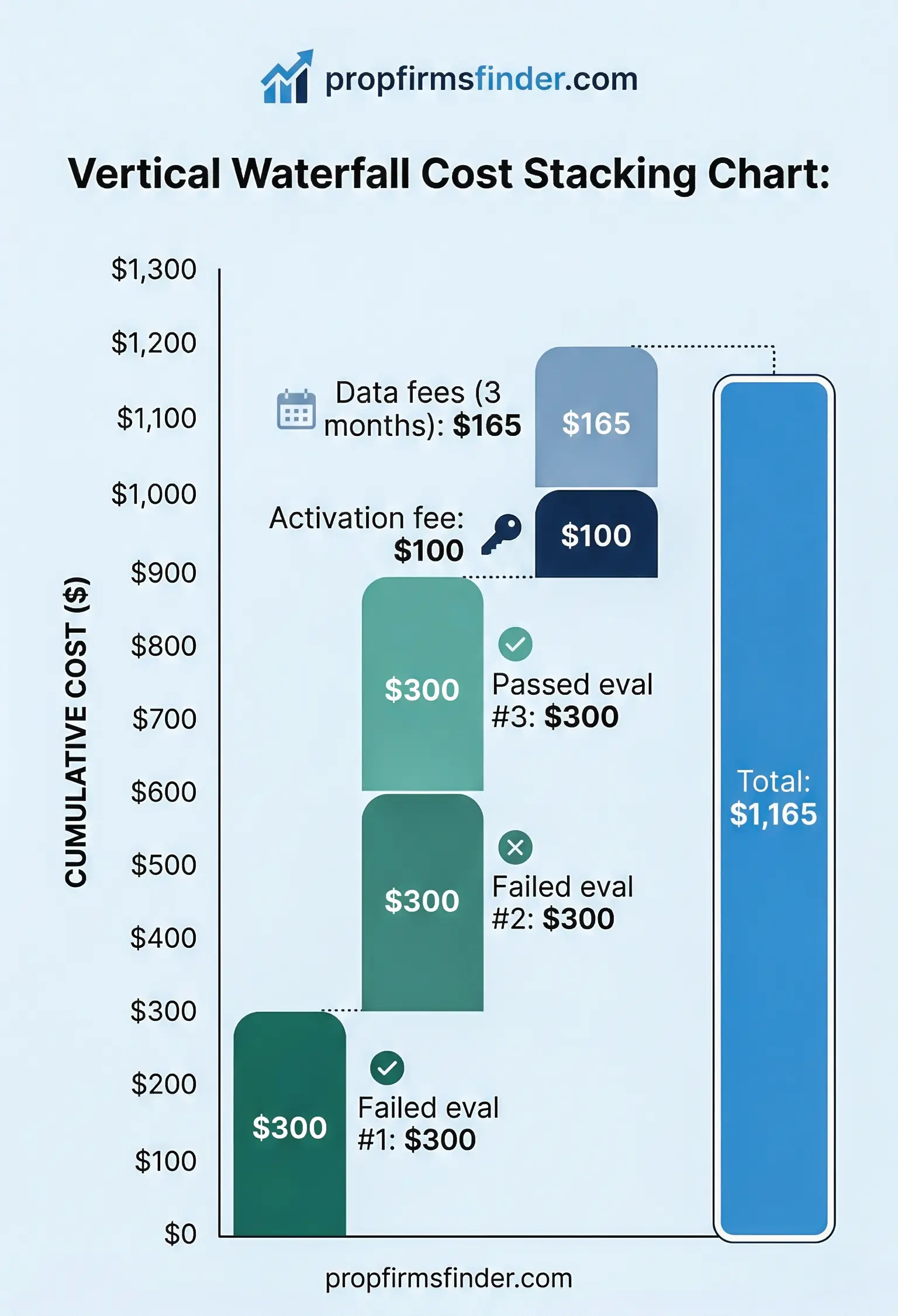
On a $100K futures account, a realistic total cost to reach funded status might look like: 2 failed evaluations ($300 each) + 1 passed evaluation ($300) + activation fee ($100) + data fees for 3 months ($165) = $1,165. That's a meaningful number, and it's worth calculating before you start.
The graphic below aims to help you calculate the real costs of funded trading:
What Rules Do Prop Firms Have?
If you are thinking about putting your trading skills to work by using a prop firm's money, you must be aware of its rules. After testing +50 prop firms in the market, we'll highlight below the most important rules and elaborate on them in the following sections:
- The "Risk" rule: It involves different Drawdown limits, which measure when your account is "blown". Companies offer accounts with Intraday trailing, EOD, or Static drawdowns.
- Consistency rule: The consistency rule states that no single day can account for more than X% of the total profit target. Prop Firms usually apply a 30% or 40% consistency rule.
- Minimum Trading days: The minimum trading days to qualify for a funded account.
Let's dive now into these rules and some others that are crucial. Understand them first, trade later.
Daily Loss Limit
This is the maximum amount, or the cap on how much you can lose in a single trading session. If you hit the daily loss limit, your trading pauses for the day. At some firms, breaching this limit fails the evaluation entirely. At others (like Apex Trader Funding's EOD accounts), it pauses trading but doesn't end the account.
Some firms don't have a Daily Loss Limit rule. They don't enforce it. We found that this is an advantage since it gives you freedom. You can have more negative days without losing the account.
Maximum Drawdown
The total amount your account can withdraw from its starting balance (or peak balance, depending on the firm) before the account is terminated. This is the most important rule at every firm. The typical maximum drawdown ranges from $2,000 to $6,000 on a $100,000 account.
Drawdown Types: Trailing, Static, and End-of-Day
Not all drawdowns are calculated the same way:
- Static drawdown is a fixed floor that never moves.
- Trailing drawdown moves up as your account grows, but never moves back down.
- End-of-day trailing only recalculates at market close, while intraday trailing updates in real time during the session.
The drawdown type your firm uses changes everything about how you manage risk. We cover the differences in detail in our trailing drawdown comparison.
Consistency Rules
Some firms limit how much of your total profit can come from a single trading day. At Apex Trader Funding, no single day can account for 50% or more of your total net profit when requesting a payout. Other firms use 30% or 20% thresholds. Some firms have no consistency rule at all.
Minimum Trading Days
Some evaluations require you to trade a minimum number of days before you can pass. This ranges from zero (Apex Trader Funding allows passing in a single day) to 10+ days at some firms. Minimum trading days also apply to payout requests at the funded stage.
How Do Prop Firms Make Money? The Honest Answer
The honest answer: primarily from evaluation fees paid by traders who don't pass.
Industry data from FPFX Tech, which analyzed 300,000+ prop accounts across 10 firms, shows that only about 14% of traders pass their evaluation, and only 7% ever receive a payout. That means the large majority of evaluation fees go to traders who never reach the funded stage.
Successful prop firms also earn from the profit split on funded accounts. This means that they keep 10-30% of the trader profits, activation fees, and data feed markups. But the core revenue engine is evaluation volume.
This is not inherently wrong. For example, gyms make money from members who don't show up. The model works as long as the firm also pays traders who do perform.
Are Prop Firm Accounts Real or Simulated?
This is one of the most important things to understand about modern prop firms, and the industry is not always transparent about it.
The majority of retail prop firms in 2026 use simulated capital. Your funded account trades on a demo server, not the live market. The firm's risk is limited to the payouts it sends you, not to market exposure from your trades.
Yes, payouts are real money. When you hit a profit target and request a withdrawal, you receive actual cash via bank transfer, Deel, Rise, or cryptocurrency. But the trading itself happens in a simulated environment at most firms.
A small number of firms do route live orders. These tend to be older, larger operations. But the industry trend since 2022 has been toward simulated accounts with real payouts. This is worth knowing before you sign up.
Live Accounts: Real Capital Accounts
Not all firms do this, but some, like Apex offer a transition to a real trading account. At this point, your orders go directly to the actual exchange. Usually, you have to hit certain established milestones to transition to a live account.
⚠️ Live account vs. Sim Accounts:
The key difference is that now you have the pressure of trading under real market conditions: Real execution with real slippage, the profit split often changes (e.g., 90/10 on sim → 80/20 on live), there are no payout caps, the daily payouts may become available, plus the psychological pressure increases significantly.
Who Should Use a Prop Firm?
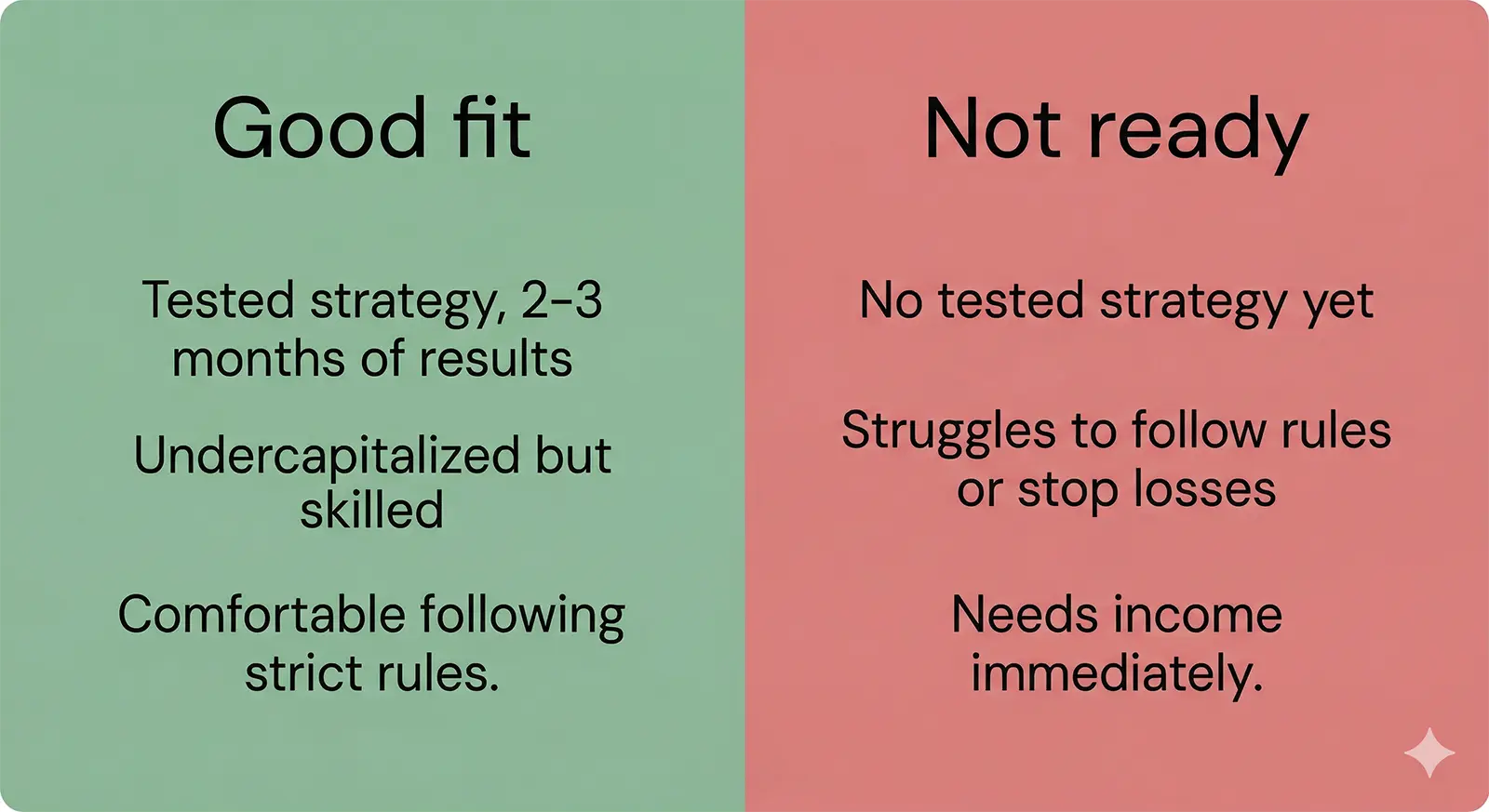
Prop firms are a good fit if you have a tested trading strategy that produces consistent results, but you don't have the personal capital to trade meaningful position sizes. A trader with a proven edge on a $2,000 personal account is limited by size. That same edge applied to a $100,000 funded account produces much larger returns.
Prop firms also work well for traders who want to separate their trading capital from their personal savings. If your strategy has an edge but you're uncomfortable risking $50,000 of your own money, a $300 evaluation fee is a much lower-risk way to access that capital.
Who Should NOT Use a Prop Firm?
If you don't have a tested strategy that you've traded for at least 2-3 months on a demo or small live account, a prop firm evaluation is not the place to learn. The 5-15% pass rate exists because most traders attempt evaluations before they're ready.
If you struggle to follow rules, prop firms will punish you. Every firm has specific constraints that we mentioned above: drawdown limits, daily loss caps, position close deadlines, and sometimes consistency requirements. If you frequently move stop losses, revenge trade after losses, or overtrade when the market is slow, you will fail evaluations regardless of your trading ability.
If you need money right now, prop firms are not a quick-money path. Between the evaluation period (1-60 days), the funded trading period, and the payout cycle (5-14 days after requesting), it can take weeks or months from your first trade to your first dollar of income.
How to Choose a Prop Firm
The right firm depends on what you trade, how you trade, and what rules you can tolerate.
Start with the asset class. If you trade futures, you need a futures-focused firm. If you trade forex, you need a firm that supports MT4/MT5 or cTrader. The overlap between these categories is minimal.
Then compare on the factors that affect your pass rate: drawdown type (trailing vs. static vs. EOD), daily loss limit, minimum trading days, consistency rules, and fee structure (one-time vs. monthly).
Finally, check the firm's payout track record. Look at Trustpilot reviews, Reddit discussions, and independent payout tracking. A firm with thousands of positive reviews over several years is a safer choice than a new firm with aggressive pricing but no track record.
📌 You can also start by reading our detailed reviews and tests. We try and compare the top firms across all of these factors on our best prop firms rankings page.
Frequently Asked Questions
Is prop trading legal?
Yes. Proprietary trading is legal in all major jurisdictions. Retail prop firms that use simulated accounts are generally not regulated as financial institutions because they are not managing client funds or providing investment advice. Firms that route live orders may fall under specific regulatory requirements depending on the jurisdiction.
Do prop firms pay out?
Established firms do, yes. FTMO, Apex Trader Funding, Topstep, and several others have publicly documented payout totals in the hundreds of millions of dollars. Newer or smaller firms carry more risk. Before choosing a firm, check independent reviews for payout complaints.
How much can you make with a prop firm?
It depends on your account size, profit split, trading performance, and how many accounts you run. A trader making 5% per month on a $100,000 account with a 90% profit split earns $4,500. Some firms allow up to 20 simultaneous accounts. The ceiling is high, but the median outcome is much more modest, and most evaluation attempts end in failure.
Can you make a living from prop trading?
Some traders do. It requires consistent profitability, multiple funded accounts, and the discipline to follow firm rules month after month. It is not passive income and it is not guaranteed. Treat it as a business with real costs (evaluation fees, data fees, failed attempts) and uncertain revenue.
What happens if you break a rule?
It depends on the rule. Breaching the maximum drawdown typically ends the account immediately. Hitting a daily loss limit pauses trading for the day at some firms, or fails the account at others. Breaking a consistency rule delays your payout but does not terminate the account at most firms. Always read the specific consequences for each rule before trading.
Are prop firms a scam?
The established firms with years of operation and verified payout histories are not scams. They run a legitimate business where they profit from evaluation fees and profit splits. The concern is valid for newer firms with no track record, aggressive marketing, and no public payout proof. Between 2023 and 2024, an estimated 80 to 100 prop firms shut down. Due diligence matters. Check Trustpilot, Reddit, and independent review sites before spending money