Prop Firm Hedging Rules: What's Allowed, What's Banned, and Why the Rules Are So Confusing
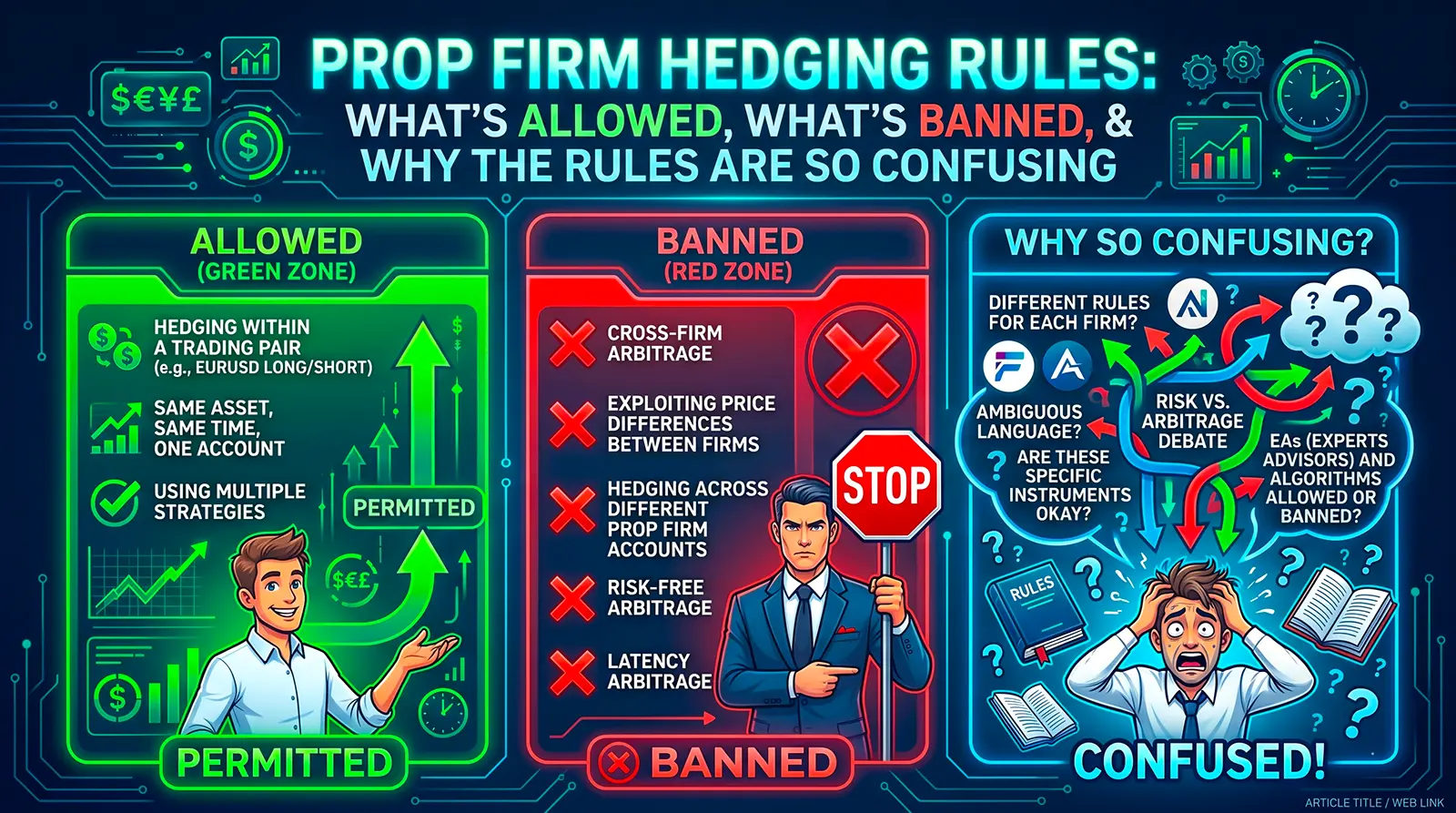
Most prop firms allow same-account hedging (offsetting positions on one account) but ban hedging across multiple accounts at the same firm. Cross-firm hedging is harder to detect but violates most firms' terms. Pair trading with correlated instruments is generally allowed as a legitimate strategy.
What Is Hedging in Trading?
Hedging means opening a position that offsets the risk of another position. If you're long EUR/USD and you open a short EUR/USD of the same size, your net exposure is zero. Whatever one position gains, the other loses. Your account balance stays flat regardless of where the market goes.
In prop trading, the word "hedging" causes more confusion than almost any other rule. The reason: it means at least four different things depending on context, and firms treat each type completely differently. A trader who hedges within one account is following a legitimate risk strategy. A trader who hedges across two accounts to guarantee one passes is gaming the system.
This page untangles those categories. If you read nothing else, read the next section.
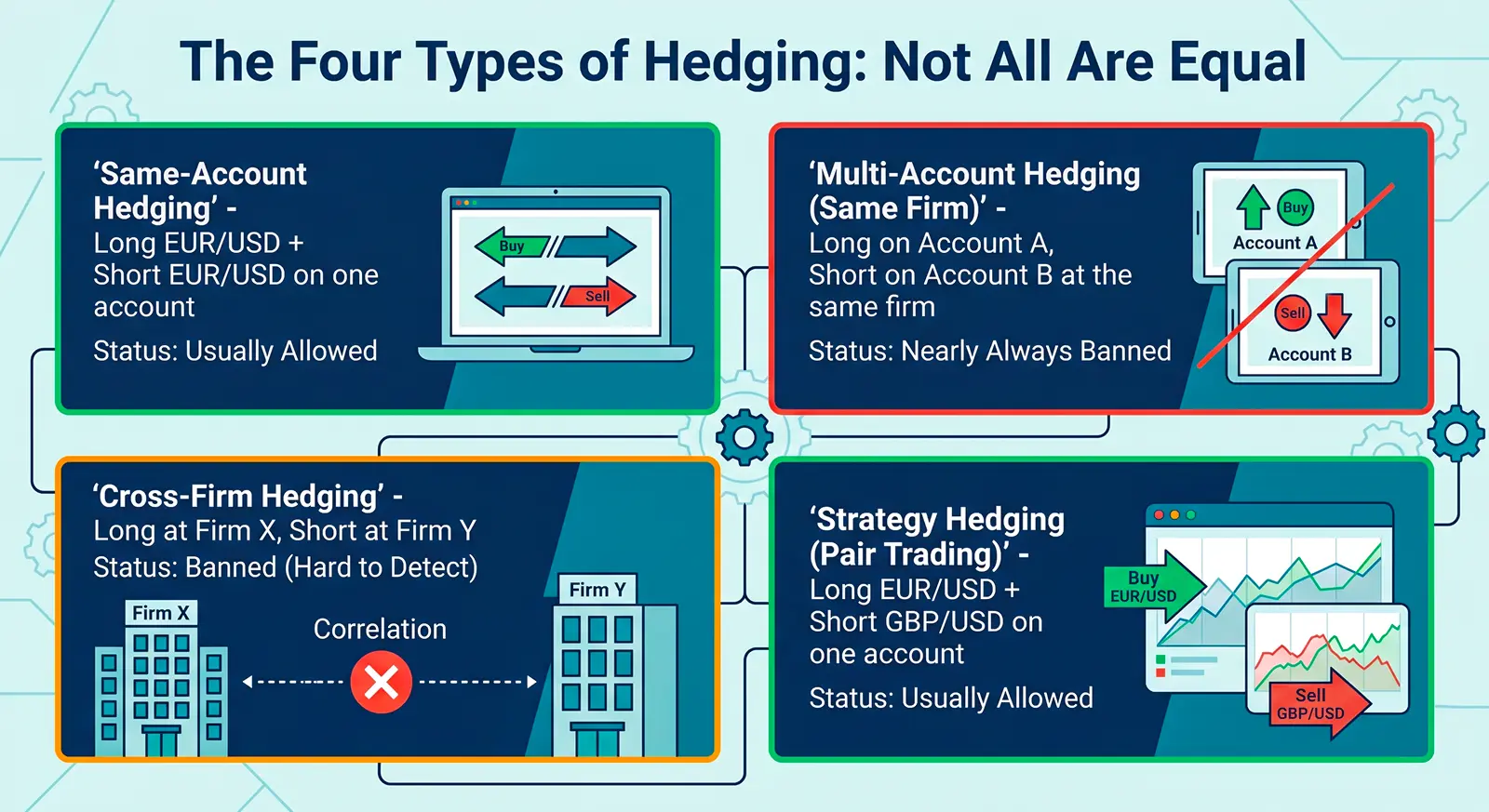
The Four Types of Hedging in Prop Trading
Before checking any firm's rules, you need to know which type of hedging you're asking about. The answer to "is hedging allowed?" depends entirely on which type.
Type 1: Same-Account Hedging
Opening offsetting long and short positions on the same instrument within a single funded trading accounts. You buy 1 lot EUR/USD and sell 1 lot EUR/USD on the same account. Both positions exist simultaneously.
Status: Allowed at most firms. BrightFunded, FTMO, FundedNext, The 5%ers, and most others permit same-account hedging. Some platforms require "hedging mode" to be enabled (as opposed to "netting mode" where opposite positions cancel out).
Why firms allow it: Same-account hedging is a legitimate risk management tool. It doesn't game the evaluation because both positions live on the same account. The drawdown still applies to the net result.
Type 2: Multi-Account Hedging (Same Firm)
Running opposite positions on two accounts at the same firm. Account A goes long EUR/USD. Account B goes short EUR/USD. The market moves. One account profits, the other loses. The trader keeps the profitable account and lets the losing account blow.
Status: Banned at virtually every firm. This is the single most universally prohibited practice across the prop firm industry.
Why firms ban it: It guarantees one account passes without the trader demonstrating any market skill. The trader pays two evaluation fees (e.g., $500 total), loses one ($250), and gains a funded account worth $50,000-$200,000 in virtual capital. The expected value is massively positive for the trader and negative for the firm.
Type 3: Cross-Firm Hedging
The same pattern as multi-account hedging, but spread across different firms. Long at Firm A, short at Firm B. One wins, one loses.
Status: Banned in the terms of most firms, though harder to detect. Some firms have begun sharing trader data through third-party risk management services to identify cross-firm coordination. Getting caught results in account termination and permanent ban.
Type 4: Strategy Hedging (Pair Trading)
Using correlated or inversely-correlated instruments to offset directional risk. Long EUR/USD and short GBP/USD to reduce dollar exposure. Long gold and short silver to trade the ratio. These aren't direct hedges because the instruments are different, so the offset is imperfect.
Status: Generally allowed as a legitimate trading strategy. Firms don't consider this "hedging" in the banned sense because it requires genuine market analysis and carries real directional risk.
Why Prop Firms Regulate Hedging
Preventing Guaranteed Evaluation Passes
Multi-account hedging turns the evaluation from a test of skill into a coin flip where the trader wins regardless of the outcome. One account passes, one fails. The trader's only cost is the losing account's evaluation fee, which is typically $100-$500. The winning account provides access to $50,000-$200,000 in simulated capital.
Blocking Risk-Free Arbitrage
Opposite positions across two accounts create a synthetic guaranteed outcome. No matter which way the market moves, one account profits. This isn't trading. It's an arbitrage against the firm's evaluation model.
Maintaining Evaluation Integrity
The evaluation exists to filter for traders who can generate consistent profits with managed risk. If traders bypass this filter through hedging schemes, the funded trader pool contains traders with no demonstrated edge. This increases the firm's payout exposure without a corresponding increase in trader quality.
Same-Account Hedging: How It Works and Why It's Allowed
Hedging Mode vs. Netting Mode
Trading platforms offer two modes: hedging mode (allows simultaneous long and short positions on the same instrument) and netting mode (opposite positions cancel each other out, reducing net exposure). Most prop firms default to hedging mode on MT5. If your platform is in netting mode, you can't same-account hedge because the platform automatically nets your positions.
Practical Uses of Same-Account Hedging
Locking in profit while waiting for a better exit. Protecting a position during a news release without closing it (related to EAs and automated trading strategies that auto-hedge around events). Scaling into a reversal while still holding the original position.
Same-account hedging is a tool, not a strategy. Use it for risk management on specific positions, not as a primary trading approach.
Multi-Account Hedging: How Firms Detect It
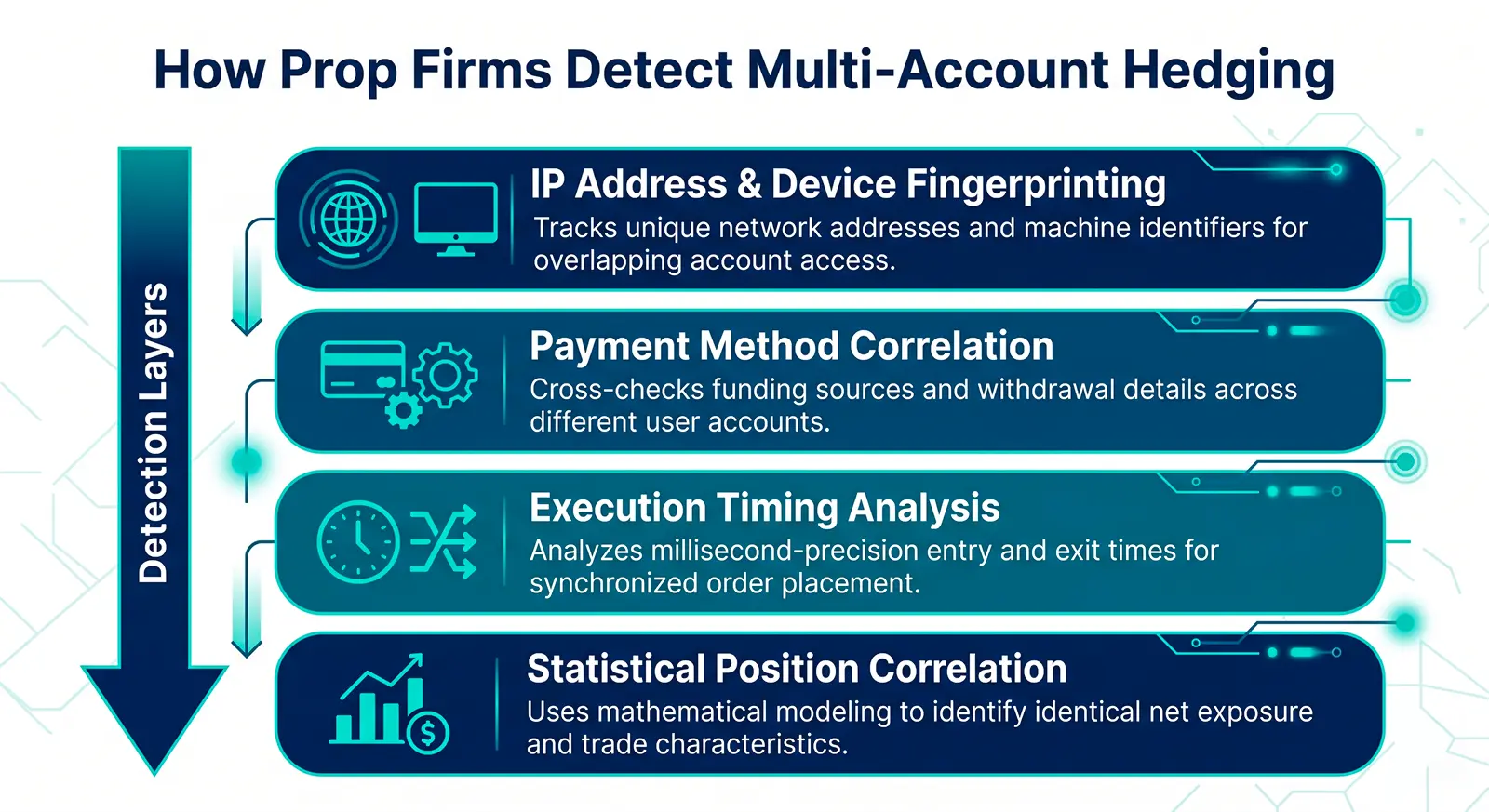
Even though multi-account hedging is banned, some traders attempt it. Firms use multiple detection layers to catch it.
IP Address and Device Fingerprinting
If two accounts access the platform from the same IP address or device, the system flags them as linked. Using a VPN or different devices doesn't fully solve this because firms also track browser fingerprints, screen resolution, and system language settings.
Payment Method Correlation
Two accounts funded with the same credit card, bank account, or crypto wallet address flag as linked. Firms cross-reference payment methods across all active accounts.
Execution Timing Correlation
If two accounts open opposite positions on the same instrument within seconds of each other, the statistical probability of this being coincidental is near zero. Detection algorithms flag accounts with opposite positions opened within a tight time window.
Statistical Position Correlation
Advanced detection goes beyond same-instrument matching. If Account A is consistently long EUR/USD every time Account B is short EUR/USD, and this pattern repeats over days or weeks, the system flags both accounts. This catches traders who try to stagger entries or use slightly different instruments.
Consequences
Both accounts are typically terminated. Profits are disqualified. The trader may be permanently banned from the firm. BrightFunded's documented policy: first detection is a soft breach (warning + all trades closed). Second detection is a hard breach (permanent account closure).
Cross-Firm Hedging: The Gray Zone
Why Traders Attempt It
Cross-firm hedging is harder to detect because the two firms don't share the same platform, the same login, or the same payment system. Traders believe the separation makes detection impossible.
Why It's Getting Riskier
Firms are increasingly using third-party risk management services that aggregate trader data across multiple prop firms. Shared liquidity providers can see the same trader placing opposite positions at different firms. Some firms explicitly state in their terms that cross-firm hedging is prohibited and that they cooperate with other firms to detect it.
The Risk of Getting Caught
If detected, all accounts at both firms are terminated. Profits are reversed. The trader is permanently banned from both firms. Even if the probability of detection is low for any single pair of trades, running the strategy repeatedly increases the probability of eventual detection.
Pair Trading and Correlated Hedging
Why Pair Trading Is Usually Allowed
Pair trading (long one instrument, short a correlated instrument) is a legitimate strategy that requires market analysis and carries real directional risk. The correlation between EUR/USD and GBP/USD isn't perfect, so the trade can lose on both sides if the correlation breaks down. This is genuine risk, not a guaranteed outcome.
When Pair Trading Gets Flagged
If you pair-trade two instruments that are 99%+ correlated (essentially the same thing), firms may treat it as a same-instrument hedge. Trading the same instrument on different timeframes or using nearly identical CFDs may also flag. The key test: does the trade carry real directional risk, or is it functionally a guaranteed offset?
How Hedging Interacts With Other Prop Firm Rules
Hedging and the Consistency Rule
If you hedge a position and then close the profitable side, the consistency rule evaluates the closed profit against your daily P&L distribution. A large hedged profit closed on one day could flag a consistency violation.
Hedging and Drawdown
Same-account hedging doesn't freeze your drawdown. While the positions are offsetting, your equity doesn't move much. But the moment you close one side, the remaining position is fully exposed. If the market has moved significantly while you were hedged, closing the losing side crystallizes the loss and your drawdown updates.
Hedging and Daily Loss Limit
If you hold a hedged position and close the losing side, the realized loss counts toward your daily loss limit. The winning side is still open and unrealized. Your daily P&L shows a loss from the closed trade even though the overall hedged position was flat.
Hedging Rules Across Major Prop Firms (April 2026)
Rules verified against each firm's publicly available terms as of April 2026. Always verify before trading.
|
Firm |
Same-Account |
Multi-Account (Same Firm) |
Cross-Firm |
Notes |
|
FTMO |
Allowed |
Banned |
Banned |
Swing accounts exempt from some restrictions |
|
FundedNext |
Allowed |
Banned |
Banned |
Strategy must be consistent across eval and funded |
|
The 5%ers |
Allowed |
Banned |
Banned |
Hedge arbitrage explicitly banned |
|
BrightFunded |
Allowed |
Banned (soft breach first, hard breach second) |
Banned |
Documented multi-step enforcement |
|
E8 Markets |
Allowed |
Banned |
Banned |
No hedging across accounts |
|
Apex Trader Funding |
N/A (futures, netting) |
Banned |
Banned |
No opposite positions across accounts |
|
Topstep |
N/A (futures, netting) |
Banned |
Banned |
Standard futures netting |
|
Tradeify |
N/A (futures, netting) |
Banned (automated 10-sec detection) |
Banned |
No mini + micro simultaneous positions |
|
My Funded Futures |
N/A (futures) |
Banned |
Banned |
No hedging of any kind |
|
Alpha Capital Group |
Allowed |
Banned |
Banned |
Standard restrictions |
The pattern: same-account hedging is allowed at every forex firm. Multi-account hedging is banned at every firm without exception. Cross-firm hedging is banned in terms at every firm, with enforcement improving. Futures firms don't support same-account hedging because CME-based platforms use netting mode (opposite positions cancel rather than coexist).
How to Trade Hedging Strategies Safely on a Prop Firm
Verify Same-Account Hedging Is Allowed
Check your firm's specific hedging policy and confirm your platform is in hedging mode (not netting mode). Most MT5-based forex firms support it by default.
Never Run Opposite Positions on Two Accounts at the Same Firm
There are no exceptions and no gray area here. Long on Account A and short on Account B at the same firm is banned. Even brief accidental overlaps (under 10 seconds at Tradeify) should be avoided. For more evaluation tactics, see our how to pass a prop firm evaluation guide.
Document Pair Trading Logic
If you use a pair trading strategy (long one instrument, short a correlated one), keep records of your analysis. If a firm questions your trades, being able to explain the pair trade logic as a legitimate strategy (with real directional risk) protects you.
Avoid Coordinating Trades With Other Traders
If you and another trader at the same firm run identical opposing trades, the system flags both accounts as coordinated. This applies even if you don't know the other person. If you use the same purchased EA or signal service, your trade patterns may be indistinguishable from coordinated hedging.
Common Hedging Misconceptions
"Hedging Is Always Allowed Because It's a Legitimate Strategy"
Same-account hedging is. Multi-account hedging is not. The word "hedging" covers both, which is why the distinction matters. The legitimacy depends on the type, not the label.
"Multi-Account Hedging Is Safe If I Use Different Devices"
Firms detect it through payment method correlation, execution timing, and statistical analysis. Different devices help with one detection layer but don't address the others.
"Pair Trading and Banned Hedging Are the Same"
Different. Pair trading uses different instruments with imperfect correlation. Banned hedging uses the same instrument with perfect offset. Pair trading carries real directional risk. Banned hedging eliminates all risk.
"If the Firm Can't Detect It, It's Not Against the Rules"
It is. The terms of service prohibit it regardless of detection. If caught at any point (even months later), profits are reversed and accounts are terminated.
"Same-Account Hedging Doesn't Count Against Drawdown"
While the hedge is active, your equity is roughly flat. The moment you close one side, the remaining position is exposed. If the market moved against you while hedged, closing the losing side crystallizes the loss and your drawdown updates instantly.
Is Hedging Worth It on a Prop Firm Account?
When Hedging Adds Value
Same-account hedging as a temporary risk management tool during volatile events. Locking in profit while waiting for a cleaner exit. Pair trading as a market-neutral strategy. These are legitimate uses that firms support.
When Hedging Creates Unnecessary Risk
Using same-account hedging as a primary strategy rather than a tool. Holding a hedge too long (swap fees accumulate on both sides). Hedging to avoid closing a losing position (the drawdown still applies when you eventually unwind).
Choosing a Firm Based on Your Hedging Strategy
If you pair trade, almost any forex firm works. If you need same-account hedging, confirm the platform is in hedging mode. If you trade futures, same-account hedging isn't available because CME platforms use netting.
Compare firms on all factors on our best prop firms rankings page.
Frequently Asked Questions
Can I hedge on a prop firm account?
Same-account hedging (offsetting positions on one account) is allowed at most forex prop firms. Multi-account hedging and cross-firm hedging are banned at every firm.
Is multi-account hedging allowed at any prop firm?
No. Multi-account hedging is banned universally. It is the most consistently prohibited practice across the entire prop firm industry.
What is cross-firm hedging?
Running opposite positions at two different prop firms so that one account profits regardless of market direction. It is banned in the terms of most firms and increasingly detectable through shared data services.
Can I use a pair trading strategy on a prop firm?
Yes. Pair trading (long one instrument, short a correlated but different instrument) is generally allowed because it carries real directional risk. It is not the same as banned multi-account hedging.
How do prop firms detect multi-account hedging?
Through IP address matching, device fingerprinting, payment method correlation, execution timing analysis, and statistical position correlation. Detection is automated and runs continuously.
What happens if I get caught hedging across accounts?
Both accounts are terminated. Profits are reversed. The trader may be permanently banned. At BrightFunded, first offense is a soft breach (warning); second offense is permanent closure.
Does hedging affect my consistency rule calculation?
If you close one side of a hedged position for a large profit, that profit counts toward your daily P&L and may trigger a consistency rule violation if it represents too large a share of your total profit.
Can I hedge over the weekend to lock in profits?
Same-account hedging over the weekend is allowed at firms that permit both same-account hedging and weekend holding. The hedge protects against gap risk but accumulates swap fees on both sides.
Do prop firms share trader data to catch cross-firm hedging?
Some do, through third-party risk management services and shared liquidity providers. The extent of data sharing is increasing. Traders should not assume cross-firm hedging is undetectable.
What is delta-neutral trading on a prop firm?
Using combinations of instruments to create a market-neutral position. In forex prop trading, this usually means pair trading correlated instruments. True delta-neutral with options is rare on prop firm platforms because most don't offer options