EAs and Automated Trading Prop Firms: What's Allowed, What's Banned, and How to Choose
Most prop firms allow Expert Advisors (EAs) and automated trading on evaluation and funded accounts, but many restrict specific strategies like copy trading, high-frequency trading, grid systems, and martingale. Firms typically require the EA to be the trader's own strategy, not a shared or purchased signal service.
What Is an Expert Advisor (EA)?
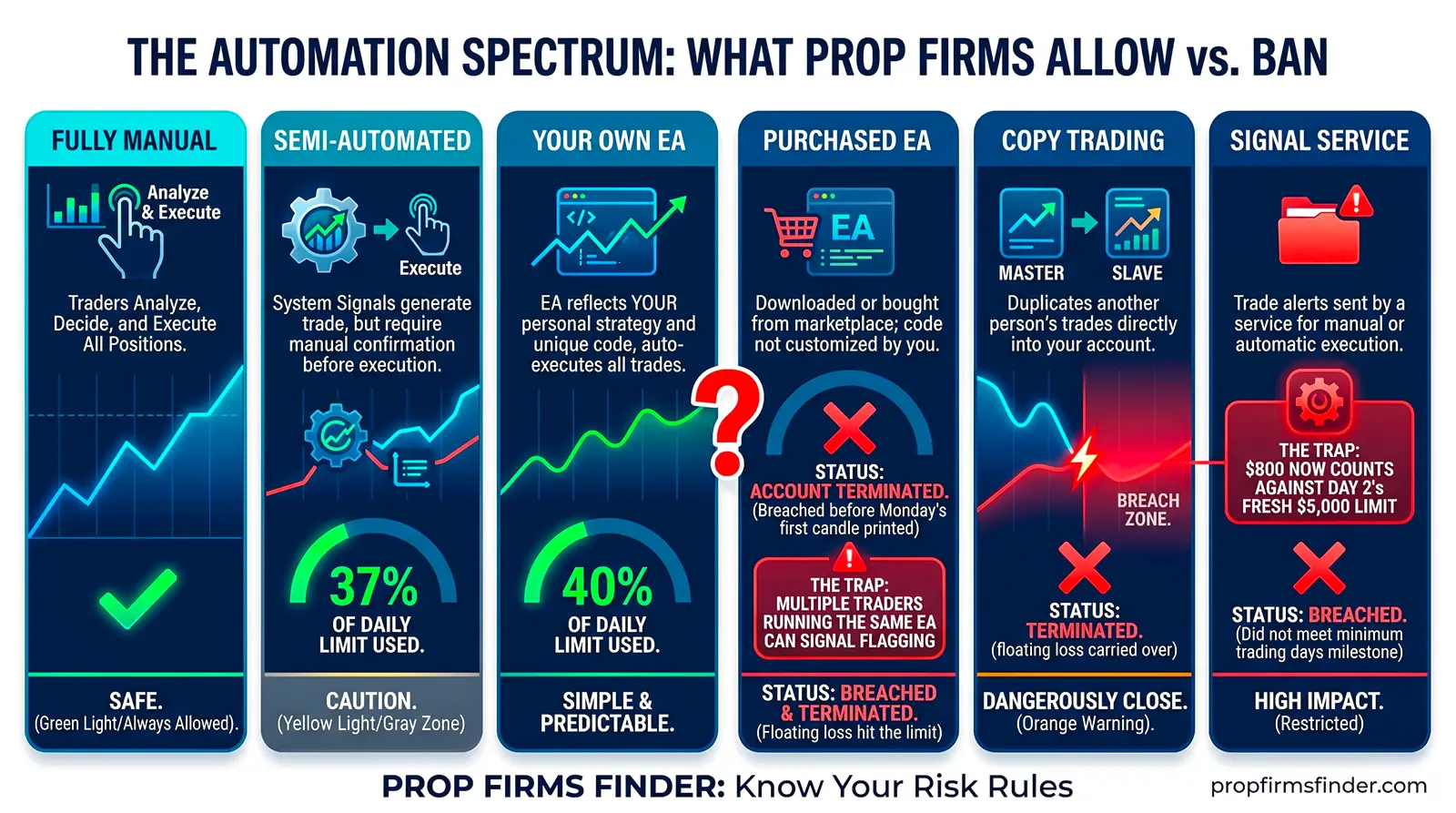
An Expert Advisor is a program that executes trades automatically based on coded rules. It runs on a trading platform (MT4, MT5, cTrader) and opens, manages, and closes positions without the trader clicking a single button. The EA follows the logic you've programmed: entry conditions, exit conditions, position sizing, risk parameters.
The term "EA" comes from MetaTrader, where automated programs are called Expert Advisors. On cTrader, they're called cBots. On NinjaTrader, they're called automated strategies. The concept is the same: code replaces manual execution.
An EA is not the same as a signal service or copy trading. An EA runs on your platform, using your logic. A signal service sends trade ideas from someone else. Copy trading duplicates another trader's positions in real time. Firms treat these three categories very differently.
What Counts as "Automated Trading"?
This is where confusion starts. Firms use "automated trading" broadly, and different categories have different rules.
Your Own EA (Self-Coded or Customized)
An EA you built or significantly customized to reflect your personal strategy. Most firms allow this. The key requirement: the strategy must be yours.
Purchased or Downloaded EAs
EAs bought from marketplaces or downloaded from forums. Many firms allow these, but some require you to own and understand the code. FundedNext charges an additional EA usage fee for third-party EAs and bans specific popular EAs by name (Forex Flex EA, X Pass Bot, among others). If the firm detects that hundreds of traders are running the same purchased EA, it may flag all of them.
Copy Trading and Signal Following
Copy trading duplicates another person's trades into your account. Signal services send trade alerts you execute (manually or automatically). Both are banned at most firms because they undermine the evaluation's purpose: testing your skill, not someone else's.
Semi-Automated Systems
Systems that generate trade signals but require you to manually confirm each execution. These generally fall into a gray zone. Most firms allow them because you're still making the final decision. But if the system auto-executes without your input, it's treated as an EA.
AI and Machine Learning Systems
A growing category. AI-driven trading systems that adapt to market conditions in real time. Most firms don't have specific policies for AI vs. traditional EAs. In practice, they're treated the same way: if the system executes trades automatically, it's automated trading. The same restrictions apply.
Why Prop Firms Regulate Automated Trading
Preventing Copy Trading
If the evaluation tests trader skill, and the trader is copying someone else's trades, the evaluation is meaningless. Firms ban copy trading to ensure the person who passed the evaluation is the person trading the funded trading accounts.
Blocking Platform Exploits
Latency arbitrage exploits the delay between a prop firm's price feed and a faster data source. The EA identifies a price the firm hasn't updated yet and trades the stale price for a near-guaranteed profit. Firms consider this exploitation, not trading, and ban it universally.
Managing Grid and Martingale Risk
Grid bots open positions at fixed intervals, building an ever-expanding position that eventually profits when the price reverts. Martingale doubles position size after each loss. Both strategies require surviving deep drawdown before recovery. On a prop firm account with a 10% max drawdown, these strategies blow up before they recover.
Protecting Evaluation Integrity
An EA designed to pass a specific firm's evaluation (hitting exact profit targets while staying within exact drawdown limits) is gaming the test rather than demonstrating trading ability. FundedNext explicitly bans EAs "designed specifically to pass prop firm challenges."
Commonly Banned Strategies (Even When EAs Are Allowed)
Most firms say "EAs are allowed" and then list everything that isn't. Here are the strategies that get traders flagged.
High-Frequency Trading (HFT)
Firms define HFT differently. Some flag any trade held under 30 seconds. Others target tick scalping (profiting from 1-2 pip movements at extreme speed). FTMO flags trades under 2 minutes. The definition varies, so check your firm's specific threshold.
Grid Trading
Opening multiple positions at fixed price intervals, building a basket of trades. Even firms that allow EAs often ban grid strategies because a single extended move against the grid can breach the drawdown floor before recovery happens.
Martingale Position Sizing
Doubling position size after each loss. The math works on an account with unlimited capital. On a prop firm account with a 5-10% drawdown limit, martingale fails within a handful of consecutive losses. Banned at most firms.
Copy Trading and Signal Services
Running someone else's trades on your account, whether through automated copy software or manual execution of Telegram/Discord signals. Nearly universally banned.
Latency Arbitrage
Exploiting price feed delays between the firm's server and a faster data source. Banned at every firm. Profits are reversed and accounts are terminated.
News Spike Scalpers
EAs that automatically enter positions at the moment of a high-impact news release to capture the initial spike. These interact with news trading rules. Even at firms that allow news trading, an EA that exclusively trades news spikes may be flagged as a single-strategy exploit.
Platform Support for EAs
|
Platform |
EA Support |
Language |
Common at Firms? |
Notes |
|
MetaTrader 4 (MT4) |
Full (Expert Advisors) |
MQL4 |
Declining (legacy) |
Many firms phasing out MT4 |
|
MetaTrader 5 (MT5) |
Full (Expert Advisors) |
MQL5 |
Most common |
Standard for EA trading |
|
cTrader |
Full (cBots/cAlgo) |
C# |
Growing |
Some firms ban EAs on cTrader |
|
Match-Trader |
None (manual only) |
N/A |
Growing |
No automation support |
|
DXtrade |
Limited/None |
N/A |
Some firms |
Primarily manual execution |
|
NinjaTrader |
Full (automated strategies) |
C# |
Futures firms |
Topstep, Apex, MFFU |
|
TradingView |
Alerts only (no native execution) |
Pine Script |
Some firms via webhooks |
Requires third-party bridge |
MT5 is the standard platform for EA trading at forex prop firms. NinjaTrader is the standard for futures. cTrader supports automation natively, but some firms (including FundedNext) ban EAs specifically on their cTrader offering. Match-Trader and DXtrade don't support EAs at all. If your strategy requires automation, verify the platform supports it before purchasing.
The "Your Own Strategy" Requirement
Many firms include a clause requiring that EAs reflect the trader's own strategy. This means:
You coded or commissioned the EA. It's your logic, your rules, your risk parameters.
You customized a purchased EA significantly. You didn't run a marketplace EA with default settings.
Your EA doesn't match other traders' EAs at the same firm. If the firm detects identical trade patterns across multiple accounts running the same EA, all accounts may be flagged.
FundedNext additionally bans switching between manual and EA trading after passing evaluation. If you passed the Challenge manually, you can't switch to an EA on the funded account (or vice versa). The firm wants consistency between the strategy that passed and the strategy that trades.
Running the Same EA on Multiple Accounts
This is a common trap for algo traders who hold accounts at multiple firms (or multiple accounts at the same firm).
Account Correlation Rules
If the firm detects identical trades across multiple accounts (same entry time, same instrument, same direction, same size), it may flag them as correlated or copy-traded. This applies even if you're the sole operator of all accounts. The system can't distinguish "one trader with the same EA on three accounts" from "three traders copying the same signal."
Safer Approaches
Stagger entry times. Vary position sizes. Use slightly different parameter sets on each account. These adjustments create enough variation that automated detection systems don't flag the accounts as correlated. Some traders run different EAs on different accounts to avoid this entirely.
EA and Automation Rules Across Major Prop Firms (April 2026)
Rules verified against each firm's publicly available terms as of April 2026. EA policies change frequently. Always verify before purchasing.
|
Firm |
EAs Allowed? |
Platforms |
Banned Strategies |
Copy Trading? |
Notes |
|
FTMO |
Yes |
MT4, MT5 (not cTrader/MatchTrader) |
HFT, latency arb, tick scalping |
Banned |
Trades < 2 min flagged |
|
FundedNext |
Yes (MT4/MT5 only) |
MT4, MT5 |
HFT, specific named EAs, challenge-pass bots |
Banned |
EA fee applies. No EA on cTrader/MatchTrader |
|
The 5%ers |
Yes |
MT5, cTrader |
HFT, tick scalping, latency arb, hedge arb |
Banned |
Must own/understand EA code |
|
E8 Markets |
Yes |
MT4, MT5, cTrader, MatchTrader, TradeLocker |
HFT, hedging across accounts |
Banned (same strategy across users) |
Widest platform support for EAs |
|
Apex Trader Funding |
Yes |
NinjaTrader, Tradovate |
No specific EA bans |
Varies |
Futures only. Bracket orders mandatory |
|
Topstep |
Yes |
NinjaTrader, TopstepX, Tradovate |
No specific EA bans |
Varies |
Futures only. Ethical use required |
|
My Funded Futures |
Yes |
NinjaTrader, Tradovate, Rithmic |
HFT |
Banned |
No hedging |
|
FundingPips |
Yes |
MT5 |
HFT, latency arb |
Banned |
Standard restrictions |
|
Alpha Capital Group |
Yes |
MT5, cTrader |
Tick scalping, latency arb, martingale |
Banned |
Standard restrictions |
The pattern: most firms allow EAs. None allow copy trading. All ban latency arbitrage. Most ban HFT (though definitions vary). Grid and martingale are banned at about half the firms and grudgingly tolerated at the rest.
Which EA Strategies Work at Prop Firms?
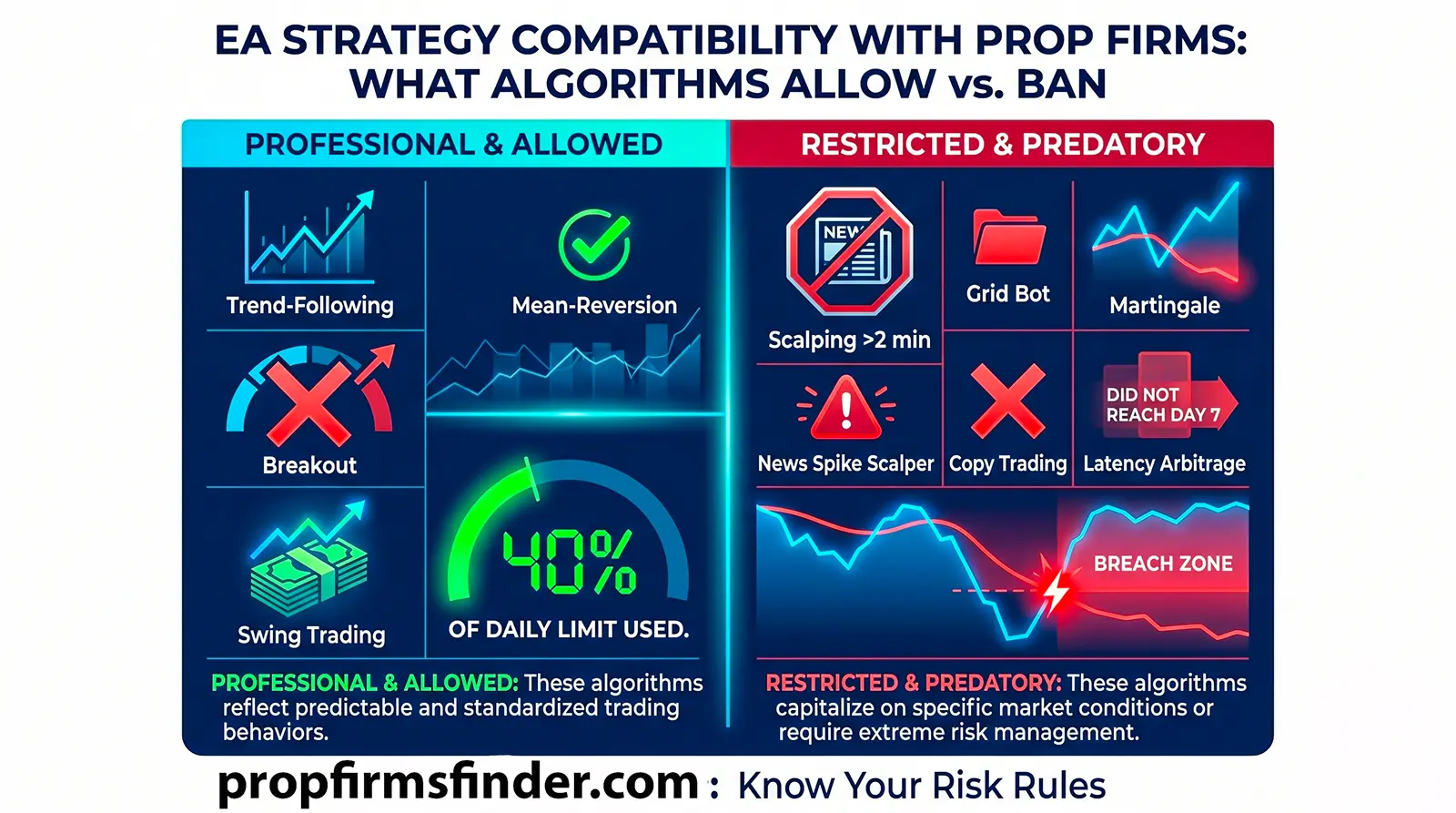
Generally allowed: Trend-following EAs, mean-reversion EAs, breakout EAs, swing trading EAs, scalping EAs (with trades held longer than 2 minutes). These strategies don't exploit platform weaknesses and produce trade patterns consistent with manual trading.
Check firm policy: Grid strategies (banned at about half the firms), purchased EAs (some firms ban specific popular EAs by name), semi-automated systems, AI/ML systems.
Usually banned: Martingale, HFT/tick scalping, news spike scalpers, copy trading, signal services, latency arbitrage, any strategy that exploits platform infrastructure.
How to Choose a Prop Firm for Algo Trading
Verify Platform Support
If your EA runs on MT5, the firm must offer MT5. If it runs on NinjaTrader, you need a futures firm. Don't assume. Some firms offer a platform but disable EA functionality on it (FundedNext allows EAs on MT4/MT5 but not on cTrader).
Read the Full Strategy Restrictions
Don't stop at "EAs allowed." Read the list of banned strategies. If your EA uses any form of grid logic, martingale sizing, or trades faster than the firm's HFT threshold, it's not compatible.
Check for the Authorship Clause
If you're running a purchased EA, verify the firm allows third-party EAs. Some firms require you to own and understand the source code. Others ban specific popular EAs by name.
Test on Demo Before Purchasing
Most firms offer demo or free trial accounts. Run your EA on the demo for at least a week before buying the evaluation. Check for any execution issues, fill quality, or trade rejection that might indicate the platform doesn't handle your EA well.
Ask Support in Writing
Before purchasing, send a message to support describing your EA's strategy in specific terms. Get written confirmation that it's allowed. A support chat screenshot is worth more than a general FAQ answer. For more evaluation tactics, see our how to pass a prop firm evaluation guide.
Common Misconceptions About EA Trading on Prop Firms
"All EAs Are Banned on Prop Firms"
Wrong. Most firms allow EAs. The ban is on specific strategies (HFT, grid, martingale, copy trading, latency arbitrage), not on automation itself. If your EA runs a legitimate trend-following or breakout strategy with proper risk management, it's welcome at most firms.
"If EAs Are Allowed, Any Strategy Is Allowed"
Wrong. "EAs allowed" and "all strategies allowed" are different statements. A firm can allow you to run an EA while banning the specific strategy your EA uses. Always check the strategy restrictions, not just the EA policy.
"Copy Trading and EA Trading Are the Same Thing"
Different. An EA runs your code on your account. Copy trading duplicates someone else's trades. Firms ban copy trading because it lets unskilled traders pass evaluations. EAs demonstrate the trader's own strategy (assuming the trader wrote or customized it).
"I Can Use a Purchased EA If the Firm Allows EAs"
Check the authorship clause. Some firms require you to own and understand the EA's code. FundedNext bans specific commercial EAs by name. If 500 traders run the same downloaded EA, the firm detects identical trade patterns and may flag all of them.
"Running the Same EA on Two Accounts Is Safe"
Potentially not. Identical trades across accounts can flag as correlated trading or copy trading. Stagger entries, vary position sizes, or use different parameter sets to avoid detection.
"AI Trading Systems Don't Count as EAs"
Firms increasingly treat AI/ML systems as a form of automated trading. The same restrictions apply: no HFT, no latency exploitation, no grid/martingale logic. The fact that the system "learns" doesn't exempt it from strategy bans.
Is Automated Trading Worth It on a Prop Firm Account?
When EAs Make Sense
If you have a proven, backtested strategy with defined risk parameters, running it as an EA removes emotional execution errors. EAs don't revenge trade, don't overtrade, and don't panic. For disciplined algo traders, automation is a significant advantage during evaluations. The EA handles the execution. You handle the oversight.
When Manual Trading Is Better
If your edge depends on reading price action, order flow, or contextual judgment that can't be coded, manual trading gives you an advantage an EA can't replicate. If your strategy is discretionary (you make decisions based on what you see, not rules), forcing it into an EA degrades performance.
Choosing a Firm Based on Automation Needs
Algo traders should filter firms by: (1) platform support, (2) EA policy, (3) specific strategy bans, (4) authorship requirements, (5) account correlation rules. These five factors matter more than profit split or drawdown type for traders whose strategy is automated.
Compare firms on all factors on our best prop firms rankings page. If your EA holds positions overnight or over weekends, also check our weekend holding rules guide.
Frequently Asked Questions
Can I use an EA on a prop firm account?
At most firms, yes. FTMO, FundedNext, The 5%ers, E8 Markets, Apex, Topstep, and many others allow EAs on supported platforms. Strategy restrictions apply.
Can I use a purchased EA on a prop firm?
It depends on the firm. Some allow purchased EAs. Others require you to own the source code. FundedNext bans specific commercial EAs by name. If many traders run the same EA, all accounts may be flagged.
Is copy trading allowed on prop firms?
No. Copy trading (duplicating another person's trades) is banned at nearly every firm. The evaluation tests your trading ability, not someone else's.
What is HFT and why do firms ban it?
High-frequency trading involves executing trades at extreme speed (often under 30 seconds) to capture tiny price movements. Firms ban it because it exploits platform infrastructure rather than demonstrating market analysis skill.
Can I run the same EA on multiple prop firm accounts?
Proceed with caution. Identical trades across accounts can be flagged as correlated or copy trading. Stagger entries, vary sizes, or use different parameters to avoid detection.
Do AI trading systems count as EAs?
In practice, yes. Firms treat any system that executes trades automatically as automated trading. The same restrictions (no HFT, no grid, no martingale, no latency arbitrage) apply regardless of whether the system uses AI or traditional rules.
Can I use a grid EA on a prop firm?
At about half the firms, no. Grid strategies are banned because the drawdown during a losing run exceeds most firms' 5-10% max drawdown limits. At firms that allow grid EAs, you need extremely conservative parameters to avoid breaching.
Are martingale EAs banned on prop firms?
At most firms, yes. Martingale doubles position size after each loss, creating exponential drawdown risk. This is fundamentally incompatible with prop firm drawdown limits.
What happens if I use a banned strategy with an EA?
Consequences vary: profit disqualification, position reversal, account termination, or all three. Enforcement is typically automated. The system detects patterns (rapid trade frequency, expanding position sizes, correlated entries) and flags the account.
Can I use signals from a Telegram group?
If you manually decide whether to follow each signal and execute the trade yourself, most firms allow it (it's semi-automated). If you use a bot to auto-execute Telegram signals, it's copy trading and it's banned