Prop Firm News Trading Rules: What's Allowed, What's Banned, and What to Watch For
Prop firm news trading rules restrict or ban trading around high-impact economic events like NFP, FOMC, and CPI releases. Some firms prohibit it entirely, others require traders to flatten positions before releases, and a few allow unrestricted news trading on evaluation or funded accounts.
What Is News Trading?
News trading is a strategy where traders take positions around scheduled economic releases, aiming to profit from the sharp price movements these events create. Major releases like Non-Farm Payrolls (NFP), Federal Reserve rate decisions (FOMC), and Consumer Price Index (CPI) reports can move currency pairs 50 to 200 pips and futures markets 20 to 50 points in minutes.
For some traders, these events are their entire edge. They study economic forecasts, position ahead of the release, and trade the reaction. For prop firms, these same events create a problem.
Why Prop Firms Restrict News Trading
Slippage and Spread Widening
During high-impact news, the spread between bid and ask on major instruments can widen from 1-2 pips to 20-50 pips or more. This creates massive execution risk. A trader who places a market order at 8:30 AM during NFP might get filled 15 pips from their intended entry. That slippage alone can breach a daily loss limit on a tight account.
Firm Risk on Simulated Capital
Most funded trading accounts are simulated. The firm doesn't route your orders to the live market. But they do owe you real money if your simulated account profits. A news trade that spikes $5,000 in seconds creates a payout obligation the firm can't hedge because the trade only existed in a simulated environment.
Protecting Evaluation Integrity
A trader who passes an evaluation by catching one NFP move hasn't demonstrated repeatable skill. Firms restrict news trading partly to ensure pass rates reflect consistent trading ability, not one-off volatility bets. This is the same logic behind consistency rules.
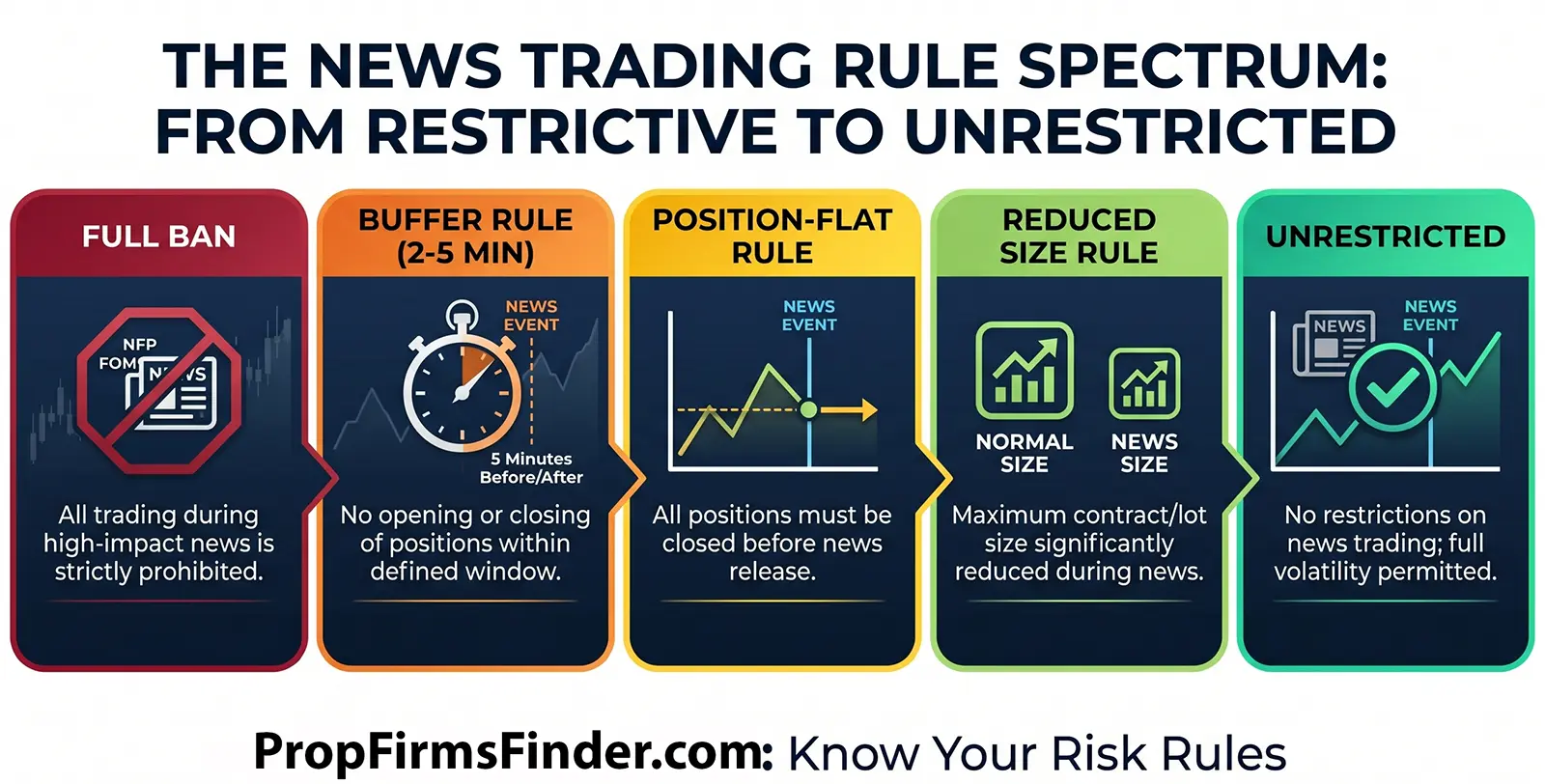
The Five Types of News Trading Rules
Full Ban: No News Trading Allowed
The strictest approach. No opening or closing positions within a defined window around high-impact releases. Some firms extend this to pending orders as well. If a firm detects that a trade was opened or closed within the restricted window, the profit from that trade is disqualified or the account is flagged.
Buffer Rule: No Trades Within X Minutes
The most common restriction. Firms set a buffer window, typically 2 to 5 minutes before and after a scheduled release. During this window, no new positions can be opened and no existing positions can be closed. FTMO uses a 2-minute buffer on Standard funded accounts. My Funded Futures uses a 2-minute buffer around Tier 1 events.
Position-Flat Rule: Close Positions Before the Release
Traders must flatten all positions before the news window begins. You can trade before and after, but you can't hold through the event. This is less restrictive than a full ban because it allows trading up to the window, but it eliminates the core news trading strategy of positioning ahead of the release.
Reduced Size Rule: Smaller Positions During News
A few firms allow trading during news windows but require reduced position sizes. This limits the firm's exposure while still letting the trader participate. Less common than buffer rules.
Unrestricted: Full News Trading Allowed
No restrictions on trading around economic events. The trader takes full responsibility for managing slippage and volatility risk. Apex Trader Funding allows unrestricted news trading during evaluation. FundedNext allows it on all account types. Topstep allows it with the expectation that traders manage their own risk.
What Counts as "High-Impact News"?
The Events Firms Typically Restrict
The events that trigger news trading restrictions at most firms:
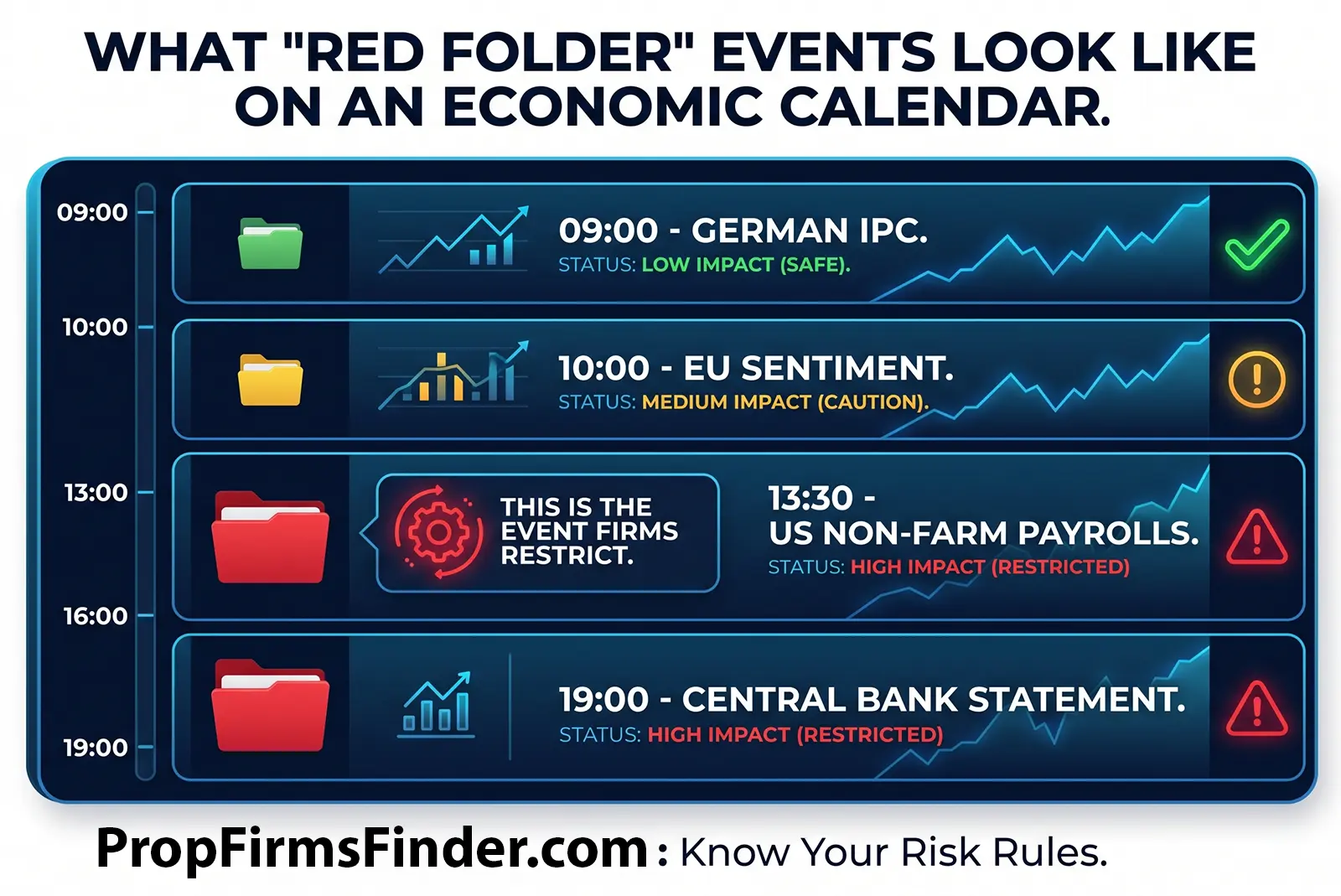
US events: Non-Farm Payrolls (NFP), FOMC rate decisions, CPI (Consumer Price Index), PPI (Producer Price Index), GDP, unemployment claims, retail sales.
International events: ECB rate decisions, BOE rate decisions, BOJ announcements, RBA decisions, SNB decisions.
Futures-specific: EIA crude oil inventory reports (for CL traders), USDA crop reports (for agricultural futures).
"Red Folder" Events
Many firms reference "red folder" events, borrowing the terminology from ForexFactory's economic calendar where high-impact events are marked with a red folder icon. But not all firms use the same calendar or the same impact classification. FTMO publishes its own list of restricted events. Other firms reference ForexFactory, Investing.com, or proprietary event lists.
The practical step: before every trading session, check your firm's specific news trading policy and cross-reference with an economic calendar. Don't assume you know which events are restricted.
News Trading Rules by Account Type
Evaluation Accounts
Several firms are more permissive during evaluation than during the funded phase. FTMO allows unrestricted news trading during the Challenge and Verification phases. The restriction applies only on the FTMO Account (funded phase) for Standard account types. Apex allows news trading during evaluation with no restrictions.
Funded Accounts
This is where restrictions tighten. FTMO's 2-minute buffer applies only on funded Standard accounts. FundedNext remains unrestricted even on funded accounts. My Funded Futures restricts T1 events on funded accounts.
The gap between evaluation and funded rules is a trap. A strategy that works during evaluation (because you traded news freely) may not work once funded (because the news window is now restricted). Check the funded account rules before you buy the evaluation.
Swing Accounts
Some firms offer swing or weekend-holding accounts that are exempt from news restrictions. FTMO's Swing account type is exempt from the 2-minute news restriction on funded accounts. If news trading is core to your strategy and you want to trade FTMO, the Swing account type removes this barrier.
Common Buffer Windows and How They Work
The 2-Minute Buffer (FTMO Standard Funded)
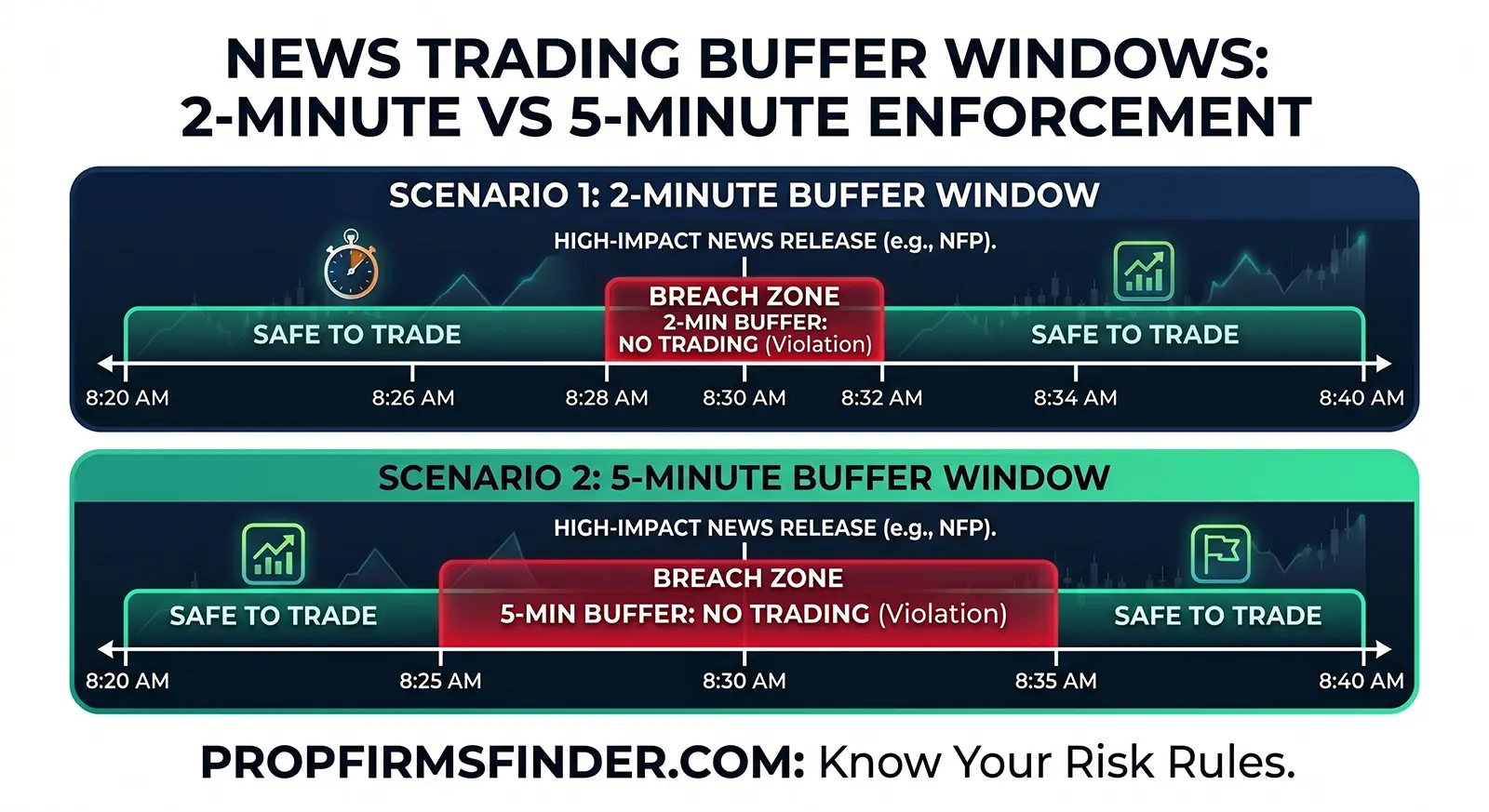
No opening or closing positions 2 minutes before and 2 minutes after a high-impact release on targeted instruments. If NFP releases at 8:30 AM ET, you can't trade the targeted pairs from 8:28 to 8:32. The restriction applies only to instruments directly affected by the news (e.g., USDJPY, GBPUSD during US data). Non-targeted pairs (e.g., EURGBP, AUDNZD) can be traded normally.
The 5-Minute Buffer
A wider window used by some firms. No trading 5 minutes before through 5 minutes after the release. This eliminates more of the initial volatility but also blocks more of the potential trading opportunity.
How Buffers Are Enforced
Enforcement is typically automated. The firm's system checks whether positions were opened or closed within the buffer window. If a violation is detected, consequences range from profit disqualification on that specific trade to account termination, depending on the firm.
What Happens If You Break a News Trading Rule
Profit Disqualification
Some firms don't terminate the account but remove the profit from the violating trade. Your account balance reverts to what it was before the news trade. If the trade lost money, the full loss applies. This asymmetry, profits disqualified but losses kept, is the harshest version of this consequence.
Account Termination
At firms with strict enforcement, opening a position during a restricted window can end the evaluation or funded account immediately, regardless of whether the trade was profitable.
Warning or Notation
A few firms issue a warning on first offense. Repeated violations escalate to disqualification or termination. This is less common but exists at some firms with softer enforcement.
Hidden News Trading Disqualifiers
"Primary Profit From News" Clauses
Some firm terms include language allowing the firm to disqualify profits if a "significant portion" of profit came from trades around news events, even if news trading is technically allowed. This catch-all clause gives the firm discretion to reverse profitable news trades after the fact. Always read the terms document, not just the marketing page.
Pending Order Rules
Does placing a limit order before the news window and having it fill during the window count as news trading? At some firms, yes. The order was placed before the restricted window, but it executed during it. This catches traders who try to use pending orders to trade news while technically "not trading" during the buffer.
Spread Widening as a Silent Breach
Even on firms that allow news trading, the spread widening during a major release can trigger a daily loss limit breach. EUR/USD spreads can widen to 30-50 pips during NFP. If you're holding a position through the release, the momentary spread widening drops your equity, potentially breaching the daily loss limit or trailing drawdown floor, even if the trade ends up profitable.
News Trading Rules Across Major Prop Firms (April 2026)
Rules verified against each firm's publicly available terms as of April 2026. Firms update rules frequently. Always verify before trading.
|
Firm |
Evaluation |
Funded Account |
Buffer |
Instrument Scope |
Breach Result |
|
FTMO (Standard) |
Unrestricted |
2-min buffer |
2 min before/after |
Targeted pairs only |
Profit disqualified or warning |
|
FTMO (Swing) |
Unrestricted |
Unrestricted |
None |
N/A |
N/A |
|
FTMO (1-Step) |
Unrestricted |
Unrestricted |
None |
N/A |
N/A |
|
Apex Trader Funding |
Unrestricted |
Unrestricted |
None |
N/A |
N/A |
|
Topstep |
Allowed (trader manages risk) |
Allowed |
None |
N/A |
N/A |
|
My Funded Futures |
2-min buffer on T1 |
2-min buffer on T1 |
2 min before/after |
All instruments |
Violation |
|
FundedNext |
Unrestricted |
Unrestricted |
None |
N/A |
N/A |
|
The 5%ers |
Varies by program |
Varies by program |
Varies |
Varies |
Varies |
|
Tradeify |
Allowed |
Allowed |
None |
N/A |
N/A |
|
Earn2Trade |
Allowed |
Allowed (manage risk) |
None |
N/A |
N/A |
The key takeaway: most futures firms (Apex, Topstep, Tradeify, Earn2Trade) allow unrestricted news trading. The restriction is primarily a forex prop firm issue, and even there, FTMO's restriction only applies on Standard funded accounts, not during evaluation or on Swing/1-Step accounts. FundedNext is fully unrestricted.
How to Trade News Safely on a Prop Firm Account
Read Your Firm's Exact Policy
Search the firm's rules page for "news," "economic event," "NFP," "FOMC," and "high-impact." Check whether restrictions apply to entries, exits, or both. Some firms ban opening new positions during windows but allow closing existing ones.
Set a Personal Buffer Wider Than the Firm's Minimum
If your firm requires 2 minutes, give yourself 5. If they require 5, give yourself 10. This accounts for execution delays and the lingering volatility that persists well beyond the official buffer window.
Flatten Positions Before Major Releases (Even If Allowed)
Even at firms that allow news trading, going flat before NFP, FOMC, or CPI is often the safer play during an evaluation. The risk of a spread-widening-induced drawdown breach outweighs the potential profit on a single news move. Protect the account first.
For more strategies on surviving the evaluation process, see our how to pass a prop firm evaluation guide.
Know Which Instruments Are Restricted
FTMO's restriction is instrument-specific: only pairs directly affected by the news release are restricted. USDJPY and GBPUSD during US data, for example. EURGBP or AUDNZD are not restricted during US releases. This distinction can let you trade around the buffer by using non-targeted instruments.
Protect Against Spread Widening
If you hold through a news release, use a wide enough stop loss that a momentary spread expansion doesn't trigger it. A 2-pip stop on EUR/USD during NFP is a guaranteed stop-out because the spread alone will blow through it. Size down and widen stops if you choose to hold through volatility.
Common News Trading Misconceptions
"Subject to Policy" Means Allowed
Not always. Some firms use vague language like "news trading is subject to policy" without defining what the policy is. In practice, this gives the firm discretion to disqualify trades retroactively. If the policy isn't spelled out in specific terms (which instruments, which events, what time window), treat it as a potential restriction.
"All Firms Define High-Impact the Same Way"
They don't. FTMO publishes its own restricted events list. Other firms reference ForexFactory's red folder events. Some firms restrict all scheduled economic data. Others restrict only the top 5-6 releases. The definition of "high-impact" varies by firm.
"Pending Orders Don't Count as News Trading"
At some firms, they do. If a limit order placed before the buffer window fills during the restricted period, the firm may treat it as a news trade. Check whether your firm restricts order placement, order execution, or both.
"If I'm Profitable, the Firm Won't Care"
They care. Firms enforce news trading rules on profitable trades as vigorously as on losing trades. In fact, a large profitable news trade is more likely to be reviewed because it creates a payout obligation. Compliance matters regardless of outcome.
"News Trading Is Only Relevant for Forex"
Wrong. US economic data moves ES, NQ, CL, and GC futures as aggressively as it moves currency pairs. EIA reports move crude oil futures. USDA reports move agricultural futures. Central bank decisions affect government bond futures. News trading rules apply across asset classes, not just forex.
Is News Trading Worth It on a Prop Firm Account?
When News Trading Makes Sense
If your entire strategy is built around economic releases and you have a documented track record of profitable news trades, then choosing a firm that allows news trading is essential. FundedNext, Apex Trader Funding, and Topstep all accommodate this. Don't shoehorn your strategy into a firm that restricts it.
When to Avoid News Trading Entirely
During an evaluation with tight drawdown, the risk-reward of news trading is poor. One bad fill can breach your daily loss limit or trailing drawdown in seconds. If news trading is not your core strategy, sitting out major releases is the safer play. You can always trade news on your personal account while keeping the prop account clean.
Choosing a Firm Based on Your Strategy
If news trading is a deal-breaker for you, filter firms by their news policy before comparing price, profit split, or drawdown type. A firm with a 95% profit split and a news ban is worthless to a news trader. Start with the rule that matters most to your strategy, then compare everything else.
Compare firms on all factors (including news trading rules) on our best prop firms rankings page.
Frequently Asked Questions
Which prop firms allow news trading?
Apex Trader Funding, FundedNext, Topstep, Tradeify, and Earn2Trade allow unrestricted news trading on most account types as of April 2026. FTMO allows it during evaluation and on Swing/1-Step funded accounts, but restricts it on Standard 2-Step funded accounts.
What is a news trading buffer?
A defined time window (typically 2-5 minutes) before and after a high-impact economic release during which the firm prohibits opening or closing positions. The buffer prevents traders from capturing the immediate spike that follows a release.
Can I trade NFP on a prop firm account?
At firms that allow news trading (Apex, FundedNext, Topstep), yes. At FTMO, you can trade NFP during evaluation and on Swing/1-Step funded accounts, but not on Standard funded accounts (2-minute buffer applies).
What is "red folder" news?
A reference to ForexFactory's economic calendar, which marks high-impact events with a red folder icon. These include NFP, FOMC, CPI, GDP, central bank rate decisions, and unemployment claims. Some firms use ForexFactory as their reference. Others publish their own event lists.
Do pending orders count as news trading?
At some firms, yes. If a pending order fills during a restricted news window, the firm may treat it as a news trading violation. Check your firm's specific policy on order placement vs order execution during restricted periods.
Can I hold a position through high-impact news?
At firms with a position-flat rule, no. At firms with a buffer rule, it depends. Some buffer rules only restrict opening/closing, not holding. At unrestricted firms, you can hold through any event. The risk is that spread widening during the event can trigger drawdown breaches even if you don't close the position.
Why is news trading often banned on instant funding accounts?
Instant funding accounts skip the evaluation, which means the firm hasn't verified the trader's ability to manage risk. Allowing news trading on these accounts exposes the firm to higher variance from traders who haven't been filtered through an evaluation process.
What happens if I accidentally trade during a news window?
Consequences vary: profit disqualification, warning, or account termination depending on the firm. Most enforcement is automated with no exceptions. "I didn't know" is not accepted as a defense. Set calendar alerts for restricted events before every session.
Can a firm reverse profits from a news trade?
Yes. Some firms include clauses that allow them to reverse or disqualify profits from trades executed during or immediately around high-impact news events, even if news trading is technically "allowed." Read the fine print.
What economic calendar do prop firms use?
Most reference ForexFactory, Investing.com, or Myfxbook calendars. FTMO publishes its own list of restricted events. When in doubt, use the calendar your firm's terms of service reference, or ask support directly.