Prop Firm Daily Loss Limit Explained: How It Works and How to Avoid Breaching It
A prop firm daily loss limit caps how much a trader can lose in a single trading day. It is pretty common for prop firms set it between 4% and 6% of the starting or previous day's balance. In most cases, breaching the daily loss limit closes the evaluation or funded account, even if the overall drawdown is still within bounds. Some cases reaching the limit will just stop you from trading that day and you will need to wait out for another day to trade again on that account (soft lock).
What Is a Daily Loss Limit?
A daily loss limit (also called daily drawdown) is the maximum amount your funded trading accounts can lose in a single trading day before the firm takes action. If your account drops by more than the allowed amount within one session, the account is either locked for the day or terminated entirely.
The daily loss limit and the maximum drawdown are two separate rules that run at the same time. Maximum drawdown tracks your total peak-to-trough decline over the life of the account. Daily loss limit tracks your decline within a single day. You need to stay within both. Breaching either one has consequences. Daily limit drawdown is almost always smaller than the maximum drawdown, which makes sense. However, there are very few companies where on some of the accounts the daily drawdown is the same as the max drawdown (very uncommon).
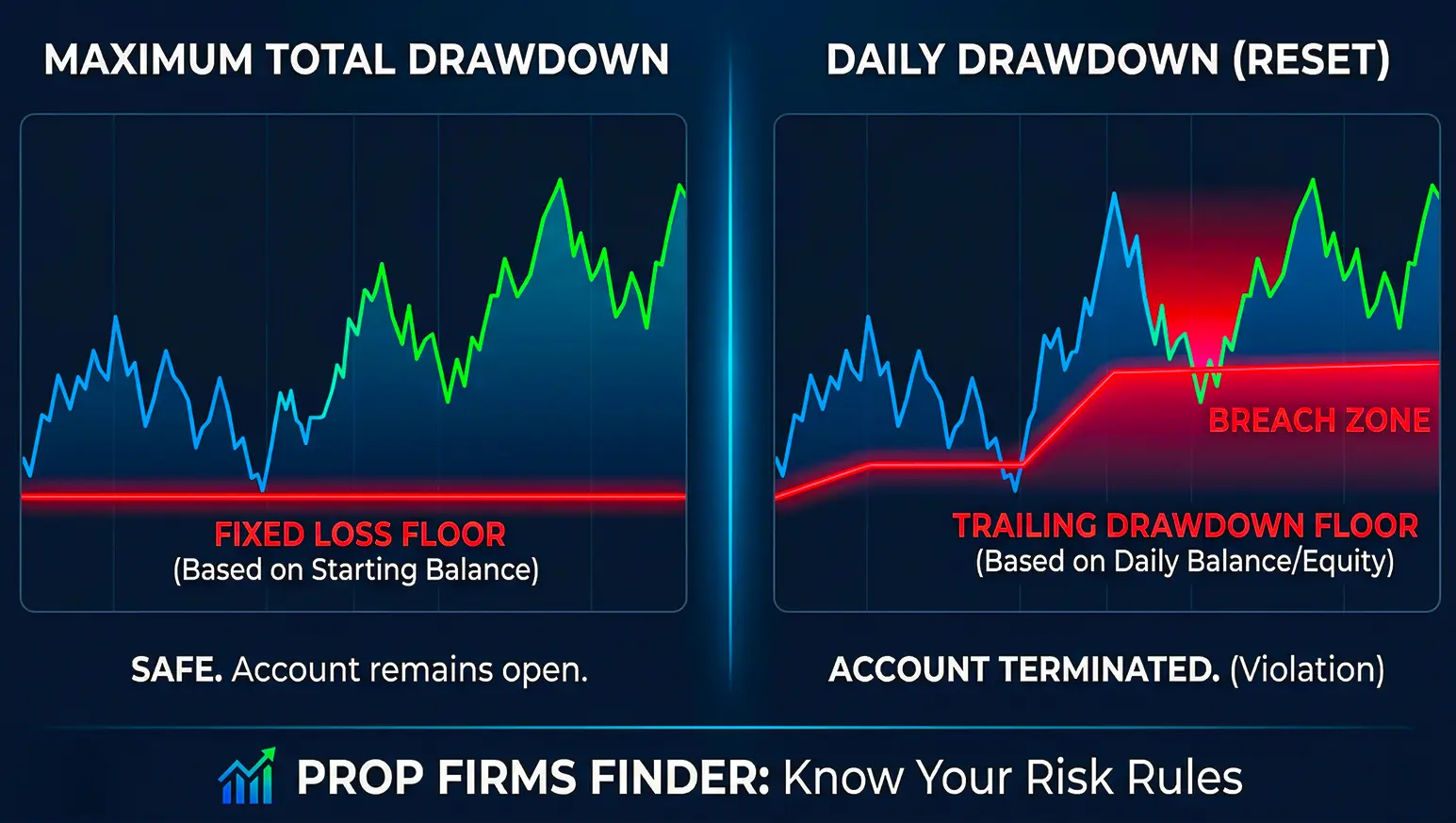
Why do firms enforce it? A single bad day with no guardrails can destroy an otherwise healthy account. The daily loss limit forces you to stop before a losing session spirals into an account-ending event. It protects both the firm's capital and (indirectly) the trader's progress.
How Daily Loss Limits Are Calculated
This is where most traders get confused, and where most breaches happen. The daily loss limit percentage is usually the same across firms (4-6%), but the baseline it's calculated from changes everything.
The Three Calculation Baselines
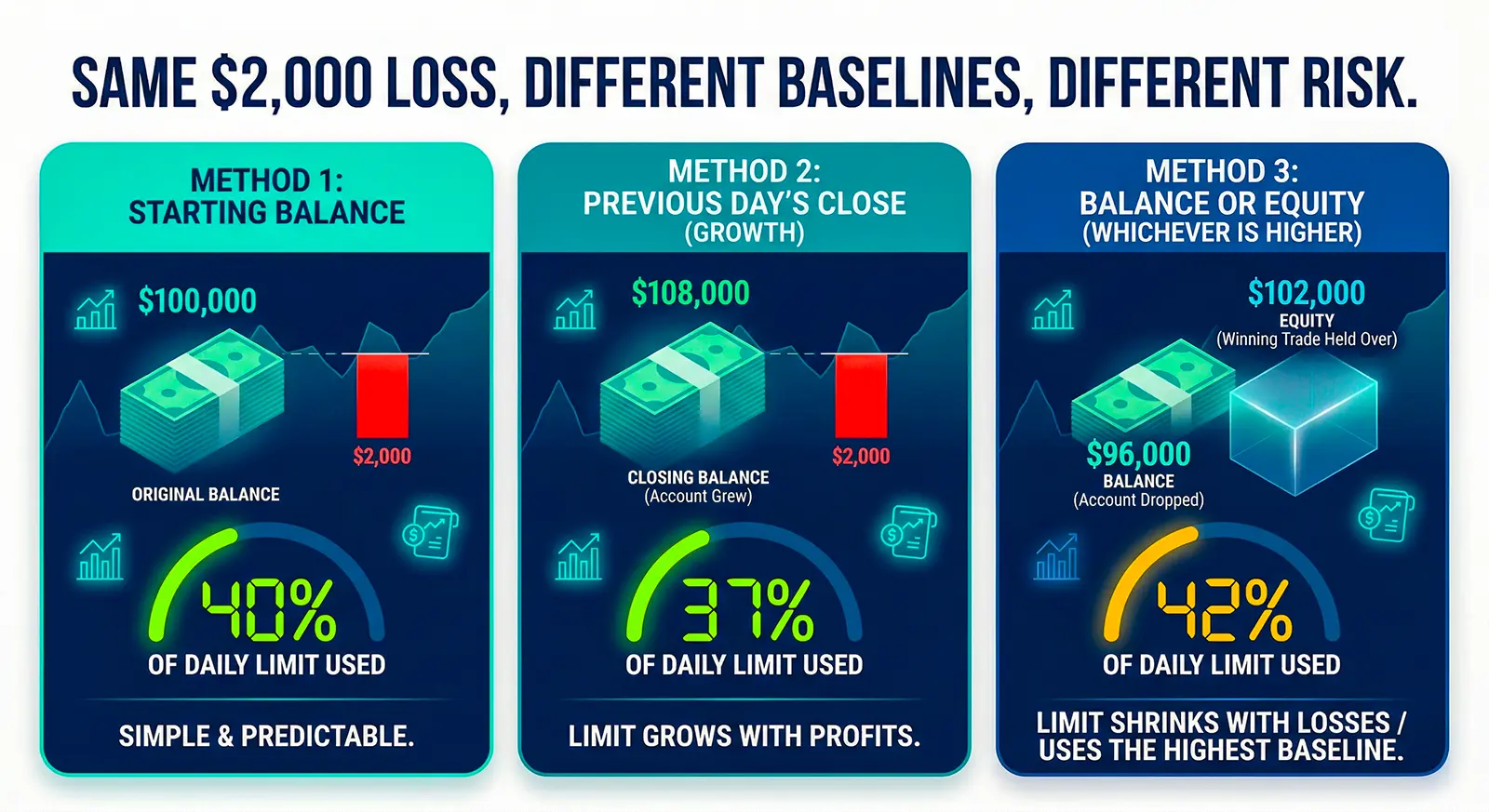
Method 1: Starting Balance. The daily limit is calculated as a percentage of your original account balance when you first received the account. On a $100,000 account with a 5% limit, your daily loss allowance is $5,000 every single day, regardless of whether your account has grown to $110,000 or dropped to $95,000. The number never changes. Simple and predictable.
Method 2: Previous Day's Closing Balance. The daily limit recalculates at midnight of the previous trading day based on where your account closed the day before. If your $100,000 account grew to $108,000 by yesterday's close, today's 5% limit is $5,400. If you had a bad week and your balance is $96,000, today's limit is only $4,800. The limit grows with your profits and shrinks with your losses. FTMO’s 2‑Step Challenge recalculates the daily floor at midnight CE(S)T as: previous midnight balance minus 5% of initial capital, and they monitor equity against that floor.
Method 3: Higher of Balance or Equity. Some firms use whichever is higher between your starting balance and your starting equity for the day. If you closed yesterday at $101,000 balance but have $102,000 in equity (because of an open winning trade carrying over), the 5% limit applies to $102,000, giving you $5,100. The 5%ers uses a version of this model, depending on the program that you choose from them.
Balance-Based vs. Equity-Based Calculation
This is the distinction that blows the most accounts and is often overlooked. It's one of those things that people don't bother checking even if it is not crystal clear what it is.
Balance-based: Only closed trades count toward the daily loss. If you have a trade open that's $3,000 underwater, your daily loss calculation hasn't changed because the trade isn't closed yet. The breach triggers only when your realized P&L (closed trades) exceeds the limit.
Equity-based: Open positions count. If your equity (balance plus/minus unrealized P&L) drops below the limit threshold at any point during the day, you've breached. It doesn't matter if the trade later recovers and closes in profit. The breach happened the moment equity touched the floor.
Many prop firms in 2026 use equity-based calculation. This means your floating losses directly threaten the daily loss limit. A trade that's $4,500 underwater on a $5,000 daily limit is one bad tick away from breach, even if you haven't closed it.
Do Open Positions Count?
At equity-based firms (which is most firms), yes. Your unrealized P&L moves your equity in real time, and if equity touches the floor, it's over. This is the most common cause of accidental daily loss limit breaches: a trader leaves a losing position open, expecting it to recover, and equity drops past the threshold.
Do Commissions and Swap Fees Count?
Yes. Commissions reduce your balance immediately when a trade is closed (or sometimes when it's opened). Swap fees for overnight positions are deducted at the daily rollover. Both of these reduce your equity and bring you closer to the daily limit. On a tight daily allowance, accumulated commissions across many trades can eat $50 to $200 of your buffer.
When Does the Day Start and End?
Server Cutoff Times
The "day" in daily loss limit is defined by the firm's server time, not your local time. Common cutoff times:
FTMO: Midnight CE(S)T (Central European Summer Time). That's 6:00 PM Eastern during daylight saving, 5:00 PM Eastern in winter.
Apex Trader Funding: 6:00 PM ET. The trading day resets at this time.
Topstep: 5:00 PM CT (Central Time). Positions must be closed by this time.
If you're trading in a different time zone, convert the cutoff to your local time and set an alarm. Missing the cutoff with an open position is one of the most common accidental breaches.
Weekend and Holiday Handling
Friday's closing balance typically sets Monday's baseline. The daily loss limit doesn't apply over the weekend because markets are closed (for futures) or trading is minimal. If you hold a forex position over the weekend and the market gaps on Sunday open, the gap counts toward Monday's daily loss when the session begins.
The Server Cutoff Trap
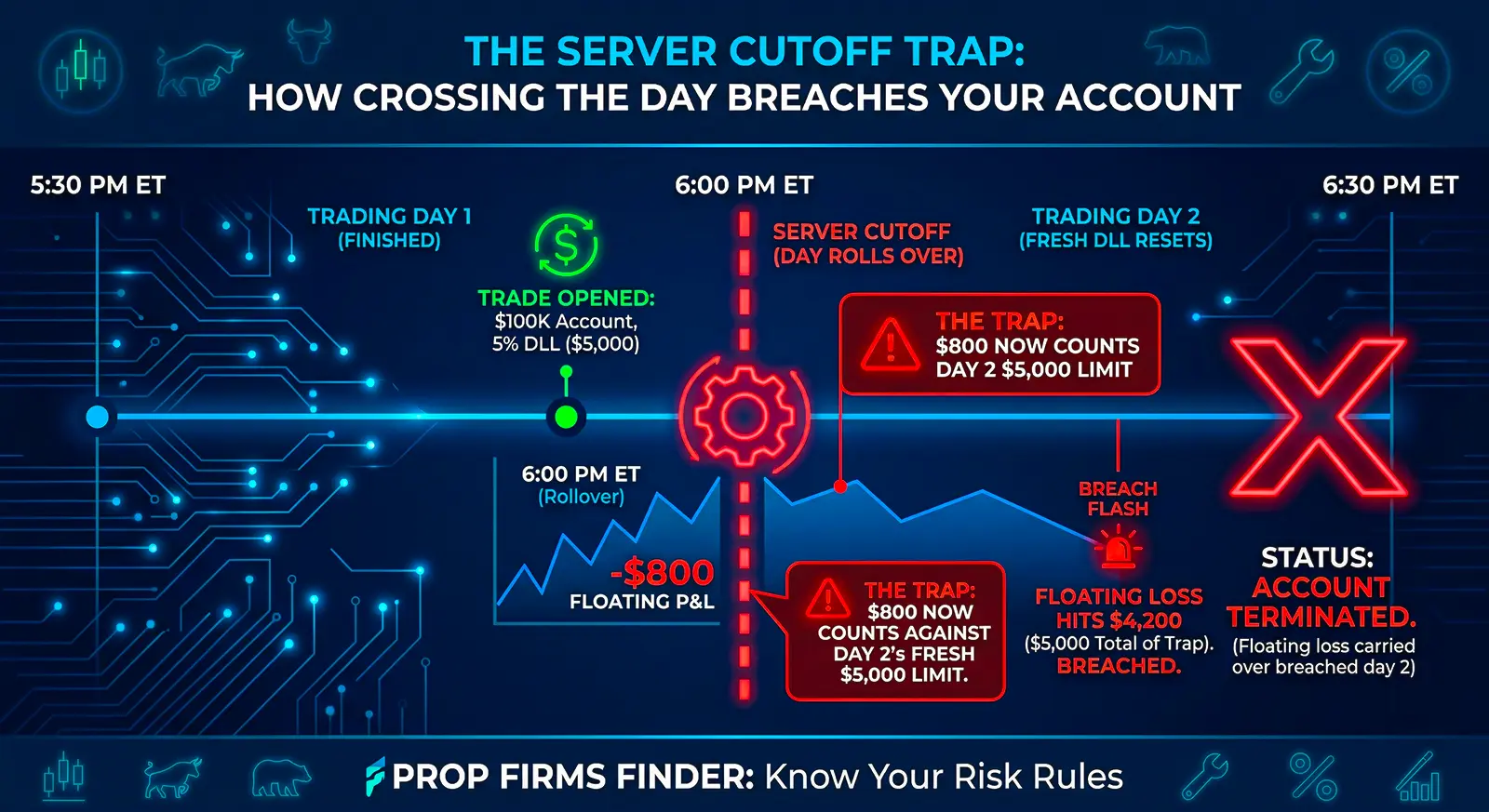
If you open a trade at 5:55 PM ET and the day rolls at 6:00 PM ET, the trade crosses into the next trading day. Any floating loss on that position now counts toward the new day's daily loss limit, which resets based on your balance at 6:00 PM. If the position is underwater, you start the new day already in negative territory.
Common Daily Loss Limit Thresholds
4% Daily Loss Limit (Strict)
On a $100,000 account, that's $4,000 per day. At 1% risk per trade, you can absorb 4 consecutive losing trades. At 2% risk, you can absorb 2. The 5%ers uses a 3-5% daily limit on some programs, making it one of the tightest in the industry.
5% Daily Loss Limit (Common in Forex)
The most common threshold. FTMO, FundedNext, and many forex firms use 5%. On a $100,000 account, that's $5,000. At 1% risk per trade, you can absorb 5 consecutive losses. This is the industry baseline that most guides reference, however, 3% is also common.
6%+ Daily Loss Limit (Lenient)
Some firms offer 6% or higher daily limits, giving more room for volatile strategies. A few instant funding programs push to 8%. More room means less stress per session, but it also means the firm is accepting more risk exposure, which sometimes shows up in tighter rules elsewhere (lower max drawdown, stricter consistency rules).
No Daily Loss Limit
Some firms don't enforce a separate daily loss limit. Apex Trader Funding's intraday trailing drawdown accounts have no daily loss limit during evaluation. While it makes sense on paper, just make sure to understand that trailing drawdown serves as a daily drawdown in a way. While there is no separate daily drawdown limit, the trailing drawdown serves pretty much the same function here.
What Happens If You Breach the Daily Loss Limit
Hard Breach: Account Terminated
At many firms, hitting the daily loss limit ends the evaluation or funded account permanently. All positions are liquidated. No recovery. No appeal. You buy a new evaluation to try again. FTMO, FundedNext, and The 5%ers treat daily loss limit breaches as hard fails (although some 5%ers programs have daily pause mechanism.
Soft Breach: Trading Locked for the Day
Some firms pause trading for the rest of the session without terminating the account. Apex Trader Funding's EOD accounts use this model. If you hit the daily loss limit, your trades are flattened and you can't open new positions until the next trading day. The account survives. You come back tomorrow with a fresh daily allowance.
The distinction between hard and soft breach is one of the most important details to check before choosing a firm. It determines whether a bad day costs you the entire evaluation or just a single session.
Can You Appeal a Breach?
In practice, no. Daily loss limit enforcement is automated. The system liquidates positions and locks or terminates the account without human review. Support teams can explain what triggered the breach, but they generally can't reverse it. The rules are applied by code, not by judgment.
Worked Examples: Daily Loss Limit in Action
Example 1: A Safe Trading Day (Balance-Based)
$100K account, 5% DLL ($5,000), balance-based calculation.
You take three trades: -$800, +$400, -$600. Net closed P&L: -$1,000. Daily loss used: $1,000 of $5,000 (20%). You have $4,000 remaining. Safe. You could continue trading.
Example 2: The Equity-Based Open Position Trap
$100K account, 5% DLL ($5,000), equity-based calculation.
You take one trade that drops $4,800 unrealized. You haven't closed it. But because the firm uses equity-based calculation, your daily loss is already $4,800 of the $5,000 allowance. You're $200 away from breach with an open trade. A 2-pip spread widening on a major pair could trigger the breach.
On a balance-based firm, this same scenario would show $0 daily loss used because no trades have been closed.
Example 3: The Previous Day Close Trap
$100K starting balance. After a week of good trading, your balance grew to $112,000. Today's DLL is 5% of $112,000 = $5,600. You have a bad morning and lose $5,500. You think you're fine because $5,500 is less than $5,600. But then commissions of $120 post. Your total daily loss is $5,620. Breach triggered. The fact that your account is still $106,380 (well above the starting $100K) doesn't matter. The daily limit was set from $112,000, and you exceeded it.
This trap catches traders who grow their account, get comfortable with the larger balance, and forget that the daily limit has grown too.
Example 4: The Commission Stacking Trap
$50K account, 5% DLL ($2,500), equity-based. You take 15 trades during a volatile session. Net P&L on trades: -$2,200. Total commissions: $315. Daily loss: $2,515. Breach triggered by $15. The trades themselves were within limits. Commissions pushed you over.
Daily Loss Limit vs. Maximum Drawdown
The Key Difference
Maximum drawdown is the total lifetime loss allowed from the peak balance. Daily loss limit is the maximum single-day loss. They are independent rules. You need to stay within both.
Why You Can Breach One Without the Other
Scenario: $100K account, $10K max drawdown (floor at $90K), $5K daily loss limit. Your account grew to $108K. You have $18K of max drawdown cushion. But your daily limit is $5,400 (5% of $108K). A $6,000 loss day breaches the daily limit while the max drawdown is nowhere near breached. One bad day ends the account even though you had $12,000 of overall cushion remaining.
The reverse is also possible: consistent $2,000 losses across 5 days ($10K total) would breach max drawdown without ever triggering the $5K daily limit.
How They Work Together
At the start of each trading day, calculate both floors. Your effective limit for the day is whichever is tighter. If your daily limit gives you $5,000 of room but your max drawdown only has $3,000 left, your real limit is $3,000. Always trade to the more restrictive number.
Daily Loss Limits Across the Prop Firm Industry
Data reflects publicly stated terms as of April 2026. Verify on each firm's website.
|
Firm |
DLL % |
Baseline |
Calculation |
Includes Open? |
Breach Result |
|
FTMO (2-Step) |
5% |
Equity floor = previous midnight balance minus 5% of initial capital (recalculated at midnight CE(S)T). |
Equity-based |
Yes |
Account terminated |
|
FTMO (1-Step) |
3% |
Daily equity drop of 3% from the reference level (previous midnight reset) |
Equity-based |
Yes |
Account terminated |
|
Apex (EOD accounts) |
Varies ($1K-$2.25K on $50K-$150K) |
Start of session |
Equity-based |
Yes |
Trading paused until next session (soft) |
|
Topstep |
Varies by plan |
Start of day |
Equity-based |
Yes |
Trading paused (soft); account remains active |
|
The 5%ers |
3-5% |
Higher of balance or equity |
Equity-based |
Yes |
Varies by program |
|
FundedNext |
5% |
Starting balance |
Equity-based |
Yes |
Account terminated |
|
My Funded Futures |
Varies by plan |
Start of session |
Equity-based |
Yes |
Trading paused until next session; repeated breaches or hitting maximum loss can end the accoun |
The industry standard is 5% equity-based with a hard breach consequence. Apex's soft-lock model on EOD accounts is the most trader-friendly. FTMO's 1-Step at 3% is among the tightest daily limit offered by major firms.
Compare all firms on our best prop firms rankings page.
How to Avoid Breaching the Daily Loss Limit
Know Your Firm's Exact Calculation Method
Before you trade, know three things: (1) What percentage is the daily limit? (2) What baseline is it calculated from? (3) Does it include open positions? Write down today's exact dollar floor before you open the platform.
Set a Personal Daily Cap at 60-70% of the Firm's Limit
If your firm allows $5,000 in daily losses, stop trading when you hit $3,000 to $3,500. This gives you a buffer for commissions, slippage, and the emotional escalation that happens near the limit. Professional funded traders routinely use personal limits at 50-70% of the firm's threshold.
Stop Trading After a Bad Opening Hour
If you're down $1,500 in the first 45 minutes on a $5,000 daily limit, that's 30% of your allowance gone. The temptation is to trade more aggressively to recover. The data says the opposite: sessions that start with large losses rarely end green. Close the platform and come back tomorrow.
Close Losing Positions Before They Become a Breach
On equity-based accounts, a floating loss of $4,800 on a $5,000 daily limit is an active threat. If the position moves another $200 against you, the account is done. Don't wait for recovery when you're within striking distance of the limit. Cut the position, take the loss, and preserve the account.
Track Daily P&L in Real Time
Most firm dashboards show your daily P&L and remaining allowance. Keep this visible during every session. If your firm doesn't show it clearly, track it in a spreadsheet: starting balance + closed P&L + unrealized P&L = current equity. Compare against the floor constantly.
For more tactical strategies for surviving evaluations, see our how to pass a prop firm evaluation guide.
Common Daily Loss Limit Misconceptions
"The Limit Resets at Midnight Local Time"
Usually wrong. The reset happens at the firm's server time, which varies: midnight CET for FTMO, 6:00 PM ET for Apex, 4:59 PM CT for Topstep. If you trade in a different time zone, your "midnight" and the firm's "midnight" are different. One wrong assumption about cutoff timing can cause a breach.
"Open Positions Don't Count"
At most firms, wrong. Equity-based calculation includes unrealized P&L from open positions. A floating loss of $5,000 on a $5,000 daily limit is a breach at equity-based firms, even if you haven't closed the trade. Only balance-based firms exclude open positions.
"A Soft Lock Is the Same as a Hard Breach"
No. A soft lock (Apex EOD accounts) pauses trading for the day. The account is alive tomorrow. A hard breach (FTMO, FundedNext) terminates the account permanently. The difference is whether a bad day costs you one session or the entire evaluation.
"Commissions Don't Count"
They do. Commissions reduce your balance and equity. On high-frequency trading days with 15-20 trades, commissions of $200-$400 can be the difference between staying within the limit and breaching it.
"All Firms Use the Same Calculation Method"
They don't. Starting balance, previous day's close, higher of balance or equity. Balance-based, equity-based. Hard breach, soft lock. These variations create fundamentally different trading experiences even when the percentage is identical.
What to Do If You Breach the Daily Loss Limit
Identify the Breach Type
Check whether your firm uses hard breach (account terminated) or soft breach (trading paused). If it's a soft lock, you can resume tomorrow. If it's a hard breach, the evaluation is over.
Review What Happened
Look at your trading journal. Was the breach from one large loss, accumulated small losses, commission stacking, or a floating position that hit the floor? The cause determines what you fix for next time.
Learn From It
Most daily loss limit breaches are preventable. The three most common causes: (1) not knowing the calculation method, (2) leaving a large floating loss open at an equity-based firm, (3) revenge trading after an early loss. Address whichever one caused your breach before purchasing your next evaluation.
Frequently Asked Questions
What is a typical daily loss limit in a prop firm?
4% to 5% of the account balance or previous day's closing balance. On a $100,000 account at 5%, that's $5,000 per day.
Does the daily loss limit reset overnight?
Yes, at the firm's designated cutoff time. This is not midnight your local time. It's the firm's server time: midnight CET for FTMO, 6:00 PM ET for Apex, etc.
What happens if I breach by $1?
The same thing as breaching by $1,000. At hard-breach firms, the account is terminated. At soft-breach firms, trading pauses. There is no tolerance threshold. $1 over is a breach.
Do open positions count toward the daily loss?
At equity-based firms (which is most firms), yes. Floating losses move your equity and can trigger a breach even if the trade later recovers.
Can I appeal a daily loss limit breach?
Generally, no. Enforcement is automated. Support can explain the breach but typically cannot reverse it.
Which prop firms have no daily loss limit?
Apex Trader Funding's intraday trailing drawdown accounts have no separate daily loss limit during evaluation. Your only constraint is the trailing drawdown itself. Most other firms enforce a daily limit.
What is the difference between daily loss limit and daily drawdown?
At most firms, they mean the same thing: the maximum loss allowed in a single trading day. Some firms use "daily loss limit" to describe a balance-based cap and "daily drawdown" to describe an equity-based cap. The terminology varies, but the mechanic is the same. Always check how your firm calculates it rather than relying on the label.
Does the daily loss limit apply on funded accounts too?
Yes. Daily loss limits apply during both evaluation and funded phases at most firms. The percentage and calculation method may differ between phases. Always check both rule sets.
How is daily loss calculated on weekends?
It isn't, because markets are closed (for futures) or trading is minimal. The daily limit resets on Monday based on Friday's closing balance. If you hold forex positions over the weekend and the market gaps, the gap counts toward Monday's daily loss