Prop Firm Minimum Trading Days Explained: How the Rule Works and How to Satisfy It Without Over-Trading
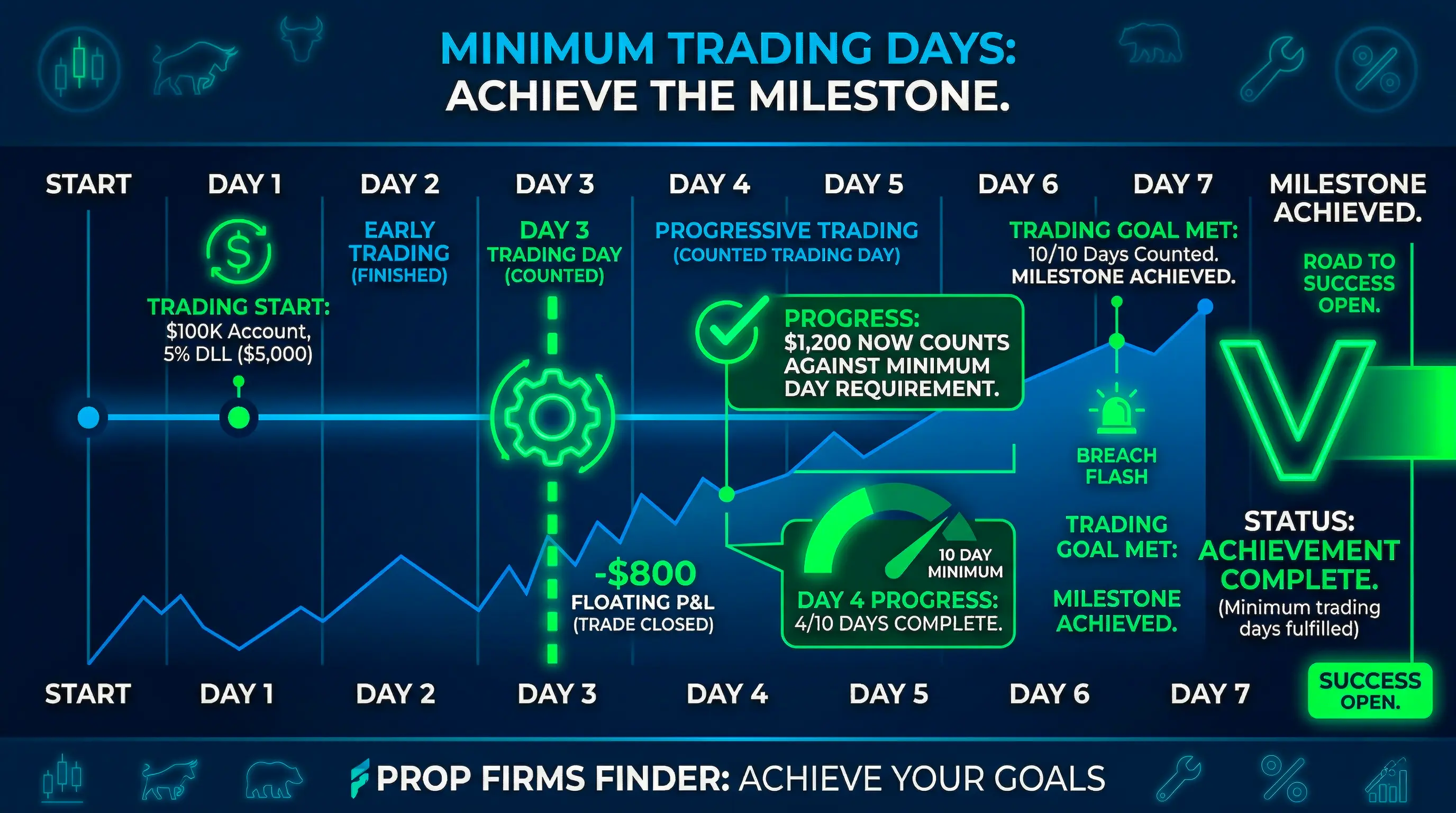
A prop firm minimum trading day rule requires traders to place trades on a minimum number of separate days during the evaluation, usually 3 to 10 days. A trading day typically counts when at least one position is opened and closed. Hitting the profit target without meeting the minimum days means the evaluation cannot be submitted as passed.
What Are Minimum Trading Days?
Minimum trading days is a rule that requires you to trade on a set number of separate calendar days before the evaluation can be marked as passed. If the firm requires 5 minimum trading days and you hit your profit target on day 2, you still need to trade on 3 more separate days before the evaluation is complete.
The rule is not the same as a time limit. A time limit sets the maximum number of days you have to pass (e.g., 30 days). Minimum trading days sets the minimum number of days you must actively trade. You need to satisfy both: trade enough days (minimum) within the allowed window (maximum).
Why the rule exists: firms want to see multiple days of trading behavior, not a single lucky session. A trader who makes 10% in one afternoon hasn't proven consistency. A trader who makes 10% over 5-10 separate sessions has demonstrated repeatable performance. The minimum day rule filters for the second type.
What Counts as a "Trading Day"?
This is where most confusion lives. The answer varies by firm.
The Round-Trip Definition
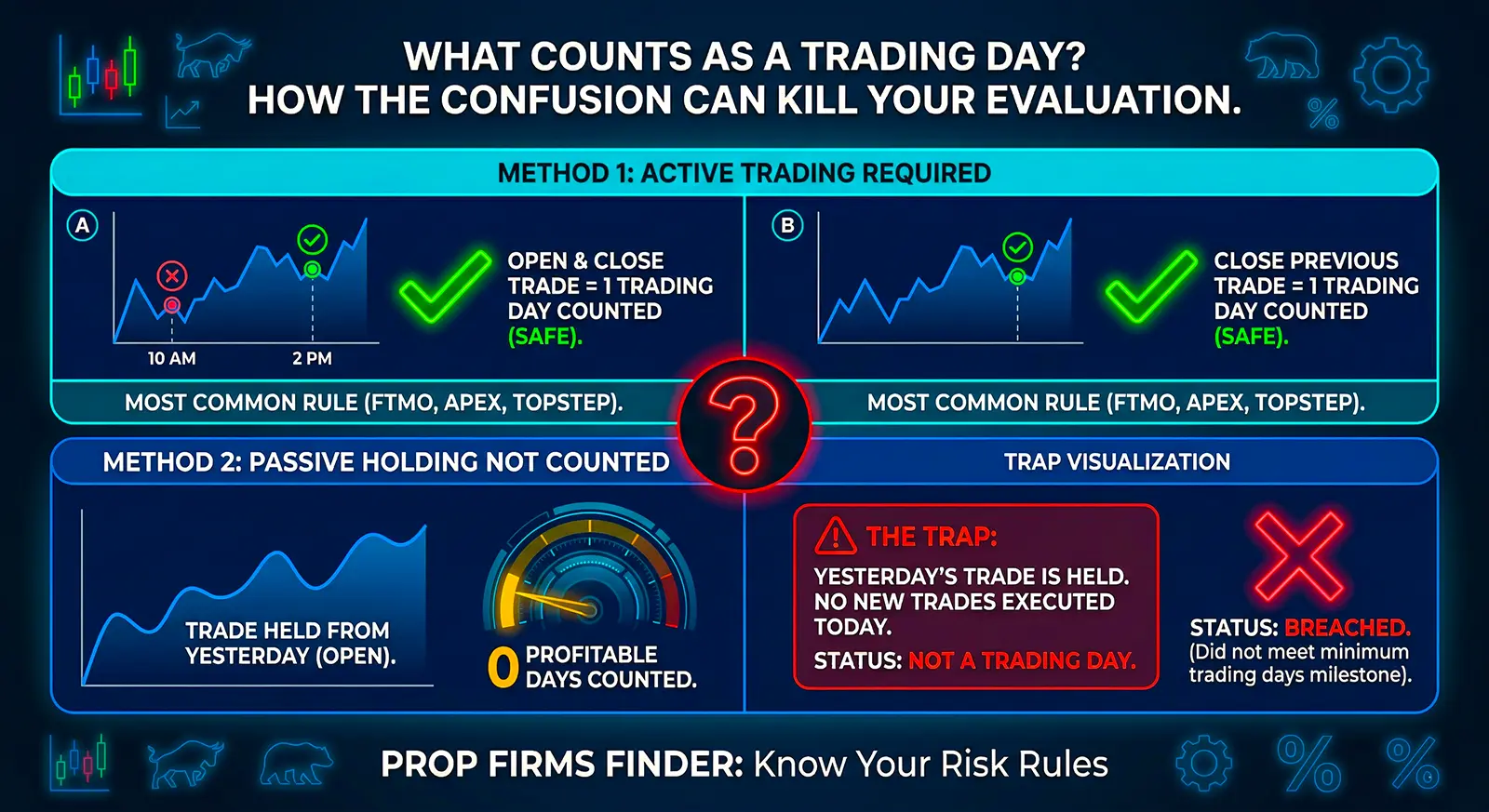
Most firms require at least one position to be opened AND closed on the same day for it to count. This is a round-trip trade. If you open a trade on Monday but don't close it until Wednesday, Monday counts as an active day only if you also closed a different trade on Monday. Simply holding a position from a prior day doesn't count.
FTMO requires trade execution (opening or closing) on the day. If you only hold an existing position without placing any new trades or closing any, the day doesn't count.
The Open-Only Definition
Some firms count a day as active if you opened at least one new position, even if you didn't close it that day. This is less common. Always check which definition your firm uses.
Weekends and Holidays
Weekends don't count as trading days because markets are closed (or in the case of forex, closed from Friday 5 PM ET to Sunday 5 PM ET). Public holidays where markets are closed also don't count. If you're on a 5-day minimum and start your evaluation on a Wednesday, the earliest you can finish is the following Tuesday (5 weekdays).
Server Time vs. Local Time
When does a "day" start? At the firm's server time, not your local time zone. FTMO resets at midnight CET. Topstep resets at a US-based time. If you're in Asia and trade at 1 AM local time, that may fall on a different calendar day than you expect at the firm's server.
Position Held Over Multiple Days
If you open a trade on Tuesday and close it on Thursday without any other activity, does that count as 1 day, 2 days, or 3 days? At most firms, it counts as 2 days (the day you opened and the day you closed). Wednesday (when you only held) doesn't count unless you opened or closed something else. Verify your firm's specific counting method.
Common Minimum Trading Day Thresholds
No Minimum Days (Same-Day Pass Possible)
Some firms have no minimum trading day requirement. The 5%ers has no minimum days on most programs. If you hit the profit target on day 1, you've passed. This suits swing traders who take a few high-conviction trades rather than trading every day.
2-3 Day Minimum
Topstep requires a minimum of 2 trading days on their Trading Combine. The consistency target (best day can't exceed 50% of total profit) functionally requires more than 2 days for most traders. Some 1-step evaluations use 3 days.
4 Day Minimum (FTMO)
FTMO requires 4 minimum trading days in each evaluation phase (Challenge and Verification). Since FTMO uses a 2-step model, that's 4 days per phase, 8 days total minimum across both phases.
5 Day Minimum
A common threshold at many forex and futures prop firms. Apex Trader Funding requires a minimum of 7 trading days during evaluation (verify current rules). My Funded Futures varies by plan.
10+ Day Minimum (Conservative Firms)
Some firms require 10 or more trading days, targeting traders who trade frequently and demonstrate consistent daily behavior. These thresholds are more common at firms that also enforce strict consistency rules.
Minimum Trading Days by Evaluation Type
1-Step Evaluations
One evaluation phase with one minimum day requirement. If the firm requires 5 days and you hit the target on day 5, you're done.
2-Step Evaluations
Each phase typically has its own minimum day requirement. FTMO: 4 days in Phase 1 (Challenge) + 4 days in Phase 2 (Verification) = 8 total minimum trading days. You can't combine days across phases.
Instant Funding
Instant funding accounts typically have no evaluation-phase minimum days because there's no evaluation. Some firms require minimum trading days on the funded account before the first payout can be requested (e.g., 5 days of trading before withdrawal eligibility).
The "Profitable Day" Requirement
Some firms don't just require minimum trading days. They require minimum profitable days.
What Is a Profitable Day?
A day where your net P&L is positive. Some firms set a threshold: the day must show at least 0.5% or 1% profit on the account to count as a "profitable day." This is stricter than a minimum trading day because you can't satisfy it with a tiny compliance trade.
How It Differs From Minimum Trading Days
Minimum trading days: trade on X separate days. Any trade counts, regardless of outcome.
Minimum profitable days: trade profitably on X separate days. Only winning days count.
The profitable-day requirement is harder to game because you can't place a 1-lot 1-pip trade to satisfy it. You need actual profit. This makes it a tougher compliance hurdle.
The Over-Trading Trap: How the Rule Blows Accounts
This is the section that matters most if you're reading this because you hit the profit target early.
The Scenario
You buy a $100,000 evaluation with a 10% profit target and a 5-day minimum. You hit $10,000 profit on day 2. You need 3 more trading days. Your account now has a $10,000 cushion above the target, and you need to trade for 3 more days without losing so much that you fall below the target.
Why Traders Lose After Hitting the Target
The pressure to "just get through" the remaining days leads to sloppy trading. Traders take setups they wouldn't normally take. They feel compelled to trade, even on days with no good entries. They size up because they feel safe with the cushion. One bad day erases the cushion and now they're scrambling to recover.
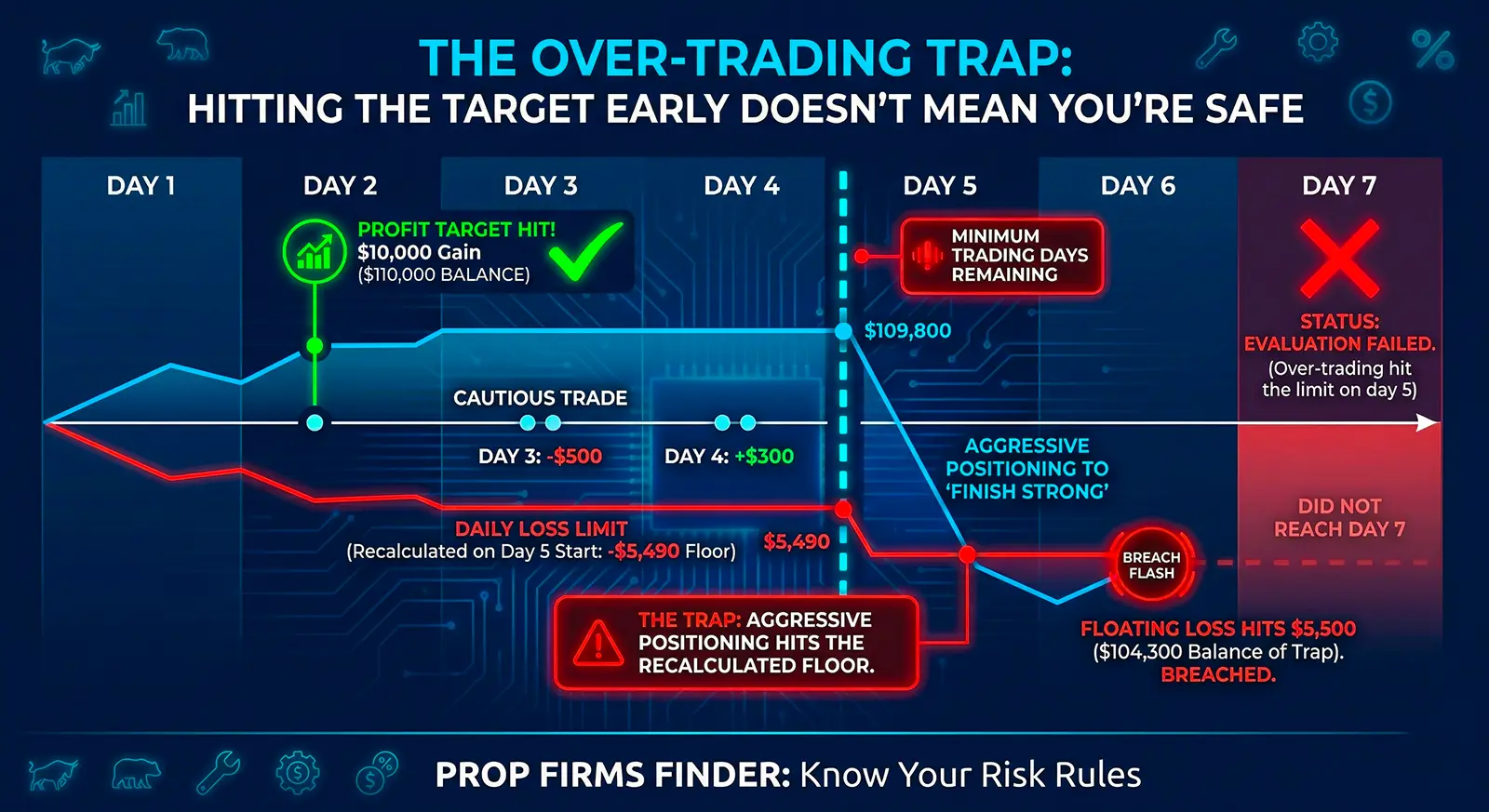
The daily loss limit is especially dangerous here. On a $110,000 account (after $10K profit), the daily loss limit is recalculated to $5,500 (5% of $110K at firms that use previous-day-close baseline). A bad morning can blow through $5,500 and fail the entire evaluation.
How to Protect Your Account After Reaching the Target
The answer is simple: trade the minimum possible. Place small, low-risk positions that satisfy the day requirement without risking the cushion. A 0.01-lot trade with a tight stop loss counts as a trading day at most firms. Risking $5 to satisfy a day is better than risking $2,000 to "make the most of it."
How to Safely Satisfy Minimum Trading Days
Plan Your Schedule Before You Start
Count the minimum days. Count the available calendar days in your evaluation window. Add a 2-day buffer. If the minimum is 5 days and the window is 30, plan to trade on 7 separate days. This protects against missed days (sick, travel, no setups).
Use Small Positions After the Target
Once you've hit the profit target, your goal changes. You're no longer trading for profit. You're trading for compliance. Place the smallest position your firm allows. Close it for a small gain or loss. Day satisfied. Account intact.
The Compliance Trade
Open 0.01 lots (or 1 micro contract on futures), set a tight take-profit, close within minutes. Net P&L: $1 to $5. This counts as a trading day at most firms. The risk to your account is negligible. This is standard practice and is not considered gaming at most firms.
Caveat: a few firms require minimum P&L thresholds per trading day (e.g., profitable days with 0.5%+ gain). At those firms, a $1 compliance trade doesn't count. Check your firm's specific definition.
For more evaluation tactics, see our how to pass a prop firm evaluation guide.
Minimum Trading Days and Other Rules
Minimum Days and Time Limit
If the firm gives you 30 days and requires 5 minimum trading days, you have plenty of room. If the firm gives you 14 days and requires 10 trading days, you must trade on 71% of available days. The tighter the time limit relative to the minimum, the less flexibility you have to wait for good setups.
Minimum Days and Consistency Rule
The consistency rule requires that no single day accounts for more than X% of total profit. If you hit your profit target on day 1 with a large gain, every subsequent day needs enough profit to dilute that day's percentage. More minimum days means more dilution opportunities, which helps consistency. Fewer minimum days means the big day stays a larger percentage.
Minimum Days and Daily Loss Limit
Over-trading to satisfy minimum days is the most common cause of daily loss limit breaches after hitting the target. Traders who would otherwise stop trading are forced to keep going, and emotional trading on compliance days creates losses that cascade into breaches.
Minimum Trading Days on the Funded Account
Some firms extend the minimum day rule beyond evaluation.
Payout Eligibility Days
FTMO requires 30 calendar days on the funded account before the first payout. During those 30 days, you must trade actively. Other firms require 5 or 7 trading days on the funded account before withdrawal eligibility.
Why Firms Use Funded-Phase Minimums
The same logic as evaluation minimums: the firm wants to see consistent trading behavior before paying out. A trader who makes $5,000 on day 1 of a funded account and immediately requests withdrawal hasn't demonstrated the kind of trading behavior the firm wants to fund long-term.
Minimum Trading Days Across Major Prop Firms (April 2026)
Rules verified against each firm's publicly available terms as of April 2026. Always verify before purchasing.
|
Firm |
Min Days (Eval) |
Eval Type |
What Counts |
Funded Min Days |
Notes |
|
FTMO |
4 per phase |
2-Step |
Trade executed (open or close) |
30 calendar days before first payout |
8 total minimum across both phases |
|
FTMO (1-Step) |
2 |
1-Step |
Trade executed |
30 calendar days |
Fewer days than 2-Step |
|
Topstep |
2 |
1-Step (Combine) |
Trade executed |
Varies |
Consistency target functionally requires more |
|
Apex Trader Funding |
7 |
1-Step |
Trade executed |
Varies by payout request |
Verify current rules |
|
FundedNext (Stellar 2-Step) |
5 per phase |
2-Step |
Trade executed |
Varies |
10 total minimum across both phases |
|
FundedNext (Stellar 1-Step) |
5 |
1-Step |
Trade executed |
Varies |
|
|
The 5%ers |
None |
1-Step / 2-Step / Bootcamp |
N/A |
Varies by program |
No minimum days on most plans |
|
My Funded Futures |
Varies |
1-Step |
Trade executed |
Varies |
Check specific plan |
|
Tradeify |
Varies by plan |
1-Step |
Trade executed |
Varies |
Check specific plan |
The range is 0 to 10 minimum days. The 5%ers stands out with no requirement. FTMO's 2-Step requires 8 days total (4 per phase). FundedNext's 2-Step requires 10 (5 per phase). Futures firms vary but typically require 2-7 days.
Fastest Theoretical Pass Time by Firm
|
Firm |
Min Days |
Fastest Theoretical Pass |
Constraint |
|
The 5%ers |
0 |
1 day |
Hit profit target |
|
Topstep |
2 |
2 calendar days |
Consistency target may require more |
|
FTMO (1-Step) |
2 |
2 calendar days |
Hit profit target on day 2 |
|
FTMO (2-Step) |
4+4 |
8 calendar days |
4 days Phase 1 + 4 days Phase 2 |
|
FundedNext (1-Step) |
5 |
5 calendar days |
Hit profit target on day 5 |
|
FundedNext (2-Step) |
5+5 |
10 calendar days |
5 days per phase |
|
Apex |
7 |
7 calendar days |
Verify current rules |
These are mathematical minimums. In practice, hitting the profit target while satisfying minimum days, consistency rules, and drawdown limits takes most traders 2-4 weeks.
Common Minimum Trading Days Misconceptions
"Hitting the Profit Target Means I Passed"
Not if the minimum days aren't met. Your evaluation dashboard will show "profit target: met" and "minimum days: not met." The evaluation stays open until both are satisfied.
"Weekends Count as Trading Days"
No. Markets are closed. Only business days when markets are open and you execute at least one trade count.
"Holding a Position Counts as a Trading Day"
At most firms, no. Passively holding a trade carried from a prior day does not count. You need to execute a new trade (open or close) for the day to register.
"Multiple Trades on One Day Count as Multiple Days"
No. 50 trades on Monday count as 1 trading day: Monday. You need to trade on separate calendar days.
"The Rule Doesn't Apply If I Finish Early"
It does. If you hit the profit target on day 2 but the minimum is 5 days, you must trade on 3 more separate days. The target being met doesn't waive the minimum.
"All Firms Require 5 Minimum Days"
They don't. The 5%ers requires 0. Topstep requires 2. FTMO requires 4 per phase. FundedNext requires 5 per phase. The range is wide.
Is the Minimum Trading Days Rule a Dealbreaker?
When the Rule Helps
It forces you to demonstrate consistency across multiple sessions. Traders who trade daily anyway won't notice the rule. It also prevents evaluation-day gambling where a trader bets big on one session.
When It Hurts
Swing traders who take 2-3 trades per week may struggle to hit 5+ minimum days in a 30-day window. Traders who hit the target early face the over-trading trap. Traders in time zones with limited market access may find it harder to trade on enough separate days.
Choosing a Firm Based on Trading Frequency
If you trade daily, minimum days won't affect you. Choose based on other factors. If you trade 2-3 days per week, look for firms with low minimums (Topstep: 2 days, The 5%ers: none). If you trade infrequently, avoid firms with high minimums or tight time limits.
Compare firms on all factors on our best prop firms rankings page.
Frequently Asked Questions
How many minimum trading days do most prop firms require?
Most firms require between 2 and 5 minimum trading days per evaluation phase. FTMO requires 4 per phase. FundedNext requires 5 per phase. Topstep requires 2. The 5%ers requires none.
What counts as a trading day in a prop firm?
A day on which you execute at least one trade (open or close a position). Simply holding a position from a prior day without any new trading activity doesn't count at most firms.
Can I pass a prop firm evaluation in one day?
Only at firms with no minimum trading day requirement, like The 5%ers on most programs. At firms with minimum days, you must trade on the required number of separate days even if you hit the profit target on day 1.
Do weekends count as trading days?
No. Weekends and market holidays don't count because markets are closed (or nearly closed). Only weekdays with open markets and active trade execution count.
What happens if I hit the profit target before the minimum days?
The evaluation stays open. You must continue trading on additional separate days until the minimum is met. The profit target is met but the evaluation is not yet complete.
Does holding a position count as a trading day?
At most firms, no. Passively holding a position without executing any new trades doesn't count. You need activity (opening or closing a trade) on the day.
Can I place tiny trades to satisfy minimum days?
At most firms, yes. A 0.01-lot trade counts as a trading day. A few firms require minimum P&L thresholds per day (profitable days). Check your firm's specific definition.
Which prop firms have no minimum trading days?
The 5%ers has no minimum days on most programs. Some instant funding accounts also have no minimum. Always verify current terms.
Does the minimum days rule apply on the funded account?
Some firms require minimum active days before the first payout can be requested. FTMO requires 30 calendar days on the funded account. Other firms require 5-7 trading days. This is separate from the evaluation minimum.
What is a "profitable day" requirement?
Some firms require not just minimum trading days but minimum profitable days, where your daily net P&L must be positive (and sometimes above a threshold like 0.5%). This is stricter than a basic minimum trading day requirement