Simulated Capital vs Real Capital: The Truth About How Prop Firms Actually Work
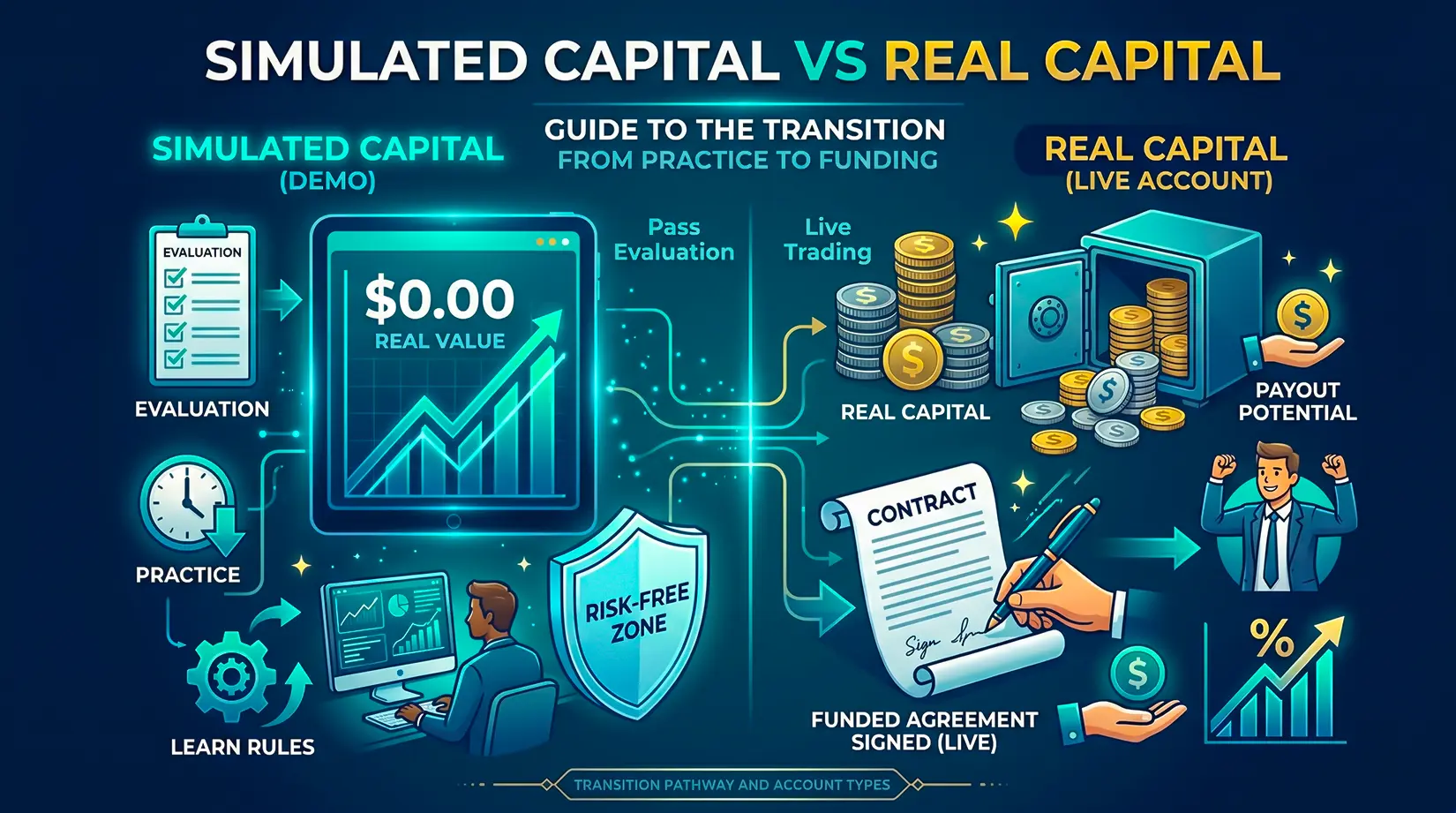
Most prop firms use simulated capital, not real trading capital. Traders execute trades in a demo environment, and the firm pays real money based on simulated profits. This model is legal and industry-standard but is often unclear in marketing. The distinction matters for legal, tax, and risk reasons.
The Direct Answer: Is Prop Firm Money Real?
The trading capital is simulated. The payouts are real.
When a prop firm gives you a "$100,000 funded account," you're not trading real money in a live brokerage. You're trading on a demo server. The $100,000 displayed on your dashboard is virtual. Your trades don't execute on a real exchange. No broker is holding $100,000 with your name on it.
But when you make a profit on that simulated account and request a payout, you receive real USD (or crypto, or bank transfer) in your actual bank account. The money you withdraw is real. The firm pays it from its own revenue.
This is the central truth of the modern prop firm industry: simulated trading, real payouts. Understanding this doesn't make prop firms bad. It makes the model transparent. And transparency is what this page provides.
What Is Simulated Capital?
Definition
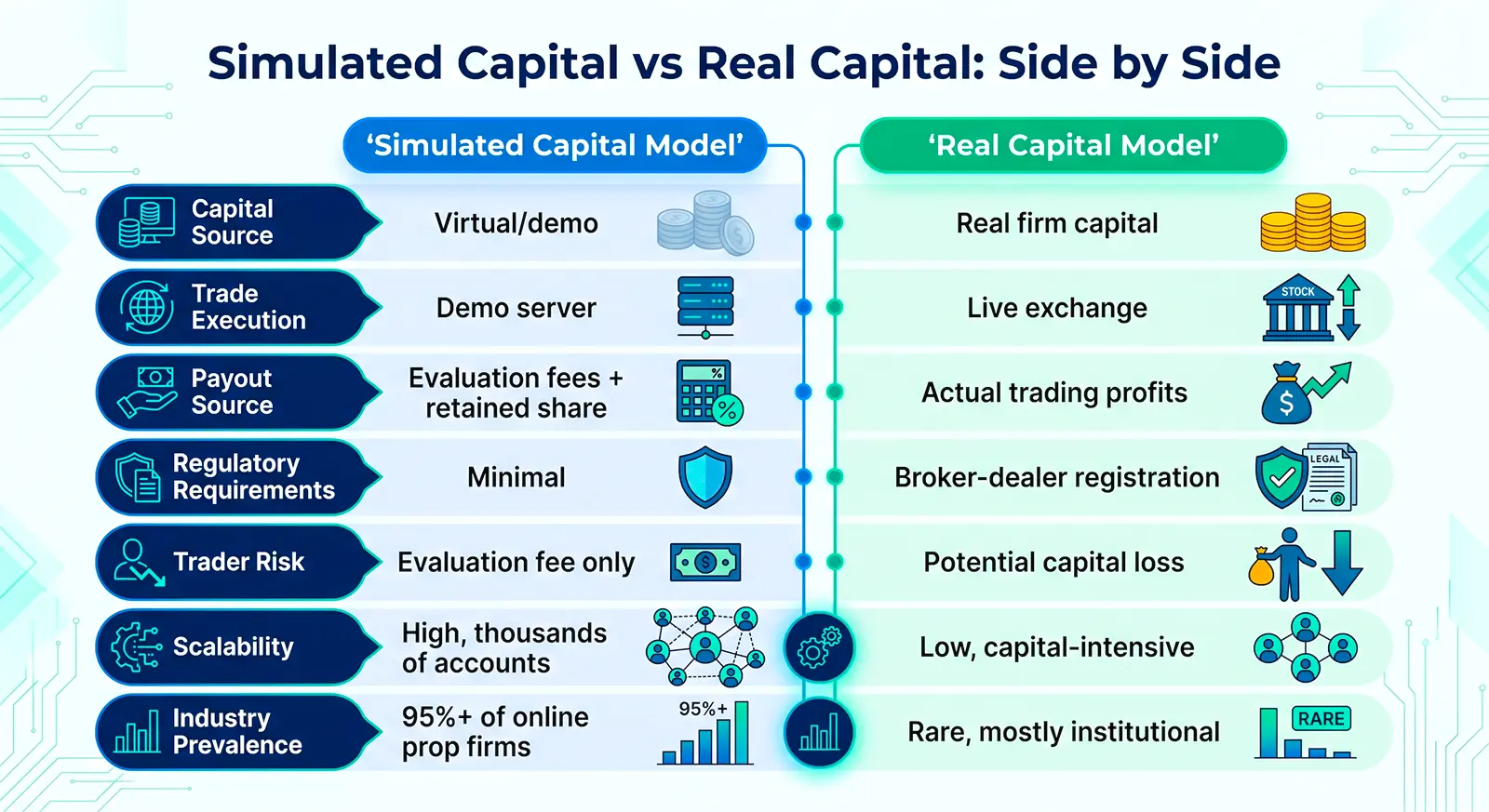
Simulated capital is virtual money used for trade execution in a demo environment. The account balance, the positions, the profits and losses are all tracked by the firm's system, but no corresponding real-money transactions happen on a live exchange. The prices are real (sourced from live market data feeds). The execution is not.
How Simulated Accounts Work
The firm connects you to a demo server provided by a broker partner (Eightcap, ThinkMarkets, or similar). The demo server feeds real-time market prices from the live market. When you click "buy EUR/USD," the platform records the entry, tracks the position, and shows P&L. But no actual EUR/USD order is placed on any exchange or with any liquidity provider.
Your account is one of potentially thousands of demo accounts on the same broker's server. The firm monitors your performance, enforces rules (drawdown, daily loss limit, consistency), and calculates your payout based on simulated results.
Why Simulated Is Different From a Standard Demo Account
A standard demo account has no real consequences. You can blow it up and reset. A prop firm simulated account has real consequences: breach the rules and you lose the evaluation fee you paid. Hit the profit target and you receive real money. The simulation is the execution method. The financial stakes are real.
What Is Real Capital?
Definition
Real capital means actual money deployed into live markets. Orders execute on exchanges. Positions exist in the real order book. If you buy 5 ES contracts on a real-capital account, 5 contracts are bought on the CME. The firm's money is at risk.
Where Real Capital Trading Exists
Traditional Wall Street proprietary trading desks (Citadel Securities, Jane Street, Jump Trading) use real capital. These firms hire traders as employees, provide live trading infrastructure, and deploy institutional capital. This is a completely different model from online retail prop firms.
A few online firms offer paths to real capital after proving consistency on simulated accounts. Phidias PropFirm transitions traders to live accounts after 3 payouts or $75,000 in cumulative withdrawals. Topstep's "Live Funded Account" option exists for qualifying traders. These hybrid paths are real but rare.
Why Real Capital Is Rare in Online Prop Firms
Deploying real capital to thousands of unproven retail traders is financially reckless. Even filtered traders have losing streaks. If a firm gave $100,000 in live capital to every trader who passed a 3-5 day evaluation, the losses from blowing accounts would bankrupt the firm within weeks.
How Simulated Prop Firms Actually Work: The Full Mechanism
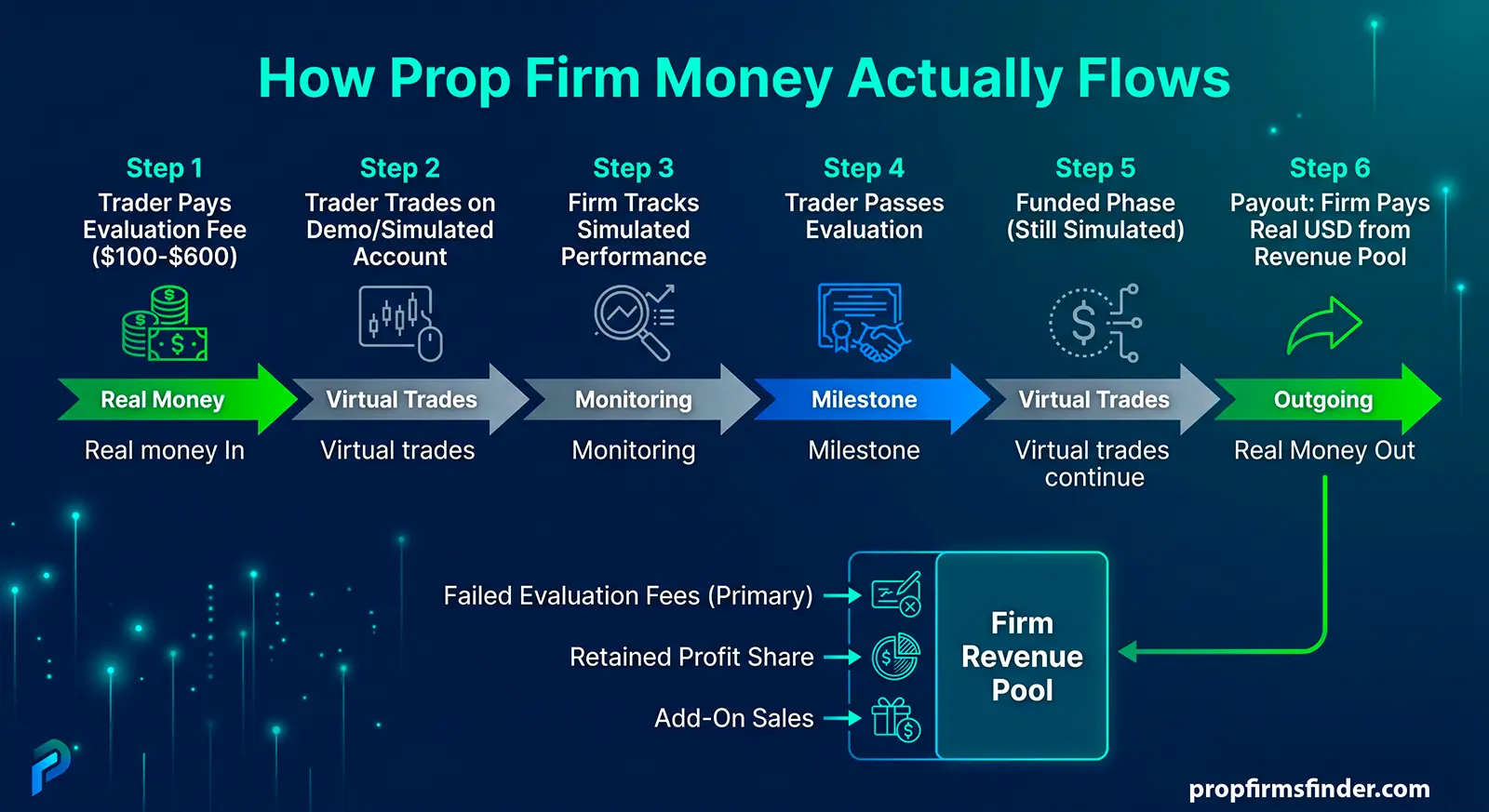
Step 1: Evaluation Fee (Real Money In)
You pay $100 to $600 for an evaluation. This is real money. It's the firm's primary revenue source.
Step 2: Simulated Trading
You trade on a demo account with real market prices. Your trades don't execute on any live exchange.
Step 3: Performance Tracking
The firm monitors your simulated P&L, drawdown, daily loss, and rule compliance.
Step 4: Passing and Getting Funded
If you hit the profit target while staying within all rules, you pass. You sign a funded trader agreement and receive a funded trading accounts.
Step 5: Funded Phase (Still Simulated)
Your funded account is still on a simulated server. The dashboard shows a $100,000 balance. Your trades still don't execute live. The difference: now your simulated profits are eligible for real payouts.
Step 6: Payouts (Real Money Out)
When you hit the payout threshold and meet all requirements (minimum days, consistency, drawdown compliance), you request a withdrawal. The firm pays you real USD based on your simulated profit multiplied by your profit split percentage.
Where Does the Payout Money Come From?
Failed Evaluation Fees (Primary Revenue)
Industry data suggests that 70-90% of traders fail evaluations. On a $300 evaluation fee, a firm processing 10,000 evaluations per month generates $3M in revenue. If 10-15% of traders pass and eventually request payouts, the firm pays out a fraction of total revenue. The math works because most traders fail.
Retained Profit Share
On an 80/20 profit split, the firm keeps 20% of every payout. A trader who earns $10,000 in simulated profit receives $8,000. The firm retains $2,000.
Add-On Sales
EA usage fees, account resets, premium dashboards, data feeds, and other add-ons generate additional revenue.
Why This Model Is Sustainable (and Why It Has Limits)
The model works as long as evaluation fee revenue exceeds payout obligations. If too many traders pass and too few new traders buy evaluations, the firm faces a revenue-payout mismatch. This is why some firms tighten rules over time (to lower pass rates) or market aggressively (to attract more evaluation buyers).
Firm closures (MyFundedFX in February 2026, MyForexFunds in August 2023) have been linked to unsustainable revenue-payout dynamics, among other factors.
Why Prop Firms Use Simulated Capital
Regulatory Cost Avoidance
Handling real client capital in live markets triggers broker-dealer registration requirements, client money protection rules, and heavy regulatory oversight. In the US, this means CFTC/NFA registration for futures and SEC/FINRA for equities. In the UK, FCA authorization. In the EU, MiFID compliance. These requirements cost millions to satisfy and maintain.
Simulated capital avoids most of these requirements because the firm isn't "managing" anyone's money. It's paying a performance-based reward from its own revenue. This legal structure is how firms operate without broker-dealer licenses.
Scalability
A firm can run 50,000 simulated accounts on a single broker's demo server. Running 50,000 live accounts would require billions in capital and massive risk infrastructure.
The Honest Answer
Simulated capital lets firms operate at scale without the capital, regulatory, and risk management overhead that real-capital trading requires. It's a business model innovation, not a deception. But the lack of clear disclosure at many firms creates legitimate trust concerns.
Is Simulated Capital Legal?
Yes. In most jurisdictions, paying a real-money reward based on performance in a simulated environment is legal. The firm is not operating as a broker, not managing client capital, and not holding deposits. The evaluation fee is a fee for a service (access to the evaluation), not a financial instrument.
Many firms legally classify themselves as research and development firms, educational firms, or software companies rather than financial services providers. This classification reflects the simulated nature of the trading and avoids triggering financial regulation.
Regulatory treatment is evolving. The CFTC took action against MyForexFunds in 2023. MetaQuotes (MT4/MT5 provider) has tightened requirements for demo account usage. Some jurisdictions are beginning to scrutinize the model more closely. The legal landscape is stable today but not guaranteed to remain unchanged.
How Firms Market Simulated Capital
Common Marketing Phrases and What They Mean
|
Marketing Language |
What It Actually Means |
|
"Funded with $100,000" |
You receive a simulated account with a $100K virtual balance |
|
"Our capital" / "Firm capital" |
The virtual balance displayed on the demo account |
|
"Real trading environment" |
Real market prices on a simulated execution server |
|
"Funded trader" |
A trader with a simulated account eligible for real payouts |
|
"Trade with up to $200,000" |
Simulated buying power, not real deployed capital |
|
"Backed by a regulated broker" |
The broker provides the execution platform; the account is still demo |
None of these phrases are technically false. They're carefully worded to be accurate while creating an impression of real capital. The difference between "funded with $100K" (which most people read as "given $100K") and "simulated account with a $100K virtual balance" is the gap this page fills.
Where Firms Disclose Simulated Status
Most firms disclose that trading is simulated. But the disclosure is typically found in the terms of service (page 8 of 15), the risk disclaimer (separate page, linked in the footer), or the funded trader agreement (presented after the evaluation is purchased). It's rarely on the main sales page.
Does Simulated Capital Mean the Firm Is a Scam?
No. Simulated Capital Is Not a Scam.
The simulated model is the industry standard. FTMO, FundedNext, The 5%ers, Apex Trader Funding, Topstep, and every major firm uses it. These firms have collectively paid hundreds of millions of dollars to traders. The capital is simulated. The payouts are real. The model works.
What Separates Legitimate Firms From Scams
Legitimate firms: pay consistently, disclose simulated status in their terms, have years of payout history, have thousands of verified reviews.
Scam firms: delay or deny payouts, change rules retroactively, have no payout history, disappear with evaluation fees. The scam is not the simulated model. The scam is a firm that collects fees and doesn't pay.
Red Flags to Watch For
No verifiable payout history. Firm registered less than 1 year ago with no track record. Promises that seem too good (99% pass rates, guaranteed profits). No public-facing terms of service. No response from support. Negative Trustpilot pattern (not 1-2 bad reviews, but dozens of unpaid payout complaints).
What Simulated Capital Means for You as a Trader
Tax Implications
Prop firm payouts are ordinary income, not capital gains. You're classified as an independent contractor receiving performance-based compensation. In the US, this means federal income tax plus self-employment tax. International traders report under their home country's rules. Consult a tax professional for specifics.
Legal Protections You Don't Have
Because you're not a brokerage client, you have no broker protections. No FDIC insurance. No SIPC coverage. No client money segregation. If the firm fails, your unrequested payouts are not protected by any financial safety net. Your relationship is governed by the trader agreement, not by financial regulation.
Risk You Don't Take
You can't lose trading capital because the capital isn't real. Your maximum financial risk is the evaluation fee you paid. A blown funded account costs you zero beyond the original fee. This is the upside of the simulated model: the evaluation fee is your total risk.
What Happens If the Firm Fails
If a prop firm closes (MyFundedFX in February 2026), traders with outstanding funded accounts lose access. Unrequested payouts are typically unrecoverable. There is no insurance, no compensation scheme, and limited legal recourse (especially cross-border). The funded trader agreement usually includes force majeure language that releases the firm from obligations in such scenarios.
Execution Quality: Simulated vs. Real Accounts
Simulated accounts may not execute identically to live accounts, even at the same broker.
Slippage: Simulated accounts often have less slippage than live accounts because orders don't interact with a real order book. A strategy that works on a simulated account with zero slippage may underperform on a live account.
Spreads: Some firms provide tighter spreads on demo than on live. Others mirror live spreads accurately. The difference affects strategy profitability.
Fill quality: On a simulated account, every order fills instantly at the requested price. In live markets, large orders may partially fill or fill at worse prices. This matters for strategies that depend on precise entry and exit.
The practical takeaway: strategies that barely pass evaluation with thin margins may not perform the same way on a live account (if the firm transitions you) or on a personal account.
Firms That Claim Real or Hybrid Capital
A few firms claim to use real capital or hybrid models.
Trade Mirroring/Copying
Some firms claim to copy profitable funded traders' positions into a live account managed by the firm. BrightFunded and a few others reference this model. The challenge: there's no independent way to verify whether trade mirroring is happening. The firm says it mirrors. Traders have no visibility into the firm's live accounts.
Progression to Live
Phidias PropFirm transitions traders to live accounts after meeting payout milestones. Topstep offers a live funded account path. These are verifiable through platform confirmation (traders can see whether they're on a demo or live server). This is the most transparent version of the hybrid model.
How to Evaluate Claims
If a firm claims real capital or trade mirroring, ask: can the trader independently verify they're on a live server? If the answer is no, the claim is unverifiable. If the answer is yes (Phidias, Topstep's live path), the claim has substance.
How to Verify a Firm's Capital Model Before Signing Up
Read the Full Terms of Service
Search the document for "simulated," "demo," "virtual," or "fictitious." Most firms include this language. Its presence confirms the simulated model.
Check the Risk Disclaimer
Most firms have a risk disclaimer page (often linked in the footer). It typically states that trading is conducted in a simulated environment and that "funded" accounts use virtual capital.
Verify the Funded Trader Agreement
The funded trader agreement almost always formalizes the simulated capital status. If the agreement says "simulated" or "demo" or "virtual capital," that's the definitive answer.
Understand the Broker Partnership
A firm partnering with a regulated broker (Eightcap, ThinkMarkets) means the broker provides the platform and market data. It does not mean your trades execute live through that broker. The broker is real. Your account at the broker is demo.
Compare firms transparently on our best prop firms rankings page.
Common Simulated Capital Misconceptions
"If It's Simulated, It's a Scam"
Wrong. Simulated capital is the industry standard. FTMO (operating since 2015, $450M+ in payouts), Topstep (operating since 2012, $1.1B+ in payouts), and every major firm uses simulated accounts. The model is legitimate.
"Simulated Means Fake Payouts"
Wrong. Payouts are real money sent to your bank account or crypto wallet. The trading is simulated. The compensation is real.
"All Prop Firms Use Real Capital"
Wrong. The vast majority of online retail prop firms use simulated capital. A few institutional-style firms and hybrid models exist, but they're the exception.
"The Broker Partnership Means I'm Really Trading"
Not necessarily. The broker provides the demo server and market data. Your orders execute on a demo environment at the broker, not in the live market.
"I Can Lose Real Money Trading Simulated Capital"
You can lose your evaluation fee (real money you paid to access the evaluation). You cannot lose trading capital because the trading capital is virtual. A blown funded account costs you zero beyond the original fee.
"Simulated Capital Has No Rules"
Wrong. Rules (drawdown, daily loss limit, consistency, minimum days) are enforced identically whether the capital is simulated or real. Breaching a rule on a simulated account has the same consequence as on a live account: account termination.
Frequently Asked Questions
Is prop firm money real?
The trading capital is simulated (virtual). The payouts you receive are real money sent to your bank account.
Do prop firms pay real money from simulated trading?
Yes. Firms pay real USD from their revenue (primarily failed evaluation fees) based on your performance in a simulated environment.
Is simulated capital the same as a demo account?
Technically, the execution environment is similar. The difference: a standard demo account has no financial stakes. A prop firm simulated account has real financial consequences (evaluation fee at risk, real payouts for profitable performance).
Are simulated capital prop firms legal?
Yes, in most jurisdictions. The firms are paying performance-based compensation, not managing client capital. Regulatory treatment varies by jurisdiction and is evolving.
How do prop firms make money?
Primarily from evaluation fees paid by traders who don't pass. Secondary revenue from retained profit share on payouts and add-on sales.
Can I lose real money at a prop firm?
You can lose the evaluation fee you paid (real money). You cannot lose trading capital because it's virtual. A blown funded account costs zero beyond the original fee.
Why do prop firms use simulated capital instead of real money?
Regulatory cost avoidance (no broker-dealer registration), capital efficiency (no need to deploy real capital to thousands of traders), and risk management (no exposure to live market losses from unproven traders).
Are there any prop firms that use real capital?
Traditional institutional prop desks use real capital. A few online firms offer paths to live accounts after proving consistency on simulated accounts (Phidias, Topstep's live path). These are rare.
What happens to my profits if the prop firm goes out of business?
Unrequested payouts are typically unrecoverable. There is no insurance or compensation scheme. The funded trader agreement usually releases the firm from obligations during insolvency. This is a model risk.
Is simulated capital a scam?
No. Simulated capital is the industry standard used by every major prop firm. The legitimacy of a firm depends on whether it pays consistently and operates transparently, not on whether the capital is simulated.
Why don't prop firms clearly disclose that it's simulated?
Most firms do disclose it, but in terms of service, risk disclaimers, and trader agreements rather than on the main sales page. Marketing language is designed to impress, not to clarify the execution model. The disclosure exists. It's just not prominent.
How is simulated capital different from a demo account?
Execution is similar (both use demo servers). The difference is stakes: a demo account has no financial consequences. A prop firm simulated account has real financial consequences (you paid for the evaluation, you can earn real payouts)