What Is a Funded Trader Agreement? The Legal Document Between You and the Prop Firm
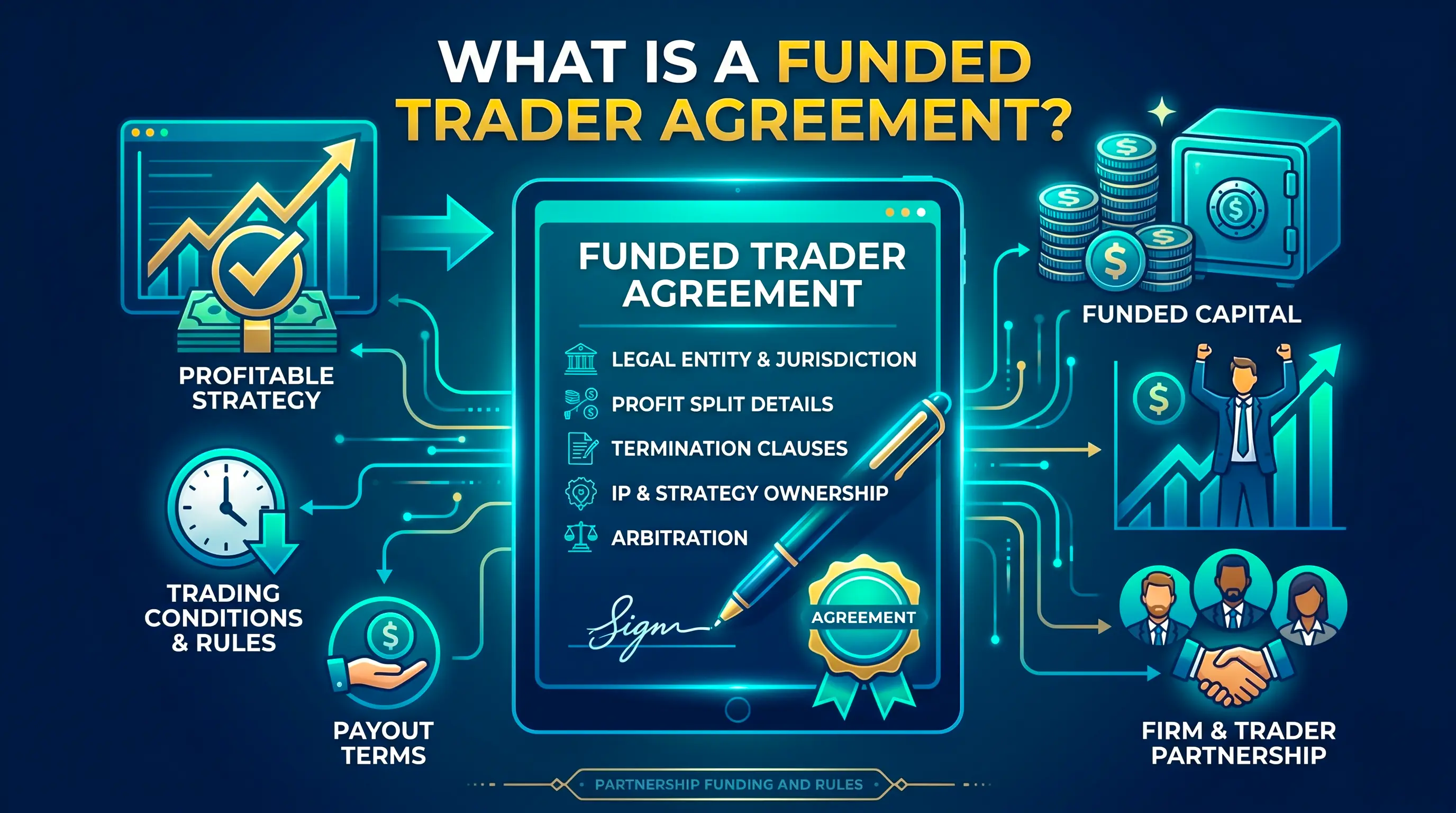
A funded trader agreement is the contract a prop firm requires a trader to sign after passing the evaluation, before accessing the funded account. It governs profit splits, payout terms, account termination rights, rule compliance, simulated capital disclosure, and the legal relationship between trader and firm.
LEGAL DISCLAIMER: This page is educational content about the general structure of funded trader agreements. It is not legal advice. Laws vary by jurisdiction and agreements vary by firm. Consult a licensed attorney in your jurisdiction for advice specific to your situation.
What Is a Funded Trader Agreement?
A funded trader agreement is the formal legal contract between you and the prop firm that governs every aspect of your funded account relationship. It defines what you're allowed to do, what you'll be paid, how the firm can terminate the relationship, and what recourse you have if something goes wrong.
Most traders encounter this document after how to pass a prop firm evaluation. The dashboard congratulates them. A link appears to accept the trader agreement. Most traders click "accept" and start trading. Very few read the full document.
That's a problem. The agreement overrides marketing promises. "Up to 90% profit split" becomes "subject to terms in section 4." "Scale to $2.5M" becomes "at the firm's sole discretion." "Refundable evaluation fee" becomes "upon first successful payout subject to full compliance." The agreement is where the actual terms live.
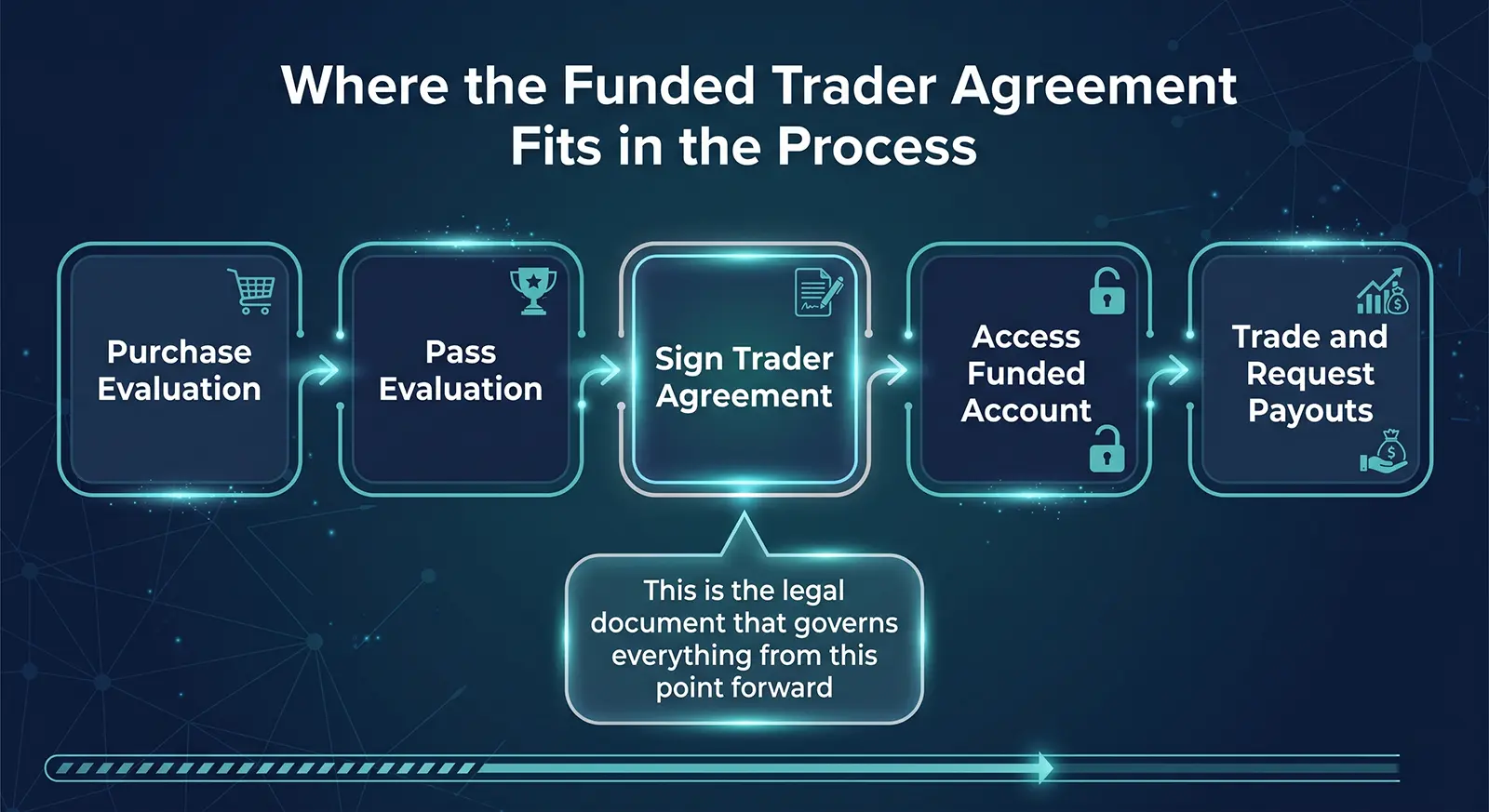
When You Sign the Agreement
At Signup (Initial Terms Acceptance)
Some firms present the trader agreement as part of the initial signup process. When you create an account and buy an evaluation, you accept the firm's Terms of Service, which may include or reference the trader agreement. In these cases, you've agreed to the terms before you've traded a single day.
After Passing the Evaluation
Most firms present a separate funded trader agreement after you pass. This is a distinct document from the general Terms of Service. It specifically governs the funded account relationship: profit split, payout mechanics, compliance requirements, and termination rights.
Why the Timing Matters
If the agreement is presented at signup, you've committed before you know whether the evaluation terms are acceptable. If it's presented after passing, you've already invested time and an evaluation fee, which creates pressure to accept without reading. In both cases, reading the document before committing money is the safer approach.
The Parties to the Agreement
The Firm's Legal Entity
The legal entity that signs the agreement is often different from the brand name you see in marketing. FTMO the brand is operated by FTMO s.r.o., a Czech entity. FundedNext operates through a Bangladesh-registered entity. The legal entity determines which country's laws govern the agreement, where disputes are resolved, and which regulatory framework (if any) applies.
Check the first section of any agreement for the full legal name, registration number, and registered address. This is the entity you'd deal with in a dispute, not the marketing brand.
The Trader
The trader signs as an individual or through a business entity (LLC, sole proprietorship). How you sign affects tax treatment and liability. Most traders sign as individuals.
Standard Clauses in a Funded Trader Agreement
Profit Split Terms
The agreement formalizes the profit split percentage, when it's calculated, and how it's paid. Look for: the base split percentage, conditions under which the split increases (e.g., scaling plan), whether the split is calculated on gross or net profit, and whether commissions and swap fees are deducted before the split calculation.
Payout Mechanics and Timing
How and when payouts are processed. Common details: payout frequency (weekly, bi-weekly, monthly), minimum payout threshold, minimum trading days before first payout (FTMO requires 30 calendar days on the funded account), payout methods (bank transfer, crypto, Deel, Rise), and processing time. The agreement is where you find the actual schedule, not the marketing page.
Simulated Capital Disclosure
This is the clause most traders miss or misunderstand. Most funded trading accounts use simulated (demo) capital, not real money in a brokerage. The agreement formalizes this: "Trading is conducted in a simulated environment" or "The trader is provided with virtual capital." Your dashboard shows a $100,000 balance, but no $100,000 is deposited anywhere with your name on it.
This isn't a trick. It's the industry model. But it matters legally because you're not managing real assets. You're performing services (trading simulated capital) and receiving compensation (profit split payouts) as a contractor.
Account Termination Rights
Who can terminate the account and under what conditions. Typical language gives the firm broad termination rights: breach of any trading rule, violation of terms, at the firm's sole discretion, or for regulatory or legal reasons. Trader termination rights are usually simple: you can stop trading at any time, but you forfeit any unrealized profits and there's no refund of the evaluation fee.
Rule Compliance
The agreement typically incorporates all trading rules (drawdown, daily loss limit, consistency rule, minimum trading days, news trading restrictions) by reference. If you breach any rule, the agreement gives the firm the right to terminate the account and disqualify profits.
Refund Terms
If the firm advertises a "refundable evaluation fee," the agreement specifies the conditions: typically "upon first successful payout on the funded account, subject to full compliance with all terms." This means the refund isn't automatic. It's contingent on earning a payout, which requires passing, getting funded, trading profitably, and meeting all rules.
Contractor vs. Employee: Your Legal Classification
Funded traders are classified as independent contractors at nearly every prop firm. You are not an employee.
What This Means in Practice
You receive no benefits (health insurance, retirement, paid leave). You're responsible for your own taxes, including self-employment tax in the US. You have no employment protections (no wrongful termination claims, no minimum wage, no overtime). The firm doesn't withhold taxes from your payouts. You receive a 1099-NEC (in the US) or equivalent, not a W-2.
Tax Implications
Prop firm payouts are ordinary income, not capital gains. In the US, you pay federal income tax plus self-employment tax (15.3% for Social Security and Medicare). International traders report payout income under their home country's tax rules. Consult a tax professional. The specifics vary by jurisdiction and individual circumstances.
|
Employee |
Independent Contractor (Funded Trader) |
|
|
Tax withholding |
Employer withholds |
You handle it yourself |
|
Benefits |
Health, retirement, PTO |
None |
|
Tax form (US) |
W-2 |
1099-NEC |
|
Self-employment tax |
Split with employer |
You pay full 15.3% |
|
Termination protections |
Employment law applies |
Contract terms only |
|
Business deductions |
Limited |
Broad (platform fees, data, equipment) |
The "Sole Discretion" Clause
You'll see the phrase "at the firm's sole discretion" throughout most agreements. It appears in profit split adjustments, account termination, payout approval, scaling plan progression, and rule interpretation.
What it means: the firm can make unilateral decisions on these matters without the trader's consent. The firm decides whether your payout is approved. The firm decides whether a rule violation occurred. The firm decides whether to scale your account.
Why firms include it: operational efficiency and risk management. Reviewing every edge case with mutual agreement would be impractical at scale. But it also means the firm has broad authority over the relationship.
Arbitration and Class Action Waivers
What Arbitration Means
An arbitration clause means disputes between you and the firm go to a private arbitrator instead of a public court. Arbitration is typically faster than court proceedings but offers fewer procedural protections (no jury, limited discovery, limited appeal rights). The firm usually selects the arbitration provider and jurisdiction.
Class Action Waivers
A class action waiver means you agree not to join a group lawsuit against the firm. If 500 traders have the same complaint, each must pursue individual arbitration rather than filing a collective claim. This significantly reduces the firm's exposure to large-scale litigation.
These clauses are increasingly common across the prop firm industry.
Strategy Ownership and IP Clauses
Most firms do not claim ownership of your trading strategy. Your analysis, your EA code, your indicators remain yours.
Some agreements include confidentiality clauses that restrict you from sharing the firm's proprietary tools, platform details, or internal processes. This is different from strategy ownership. The firm doesn't own your strategy; they want you to keep their systems confidential.
A few firms include broader IP language. If you develop a strategy while using the firm's infrastructure, some agreements claim a right to review or audit that strategy. Read this section carefully. If the language is ambiguous, ask support for clarification in writing.
How Firms Can Change the Agreement
Unilateral Amendment
Most agreements give the firm the right to modify the terms at any time with or without notice. Some firms commit to notifying traders of material changes (usually by email or dashboard notification). Others reserve the right to update terms without individual notification.
What Happens When Terms Change
Continued use of the platform after a change typically constitutes acceptance of the new terms. If you disagree with a change, your recourse is usually to stop trading and terminate the account. You typically can't insist on the original terms.
This matters long-term. The agreement you sign today may not be the same agreement governing your account in 12 months.
Jurisdiction and Governing Law
Why It Matters
The governing law clause determines which country's (or state's) laws apply to the agreement. If a firm is registered in the Czech Republic and the agreement specifies Czech law, any dispute is governed by Czech courts or Czech arbitration, regardless of where you live.
Common Jurisdictions
UK-registered firms (including some London-based firms) use English law. US-registered firms typically specify a US state (Delaware, Texas, Wyoming). Dubai-based firms use UAE law. Czech firms use Czech law. The jurisdiction affects what consumer protections apply, how arbitration works, and what enforcement mechanisms exist.
Cross-Border Trader Considerations
If you're a US-based trader using a Dubai-registered firm under UAE law, enforcing any agreement provision requires navigating a foreign legal system. The practical difficulty of cross-border enforcement should factor into your firm selection.
Force Majeure: What Happens If the Firm Fails
Force majeure clauses address what happens during extraordinary events: firm bankruptcy, broker partner failure, platform outages, regulatory actions, or major market disruptions.
Typical language releases the firm from obligations during force majeure events. If the firm's broker partner goes down or the firm itself becomes insolvent, the agreement usually states the firm is not liable for losses or unpaid profits during such events.
What you're entitled to in practice: probably very little. If a firm closes (MyFundedFX in February 2026, MyForexFunds in August 2023), traders with outstanding funded accounts and unrequested payouts have limited recourse. The funded trader agreement typically does not guarantee repayment in bankruptcy.
What to Check Before Signing a Funded Trader Agreement
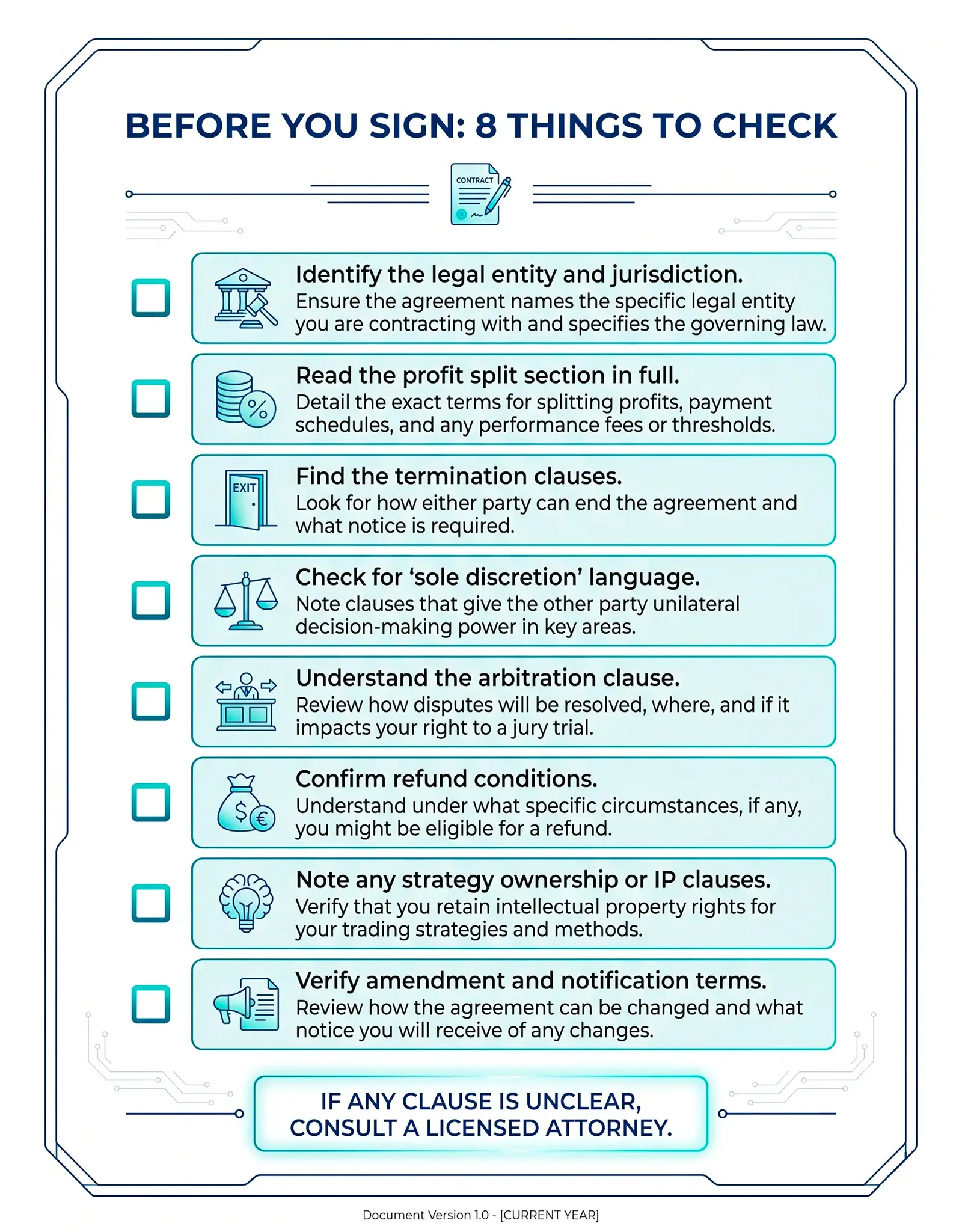
Identify the Legal Entity
Find the firm's full legal name, registration number, and jurisdiction. This tells you which country's laws govern your relationship.
Read the Profit Split Section
Confirm the base split, conditions for increases, what's deducted before calculation, and whether the split can change without your consent.
Find the Termination Clauses
Understand the conditions under which the firm can terminate your account. Look for "sole discretion" language that gives the firm broad authority.
Understand the Arbitration Clause
If disputes go to arbitration, know where the arbitration takes place and which rules apply. Arbitration in a foreign jurisdiction is harder and more expensive for you.
Confirm Refund Terms
If the firm advertises a refundable evaluation fee, find the exact conditions in the agreement. The refund is typically conditional on earning a payout.
When to Consult a Lawyer
If you're funding a large account ($100,000+), if the firm is registered in a foreign jurisdiction, or if any clause seems unusual or overly broad, consulting a licensed attorney is worth the cost. The agreement governs a financial relationship that could involve thousands of dollars in payouts.
Reminder: This page is educational content, not legal advice. Consult a licensed attorney for advice specific to your situation.
Common Funded Trader Agreement Misconceptions
"The Agreement Is Just a Formality"
It isn't. The agreement is the legally binding document that governs every aspect of your funded account. Everything the firm can do to your account, your payouts, and your profits is specified in this document.
"I'm an Employee of the Firm"
You're an independent contractor. This affects your taxes, benefits, protections, and the nature of the firm's obligations to you.
"Simulated Capital Is Just Marketing Language"
It's a legal fact. Most funded accounts trade on demo servers with simulated capital. The agreement formalizes this. You're not managing real assets in a brokerage. You're performing services and receiving compensation.
"I Can Sue If They Don't Pay Me"
Most agreements require arbitration, not litigation. Class action waivers prevent group claims. Cross-border enforcement is difficult. The legal path to recovering disputed payouts is expensive and uncertain. This doesn't mean firms can act without consequence, but the agreement shapes what remedies are available.
"All Agreements Are the Same"
They're not. Jurisdiction, arbitration terms, amendment rights, IP clauses, and termination conditions vary across firms. The agreement at a UK-registered firm under English law is structurally different from one at a Dubai-registered firm under UAE law.
"I Can Ignore the Fine Print"
You can, but the firm won't. Every clause in the agreement is enforceable (to varying degrees depending on jurisdiction). If a dispute arises, the agreement is the document that determines the outcome.
Should You Sign Without Reading?
The Pragmatic View
Most traders sign without reading. They've passed the evaluation, they're excited, and the agreement is 15-30 pages of legal text. In practice, most funded relationships proceed without issues, and the agreement sits unread.
The Careful View
A few minutes reviewing the key clauses (profit split, termination, arbitration, amendment, simulated capital) can prevent surprises later. You don't need to read every word. You need to understand the five clauses that matter most.
The Middle Ground
Read the profit split section. Read the termination section. Check for arbitration. Note the governing law. This takes 10 minutes and covers 90% of what could affect you.
Compare firms and their terms on our best prop firms rankings page.
Frequently Asked Questions
Is a funded trader agreement legally binding?
Yes. It is a contract between two parties (you and the firm). Clicking "accept" constitutes agreement in most jurisdictions. Electronic acceptance is legally equivalent to a handwritten signature in most countries.
Can I negotiate the terms?
In practice, no. Funded trader agreements are standardized. The firm offers the same terms to all traders. You accept or decline. There is no negotiation process.
Am I an employee of the prop firm?
No. Funded traders are classified as independent contractors at nearly every firm. You receive no employment benefits or protections.
What happens if the firm changes the agreement?
Most agreements give the firm the right to modify terms. Continued use constitutes acceptance. Your option if you disagree is to stop trading and terminate the account.
Can the firm terminate my account without cause?
At most firms, yes. "Sole discretion" language gives the firm broad termination rights. In practice, firms terminate for rule violations, not arbitrarily, but the legal right is broad.
Does the agreement confirm trading is simulated?
At most firms, yes. The agreement typically states that trading is conducted in a simulated environment with virtual capital. Your payouts are real money, but the trading capital is not.
What is a class action waiver?
A clause where you agree not to join a group lawsuit against the firm. Disputes must be handled individually, usually through arbitration.
Can I sue a prop firm for unpaid profits?
Most agreements require arbitration instead of court proceedings. Cross-border enforcement adds complexity. Consult a licensed attorney in your jurisdiction for specific guidance.
Does the prop firm own my trading strategy?
At most firms, no. Your strategy, code, and analysis remain yours. Some firms include confidentiality clauses about their systems but don't claim ownership of your work.
What happens to my profits if the firm goes bankrupt?
Force majeure clauses typically release the firm from obligations during insolvency. In practice, traders with unrequested payouts at a bankrupt firm have limited recourse. This is a risk of the model.
Should I consult a lawyer before signing?
If you're funding a large account, using a firm in a foreign jurisdiction, or have specific legal concerns, consulting a licensed attorney is prudent. For smaller accounts at well-established firms, reading the key clauses yourself provides reasonable protection.
Can I terminate the agreement myself?
Yes. You can stop trading and request account closure at any time. You typically forfeit any unrealized profits and don't receive a refund of the evaluation fee.