Breakout Review October 2026
Last Updated: April 15, 2026How we rate Breakout
Composite 9.30/10, built from the components below. Each score shows the evidence behind it.
-
Payout evidence 4.0/10No public payout total we can track and verify.
-
Rule strictness 4.5/10Target-to-drawdown ratio up to 3.00 — strict relative to how much loss is allowed.
-
Pricing 4.3/10$5.99 per $1,000 funded — cheaper than 6% of 32 comparable firms.
-
Platform support 6.2/101 supported platform: Breakout Terminal.
-
Transparency 1.6/103 of 19 firm-wide rules published.
Risk profile
On the strictest plan you must earn $3.00 for every $1.00 of drawdown you are allowed to lose.
What this drawdown type means for you
End-of-day trailing drawdown
Your loss limit moves up based on your closing balance each day, not on intraday spikes. Profit you take and hold to the close raises the floor; profit you win and lose back within the same session does not count against you. It is materially more forgiving than intraday trailing, but the floor still ratchets upward permanently and never falls back once it has moved.
Static drawdown
Your loss limit is set once, a fixed distance below your starting balance, and never moves. Every dollar of profit becomes a real buffer between you and the breach point. This is the most forgiving of the three mechanics, and the easiest to plan around, because the number you must not touch is known on day one and stays put.
Pricing position
Cost per $1,000 funded counts the evaluation plus any activation fee, then normalises across account sizes — the honest way to compare a cheap small account against a pricier large one. Prices shown before promo codes. See all 22 plans →
Breakout is a cryptocurrency-focused proprietary trading firm that offers traders the opportunity to trade digital assets with funded capital after passing an evaluation. Founded in 2023 in the United States under the legal entity Breakout Trading Group, LLC (Registration No. 7403672), the firm was acquired by Kraken, the major crypto exchange, in 2025. This gave Breakout institutional backing.
Breakout exclusively trades crypto perpetual futures, offering access to over 100 digital assets with liquidity sourced from tier-1 centralized exchanges. The firm has issued over 20,000 funded accounts since launch. Its Trustpilot rating is a 4.8 out of 5 based on 800+ reviews, and claims a record of zero payout denials across all market conditions. The CEO is Alex Miningham, and the firm maintains an active Discord community with over 20,000 traders.
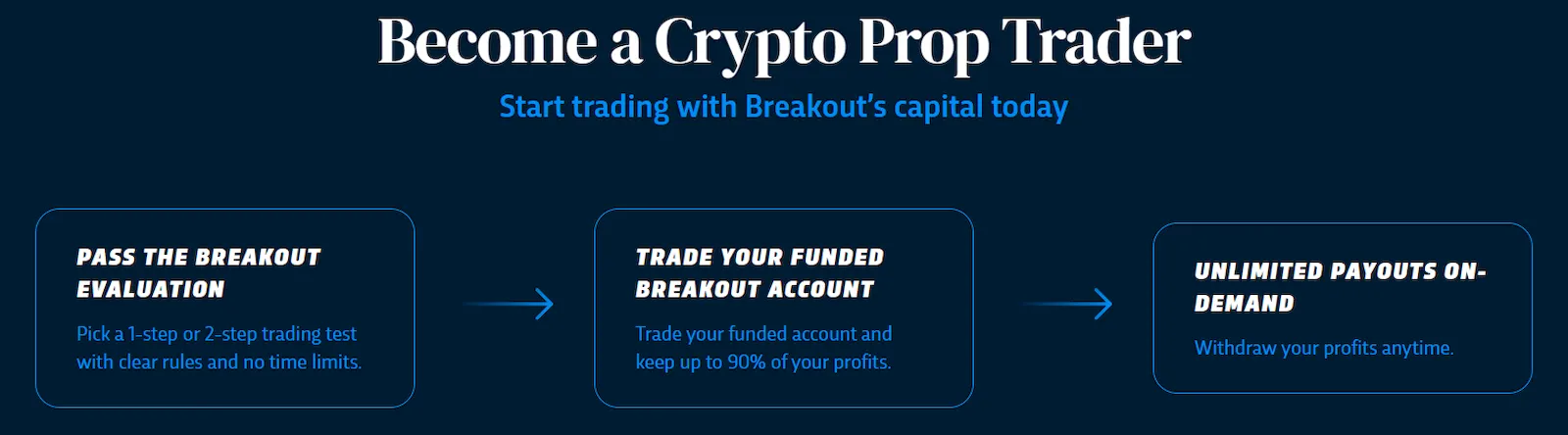 Find out all the details about the Breakout program: 1-Step Classic, 1-Step Pro, 1-Step Turbo, and 2-Step evaluation types, account parameters, drawdown mechanics, funded account rules, payout structures, trading fees, prohibited practices, and the firm's unique corporate structure involving Payward Oceanic Ltd (POL).
How Does the Breakout Funding Model Work?
Breakout operates on a two-stage funding model. Their model is pretty straightforward and simpler if we compare it to competitors:
- Stage 1 consists of the Breakout Evaluation. You pay a one-time fee to access a simulated (demo) trading environment. The objective is to reach a profit target while staying within drawdown and daily loss limits. There are no time limits, no minimum trading days, and no consistency rules. You can pass in a single trade if you hit the target. The evaluation runs on the Breakout Terminal, a proprietary platform.
- Stage 2 leads to the Funded Account (Breakout Account): After passing the evaluation, you become eligible to apply for a Funded Trader Agreement with Payward Oceanic, Ltd (POL), a separate legal entity from Breakout Trading Group. Once approved through KYC verification, you receive a funded account where you can earn real payouts of up to 90% of profits. Payouts are made in USDC (ERC-20) and can be requested on-demand.
Corporate Structure: Breakout Trading Group vs. Payward Oceanic Ltd
This is an important detail that sets Breakout apart from other prop firms. The program involves two separate and independent companies:
Breakout Trading Group, LLC operates the evaluations and provides the simulated trading environment. When you purchase an evaluation, your agreement is with Breakout.
Payward Oceanic, Ltd (POL), a Kraken-affiliated entity, provides the funded accounts. If you pass the evaluation, you enter into a separate Funded Trader Agreement with POL. All market-facing transactions on funded accounts are carried out by POL for its own principal account and at its sole discretion.
This means funded traders don't own any trading account or position and hold no beneficial or proprietary interest in POL's accounts, assets, or trades. When a funded trader submits a trade idea, POL may either record it as an internal book entry with a hypothetical result, or accept it for POL's proprietary book and route the transaction to a market maker or exchange.
What Are the Evaluation Types Breakout Offers?
Breakout offers four evaluation types across two categories:
- Classic, a 1-Step and 2-Step evaluations
- Elite, a 1-Step Pro and 1-Step Turbo evaluations
All evaluations share core features: no time limits, no minimum trading days, no consistency rules, and 24/7 trading availability. Let's learn more about them, read on.
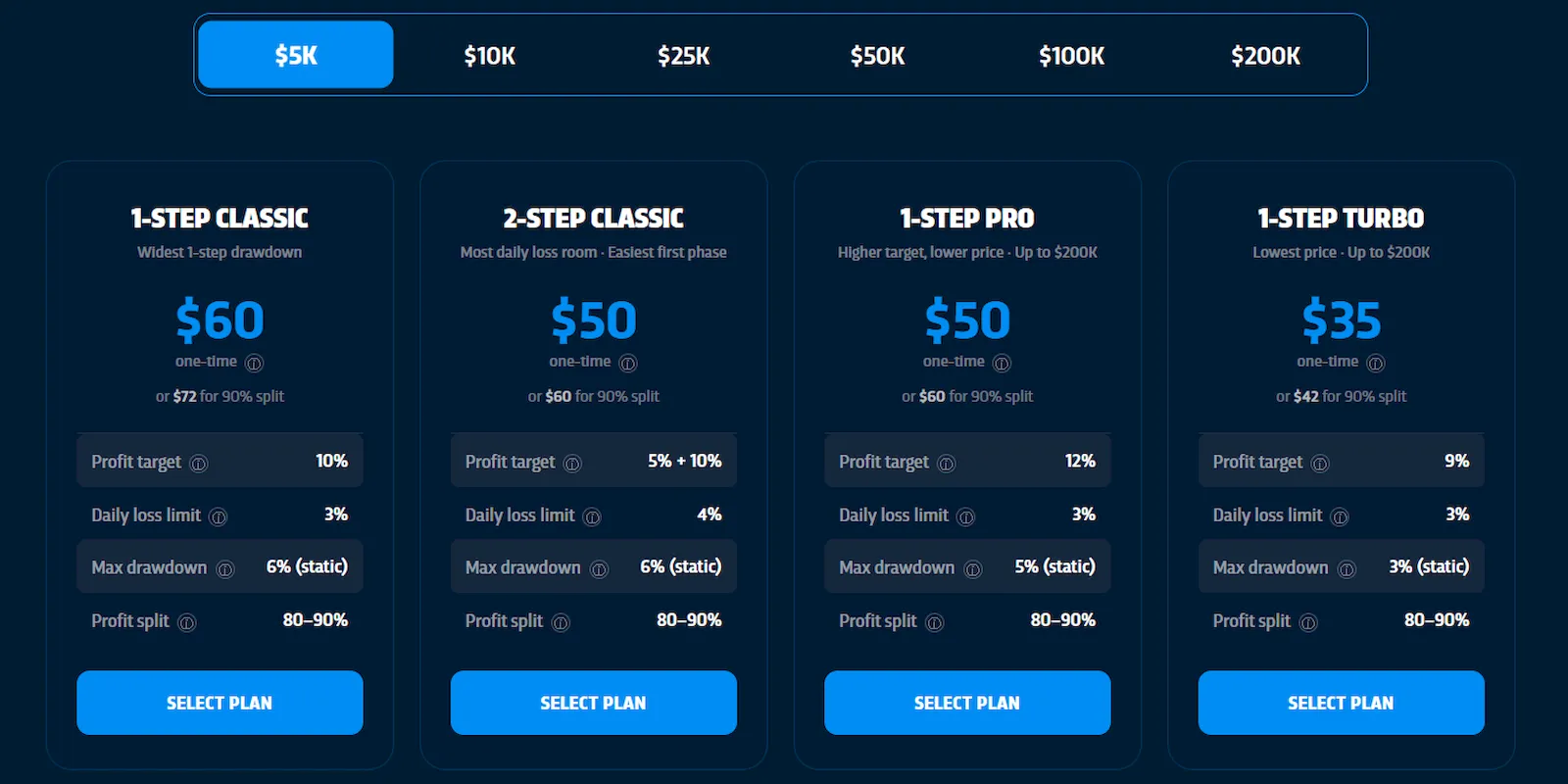
Structure and account sizes:
Classic Evaluations
The 1-Step Classic evaluation has a single-phase with a 10% profit target, 6% static max drawdown, and 3% daily loss limit.
The 2-Step Classic is a two-phase evaluation. Phase 1 requires a 5% profit target; Phase 2 requires a 10% profit target. The max drawdown is 8% trailing, and the daily loss limit is 5%.
Elite Evaluations
The 1-Step Pro consists of a single-phase evaluation with a 12% profit target, a 5% static max drawdown, and a 3% daily loss limit. It is available in account sizes up to $200,000.
The 1-Step Turbo is a single-phase evaluation with a 9% profit target, a 3% static max drawdown, and a 3% daily loss limit. It is also available up to $200,000. This is the tightest drawdown option.
All The Evalution Parameters Analyzed
Breakout offers two evaluation paths: the 1-Step and the 2-Step. Under a 1-Step Evaluation, your performance is assessed in a single phase with more stringent drawdown limits and a less challenging profit target. Under a 2-Step Evaluation, you're evaluated across two phases with more lenient drawdown limits but more demanding upgrade targets.
Within the 1-Step path, there are three variants: Classic, Pro, and Turbo, each with a different risk/reward profile. Here's a breakdown of the parameters for each evaluation type.
1-Step Classic Evaluation
|
Account Size |
Upgrade Target |
Max Drawdown (Static) |
Max Daily Loss |
Evaluation Fee |
|
$5,000 |
$500 (10%) |
$300 (6%) |
3% |
$60 |
|
$10,000 |
$1,000 (10%) |
$600 (6%) |
3% |
$110 |
|
$25,000 |
$2,500 (10%) |
$1,500 (6%) |
3% |
$275 |
|
$50,000 |
$5,000 (10%) |
$3,000 (6%) |
3% |
$550 |
|
$100,000 |
$10,000 (10%) |
$6,000 (6%) |
3% |
$999 |
1-Step Pro Evaluation
|
Account Size |
Upgrade Target |
Max Drawdown (Static) |
Max Daily Loss |
Evaluation Fee |
|
$5,000 |
$600 (12%) |
$250 (5%) |
3% |
~$55 |
|
$10,000 |
$1,200 (12%) |
$500 (5%) |
3% |
~$100 |
|
$25,000 |
$3,000 (12%) |
$1,250 (5%) |
3% |
~$250 |
|
$50,000 |
$6,000 (12%) |
$2,500 (5%) |
3% |
~$475 |
|
$100,000 |
$12,000 (12%) |
$5,000 (5%) |
3% |
~$900 |
|
$200,000 |
$24,000 (12%) |
$10,000 (5%) |
3% |
~$1,700 |
1-Step Turbo Evaluation
|
Account Size |
Upgrade Target |
Max Drawdown (Static) |
Max Daily Loss |
Evaluation Fee |
|
$5,000 |
$450 (9%) |
$150 (3%) |
3% |
~$45 |
|
$10,000 |
$900 (9%) |
$300 (3%) |
3% |
~$85 |
|
$25,000 |
$2,250 (9%) |
$750 (3%) |
3% |
~$200 |
|
$50,000 |
$4,500 (9%) |
$1,500 (3%) |
3% |
~$375 |
|
$100,000 |
$9,000 (9%) |
$3,000 (3%) |
3% |
~$725 |
|
$200,000 |
$18,000 (9%) |
$6,000 (3%) |
3% |
~$1,375 |
2-Step Classic Evaluation
|
Account Size |
Phase 1 Target |
Phase 2 Target |
Max Drawdown (Trailing) |
Max Daily Loss |
Evaluation Fee |
|
$5,000 |
$250 (5%) |
$500 (10%) |
$400 (8%) |
5% |
$50 |
|
$10,000 |
$500 (5%) |
$1,000 (10%) |
$800 (8%) |
5% |
$100 |
|
$25,000 |
$1,250 (5%) |
$2,500 (10%) |
$2,000 (8%) |
5% |
$250 |
|
$50,000 |
$2,500 (5%) |
$5,000 (10%) |
$4,000 (8%) |
5% |
$475 |
|
$100,000 |
$5,000 (5%) |
$10,000 (10%) |
$8,000 (8%) |
5% |
$725 |
Key Differences Between The Evaluation Types
Each evaluation type comes with a different combination of profit target, drawdown rules, and account size range, so the right choice depends on your trading style and risk tolerance. The 1-Step path evaluates you in a single phase with more stringent drawdown limits and a less challenging upgrade target, while the 2-Step path spreads the evaluation across two phases with more lenient drawdown limits but more demanding upgrade targets. The table below shows how all four types stack up side by side:
|
Feature |
1-Step Classic |
1-Step Pro |
1-Step Turbo |
2-Step Classic |
|
Phases |
1 |
1 |
1 |
2 |
|
Profit Target |
10% |
12% |
9% |
5% + 10% |
|
Max Drawdown |
6% static |
5% static |
3% static |
8% trailing |
|
Max Daily Loss |
3% |
3% |
3% |
5% |
|
Account Sizes |
$5K–$100K |
$5K–$200K |
$5K–$200K |
$5K–$100K |
|
Cost Range |
$60–$999 |
~$55–$1,700 |
~$45–$1,375 |
$50–$725 |
|
Funded Drawdown |
6% static |
5% static |
3% static |
8% trailing |
❌ The trade-off: The 1-Step Classic offers a moderate balance of target and drawdown. The 1-Step Pro gives the highest profit target (12%) with tighter drawdown (5%) and access to larger accounts ($200K). The 1-Step Turbo has the lowest target (9%) but the tightest drawdown of all (3%). And the he 2-Step is the cheapest per account size and offers the most generous drawdown (8%) but requires completing two phases and uses trailing drawdown.
How The Drawdown Mechanics Work
Before choosing an evaluation, it's worth understanding exactly how drawdown works because not all types calculate it the same way. Breakout uses two different drawdown mechanics depending on the evaluation: static, which applies to all 1-Step accounts, and trailing, which applies to the 2-Step.
The difference matters not just during the evaluation but also once you're funded, since the same rules carry over. Here's how each one works in practice.
Static Drawdown: 1-Step Classic, Pro, and Turbo
All 1-Step evaluations and their corresponding funded accounts use static drawdown. This means the maximum drawdown limit is calculated from your initial account balance and never changes regardless of how much profit you accumulate.
🔵 Example for 1-Step Classic, $100K: Max drawdown is $6,000 (6% of $100,000). If your balance grows to $115,000, your drawdown limit is still $94,000 ($100,000 − $6,000). You would need to lose $21,000 from $115,000 to breach, giving profitable traders significant breathing room.
Trailing Drawdown: 2-Step
The 2-Step evaluation and its funded accounts use trailing drawdown. The max drawdown is based on your highest balance reached (high-water mark), not your starting balance.
🔵 Example for 2-Step, $100K: Max drawdown is $8,000 (8% of starting balance). If your high-water mark reaches $105,000, your drawdown limit is $97,000 ($105,000 − $8,000). If your balance drops to $103,000 but your high-water mark was $105,000, you are $6,000 away from breach, not $8,000.
Important for 2-Step funded accounts: Payouts decrease your high-water mark. If you withdraw profits, the balance from which the trailing drawdown is measured moves down accordingly, tightening your available drawdown cushion.
Daily Loss Limit
Daily loss is recalculated at 00:30 UTC based on the previous day's closing balance:
- For 1-Step evaluations (all types), the daily limit is 3%.
- For 2-Step evaluations, it is 5%.
- If your equity reaches or declines below the daily loss limit, all positions are automatically closed and the account is permanently disabled.
Funded Account Parameters
After passing the evaluation, the funded account carries the same drawdown structure as the evaluation type you completed:
|
Funded Account Type |
Max Drawdown |
Drawdown Type |
Max Daily Loss |
|
1-Step Classic |
6% |
Static (from initial balance) |
3% |
|
1-Step Pro |
5% |
Static (from initial balance) |
3% |
|
1-Step Turbo |
3% |
Static (from initial balance) |
3% |
|
2-Step Classic |
8% |
Trailing (from high-water mark) |
5% |
Maximum allocation: The maximum total allocation across all funded accounts belonging to one trader is $200,000. You may hold open positions and execute trades simultaneously across multiple funded accounts.
Payouts do not affect drawdown on 1-Step accounts. Since 1-Step funded accounts use static drawdown based on initial balance, withdrawing profits has no effect on your drawdown limit.
Payouts affect drawdown on 2-Step accounts. Since 2-Step uses trailing drawdown based on high-water mark, taking a payout decreases the high-water mark, which in turn lowers your drawdown floor.
Payouts do not affect daily loss limits on any account type. The daily loss calculation is always based on the previous day's account balance.
Breakout's Payout Structure
Breakout's payout system is one of its most distinctive features in the prop trading industry. We created a list below for a better overview:
- Profit Split: Up to 90% to the trader (80% default, with a 90% add-on option).
- Payout Frequency: On-demand, available 24/7 including weekends.
- Payout Method: USDC on the Ethereum network (ERC-20) exclusively.
- Minimum Payout: $50, after accounting for Breakout's performance split percentage.
- Payout Processing: Normally within 24 hours; many traders report same-day payouts.
- Payout Caps: None. There are no limits on payout amounts or frequency.
- No Withdrawal Fees: Breakout covers withdrawal costs.
To request a payout, you must have no open positions and no breach on the account. The payout amount is immediately deducted from your account balance, and you can continue trading right away without waiting for the payout to settle. Payward Oceanic Ltd (POL) then approves the payout and requests your USDC ERC-20 wallet address.
Breached accounts cannot receive payouts. If your account breaches drawdown or daily loss limits, no further payouts are available from that account.
Payouts are not insured or guaranteed. They are subject to potential risks including smart contract bugs, network congestion, sanctions/compliance issues, and other blockchain-related complications.
Trading Fees and Commissions
Let's uncover all the company's fees now. We analyzed and split them into evaluation fees and funde account fees:
Evaluation accounts: The trading fee to execute a buy or sell order is 0.04% per side. If you hold an open position at 00:00 UTC, a daily swap fee of 0.033% per open position is deducted from your demo balance at 00:25 UTC. These are notional fees for performance calculation purposes — no actual fees are paid during the evaluation.
Funded accounts: The same fee structure applies — 0.04% per side trading fee and 0.033% daily swap fee for overnight positions. On funded accounts, these are real fees deducted from your trading performance.
Tradable Assets and Leverage
You can trade over 100 USDT perpetual futures contracts. Liquidity is sourced from tier-1 centralized exchanges including OKX, Bybit, and Binance. Also, leverage is auto-applied and cannot be changed by the trader.
Leverage:
|
Asset Class |
Max Leverage |
|
Bitcoin (BTC) |
5:1 |
|
Ethereum (ETH) |
5:1 |
|
All other digital assets (altcoins) |
2:1 |
Trading Hours
Both evaluation and funded accounts are available for trading 24/7, subject to service interruptions, scheduled maintenance, and other events that may temporarily impact access to the Breakout Terminal.
What Are the Supported Trading Platforms?
Breakout uses a proprietary platform called the Breakout Terminal, available as both a web application and mobile app. It features the following:
- One-click trading
- Advanced order types including partial take-profit orders
- Real-time order book depth and visible spreads
- Built-in risk management tools showing live drawdown limits
- Leaderboard and payout tracking
- Kraken account linking capability
The platform connects directly to centralized exchange liquidity for tight spreads and fast execution. You will be allowed to monitor your maximum daily loss and maximum drawdown limits in real time via the Breakout Dashboard.
💡 Note this: Breakout does not support MetaTrader 4/5, NinjaTrader, TradingView (for execution), or other third-party trading platforms. All trading must occur through the Breakout Terminal.
Weekend Holding and News Trading: Are These Allowed?
✅ Yes, weekend holding is allowed. Positions can be held over the weekend during both evaluations and funded accounts.
✅ News trading is also permitted. You can trade during news events in both evaluations and funded accounts. There are no restrictions on trading around economic releases, FOMC meetings, or other market-moving events.
Are Hedging and Copy Trading Permitted?
Hedging is automatically enabled and it is called "Hedge Mode". It allows for simultaneous long and short positions on the same digital asset.
As for copy trading, you may only copy trades conducted by yourself across your own accounts. Copying other traders' signals, ideas, or strategies from any third-party source (including trading communities, social media, research reports, or signal services) is strictly prohibited.
Breakout's Prohibited Trading Practices
Breakout enforces a strict list of prohibited activities during both evaluations and funded trading. It is your responsibility to read the full list before investing.
Here we prepared a list of prohibited behaviors to help you out:
1. Exploiting errors or latency in pricing or platforms
2. Using non-public or insider information
3. Front-running trades placed elsewhere
4. Trading in any way that jeopardizes Breakout's relationship with exchanges or market makers
5. Trading in ways that create regulatory issues
6. Using third-party or off-the-shelf approaches marketed to pass evaluations
7. Using one trading approach to pass evaluation and a different approach in the funded account
8. Arbitraging your demo account with another account at Breakout or any third party
9. Using approaches difficult to replicate in live markets (including trades risking auto-deleveraging or causing extreme unrealized P&L fluctuations)
10. Executing trade ideas from third parties (copying other traders, analysts, signals, communities, or crowdsourced ideas)
11. Trading more than one Breakout Evaluation simultaneously
12. Account sharing (including sharing credentials, or multiple accounts from the same household, device, or IP address)
Can I Have Multiple Accounts?
The answer is yes for evaluations and funded accounts:
- Evaluations: You may purchase multiple evaluations, but you cannot trade more than one evaluation at the same time.
- Funded accounts: You may trade multiple funded accounts simultaneously, up to the $200,000 total allocation cap per trader.
VPN Usage
VPN usage is permitted for both evaluations and funded accounts. However, using a VPN to circumvent geographic restrictions (trading from an ineligible country) is not allowed.
KYC Requirements and Minimum Age Requirement
There is no need for KYC to purchase or complete an evaluation. However, you must verify your account once you get funded.
All funded accounts must comply with a full KYC verification before receiving the actual funds to start trading. This is handled by Payward Oceanic Ltd (POL), as we mentioned at the beginning of this review.
If your KYC check is rejected, you will not receive the funded account. You will be requested to provide government-issued identification and meet POL's compliance requirements.
🔞 Remember that you must be at least 18 years old to use Breakout services.
Payment Methods Accepted by Breakout
Evaluation fees can be paid with cryptocurrency. Breakout accepts crypto payments for all evaluation purchases.
Breakout does not hold user funds. Evaluation fees are paid directly through the payment processor, and funded account payouts are managed by POL.
📌 As for payouts, they are issued exclusively in USDC on the ERC-20 network.
Refund Policy
Breakout does not offer refunds. Evaluation fees are non-refundable once trading begins, regardless of the outcome. If you fail an evaluation, you must purchase a new one.
Education and Training Services
Breakout provides a free, full trading course available to all traders. This is accessible via the official Breakout website. The firm also maintains an active Discord community for real-time discussion, chart analysis, and 24/7 peer support.
Restricted Countries
Breakout is unable to offer services to residents of the following jurisdictions:
Afghanistan, Belarus, Burma (Myanmar), Cambodia, Central African Republic, Cuba, Democratic Republic of the Congo, Ethiopia, Eritrea, Haiti, Iran, Iraq, Lebanon, Libya, Nicaragua, North Korea, Russia, Somalia, South Sudan, Sudan, Syria, Venezuela, Vietnam, Zimbabwe, and the following regions of Ukraine: Crimea, Donetsk, and Luhansk.
This list is relatively short compared to other prop firms. We can confirm that in this case, Breakout accepts traders from a wider range of countries.
Are There Any Tax Obligations?
Yes. Traders are responsible for their own tax obligations. Breakout and POL do not provide tax advice, and payouts may be subject to taxation depending on your jurisdiction.
💡 Pro Tip: Consult a tax professional regarding your funded trading income to be sure.
Risk Disclosures You Must Understand
Breakout provides unusually detailed risk disclosures that traders should understand. Make sure to follow this list:
• Evaluation performance is not predictive of funded performance. Breakout explicitly states that passing an evaluation does not guarantee success as a funded trader.
• Capital gains are not guaranteed or likely. Breakout warns that you should not rely on funded trading as a primary income source.
• Conflicts of interest exist. Breakout earns fees each time a trader fails and repurchases an evaluation. POL may receive financial incentives from third parties based on trade ideas that are not shared with funded traders.
• Insolvency risk. If POL or its service providers become insolvent, funded traders may lose access to accounts and pending payouts.
• Regulatory risk. The regulatory framework for crypto prop trading and funded trader programs is evolving. Changes in regulation could affect the program's availability or terms.
• Funded traders do not own accounts or positions. All trades are POL's proprietary activity. Funded traders provide "trade ideas" that POL may or may not execute.
Comparison to Competitors
|
Feature |
Breakout (1-Step Classic) |
Breakout (2-Step) |
AquaFunded |
FundedNext (Crypto) |
|
Asset Class |
Crypto only |
Crypto only |
Multi-asset |
Multi-asset |
|
Account Sizes |
$5K–$100K |
$5K–$100K |
$25K–$200K |
$5K–$200K |
|
Max Account (per trader) |
$200K |
$200K |
$200K |
$200K |
|
Evaluation Steps |
1 |
2 |
1–3 |
1–2 |
|
Profit Target (Eval) |
10% |
5% + 10% |
8%–9% |
8%–10% |
|
Max Drawdown |
6% static |
8% trailing |
6%–10% |
8%–10% |
|
Max Daily Loss |
3% |
5% |
4%–5% |
5% |
|
Profit Split |
Up to 90% |
Up to 90% |
Up to 95% |
Up to 90% |
|
Payout Frequency |
On-demand |
On-demand |
Bi-weekly |
Bi-weekly |
|
Payout Method |
USDC (ERC-20) |
USDC (ERC-20) |
Crypto/Wire |
Crypto/Wire |
|
Min Payout |
$50 |
$50 |
$50 |
$50 |
|
Time Limits |
None |
None |
30 days |
30–60 days |
|
Consistency Rule |
None |
None |
None |
None |
|
News Trading |
Allowed |
Allowed |
Allowed |
Allowed |
|
Weekend Holding |
Yes |
Yes |
Varies |
Varies |
|
Hedging |
Yes |
Yes |
Yes |
Varies |
|
Trading Platform |
Breakout Terminal |
Breakout Terminal |
MT4/MT5 |
MT4/MT5 |
|
Eval Cost ($100K) |
$999 |
$725 |
~$500 |
~$500 |
|
Kraken-Backed |
Yes |
Yes |
No |
No |
Breakout's main competitive advantages include on-demand payouts (unique in the industry), Kraken institutional backing, no time limits or consistency rules, hedging support, 24/7 crypto-native trading, and a clean zero-payout-denial record. Its main trade-offs are crypto-only asset coverage, a proprietary platform (no MT4/MT5), a strict ban on third-party signal copying, the split Breakout/POL corporate structure, no refunds, and relatively tight drawdown limits on 1-Step accounts (especially the 3% Turbo variant).
Who Is Breakout Best For? And Is It Worth It?
Breakout has carved out a distinct position in the prop trading industry as a crypto-focused firm backed by a major centralized exchange. The Kraken acquisition in 2025 provided it with a level of institutional credibility that few prop firms — crypto or otherwise — can match. Also, its zero-payout-denial track record across 20,000+ funded gives us a clue about its reliability.
This firm is a fit if you're a crypto-native trader who wants on-demand payouts with no waiting periods, frequency caps, or limits — including multiple withdrawals per day settled in USDC within hours of earning them. The four-tier evaluation system (1-Step Classic, Pro, Turbo, and 2-Step) offers genuine flexibility: tighter drawdown at lower fees with Turbo, maximum room to maneuver with the 2-Step's 8% trailing drawdown, or access to $200K accounts through Pro and Turbo. Addes to all of this, there is no time limits, no minimum trading days, and no consistency rules, together with 24/7 trading including weekends and news events, hedging capability, and access to 100+ crypto assets with tier-1 exchange liquidity.
However, we fount some limitations worth weighing. Breakout is crypto-only — no forex, stocks, indices, futures, or commodities. The execution is locked to the proprietary Breakout Terminal, with no MT4, MT5, NinjaTrader, or TradingView support. Third-party signals, copy trading, and shared strategies are strictly prohibited. Leverage caps at 5:1 on BTC/ETH and 2:1 on altcoins, there are no refunds on failed evaluations, and payouts are issued only in USDC ERC-20, with no fiat or bank wire options.
Besides, the split corporate structure between Breakout Trading Group and Payward Oceanic Ltd also introduces a layer of counterparty complexity that you have to understand before investing. And the 3% daily loss limit on all 1-Step evaluations is notably tight for crypto, this means that a single volatile BTC move can breach it, making the 2-Step's 5% daily loss a more appropriate choice for some strategies.
If you are a serious crypto trader, this proprietary platform may align with your approach. Plus, if you have proven strategies and value fast payouts, institutional backing, and minimal trading restrictions, Breakout could be for you.
Resources
Data in this review is based on Breakout's official FAQ documentation, website content, public Trustpilot reviews, and verified third-party analysis. Rules, pricing, and account structures are subject to change. Always verify current terms directly on breakoutprop.com before making a purchase.
Breakout firm-wide rules
Rules that apply to every account regardless of size. 3 of 19 published by the firm.
| News trading | Not published by firm |
|---|---|
| Holding overnight | Not published by firm |
| Holding over weekends | Not published by firm |
| Consistency rule | Not published by firm |
| Scaling plan | Not published by firm |
| Payout schedule | Not published by firm |
| Minimum payout | Not published by firm |
| First payout eligibility | Not published by firm |
| Payout processing time | Not published by firm |
| Payout methods | UUSDC (ERC-20) |
| Reset cost | Not published by firm |
| Platform fees | Not published by firm |
| Data feed fees | Not published by firm |
| Account type | Not published by firm |
| Restricted countries | Not published by firm |
| Consequence of a breach | Not published by firm |
| Max funded accounts | Not published by firm |
| Minimum trading days | 1 days |
| Maximum funding offered | $200,000 |
Pros
- Proprietary Breakout Terminal
- No time limits on evaluation phases for both 1-Step and 2-Step plans
- 80% to 90% profit split for funded traders
- Zero commission structure on many major trading instruments
- Multi-asset support including Forex, Indices, and Commodities
- Modern, user-friendly dashboard with advanced performance analytics
Cons
- Intraday drawdown model can be tighter than EOD alternatives
- Relatively new firm compared to industry veterans
- Limited support for third-party platforms (primary focus on Breakout Terminal)
- Specific consistency requirements apply during the evaluation phase
- Only crypto assets can be traded
Firms priced like Breakout
Frequently asked questions
Breakout details
- Headquarters British Virgin Islands 🇻🇬
- Founded 2023
- Years in operation 2
- Markets Forex, Crypto
-
Trading platforms

- Brokers Datafeed Provider
- Payment methods Credit Card, Debit Card, Crypto, PayPal
- Breakout social links
Affiliate Disclosure: We may receive a commission if you sign up via our link.
Data updated April 15, 2026.