The Trading Pit Review October 2026
Last Updated: July 19, 2026How we rate The Trading Pit
Composite 7.60/10, built from the components below. Each score shows the evidence behind it.
-
Payout evidence 4.0/10No public payout total we can track and verify.
-
Rule strictness 6.0/10Target-to-drawdown ratio up to 2.00 — demanding relative to how much loss is allowed.
-
Pricing 7.4/10$1.89 per $1,000 funded — cheaper than 68% of 28 comparable firms.
-
Platform support 10/1012 supported platforms: NinjaTrader, Quantower, TradingView, Tradovate.
-
Transparency 1.6/103 of 19 firm-wide rules published.
Risk profile
On the strictest plan you must earn $2.00 for every $1.00 of drawdown you are allowed to lose.
What this drawdown type means for you
End-of-day trailing drawdown
Your loss limit moves up based on your closing balance each day, not on intraday spikes. Profit you take and hold to the close raises the floor; profit you win and lose back within the same session does not count against you. It is materially more forgiving than intraday trailing, but the floor still ratchets upward permanently and never falls back once it has moved.
Static drawdown
Your loss limit is set once, a fixed distance below your starting balance, and never moves. Every dollar of profit becomes a real buffer between you and the breach point. This is the most forgiving of the three mechanics, and the easiest to plan around, because the number you must not touch is known on day one and stays put.
Pricing position
Cost per $1,000 funded counts the evaluation plus any activation fee, then normalises across account sizes — the honest way to compare a cheap small account against a pricier large one. Prices shown before promo codes. See all 15 plans →
Is The Trading Pit Legit?
The Trading Pit AG is incorporated in Liechtenstein, an EEA member state with its own Financial Market Authority (FMA). The firm operates through five legal entities across Liechtenstein, Cyprus, and Seychelles. You can file complaints directly with the Liechtenstein FMA if disputes arise, a recourse mechanism unavailable with most prop firms. The firm is available in 180+ countries and operates in 10 languages. The Trading Pit ranks competitively among forex prop firms for its regulatory positioning.
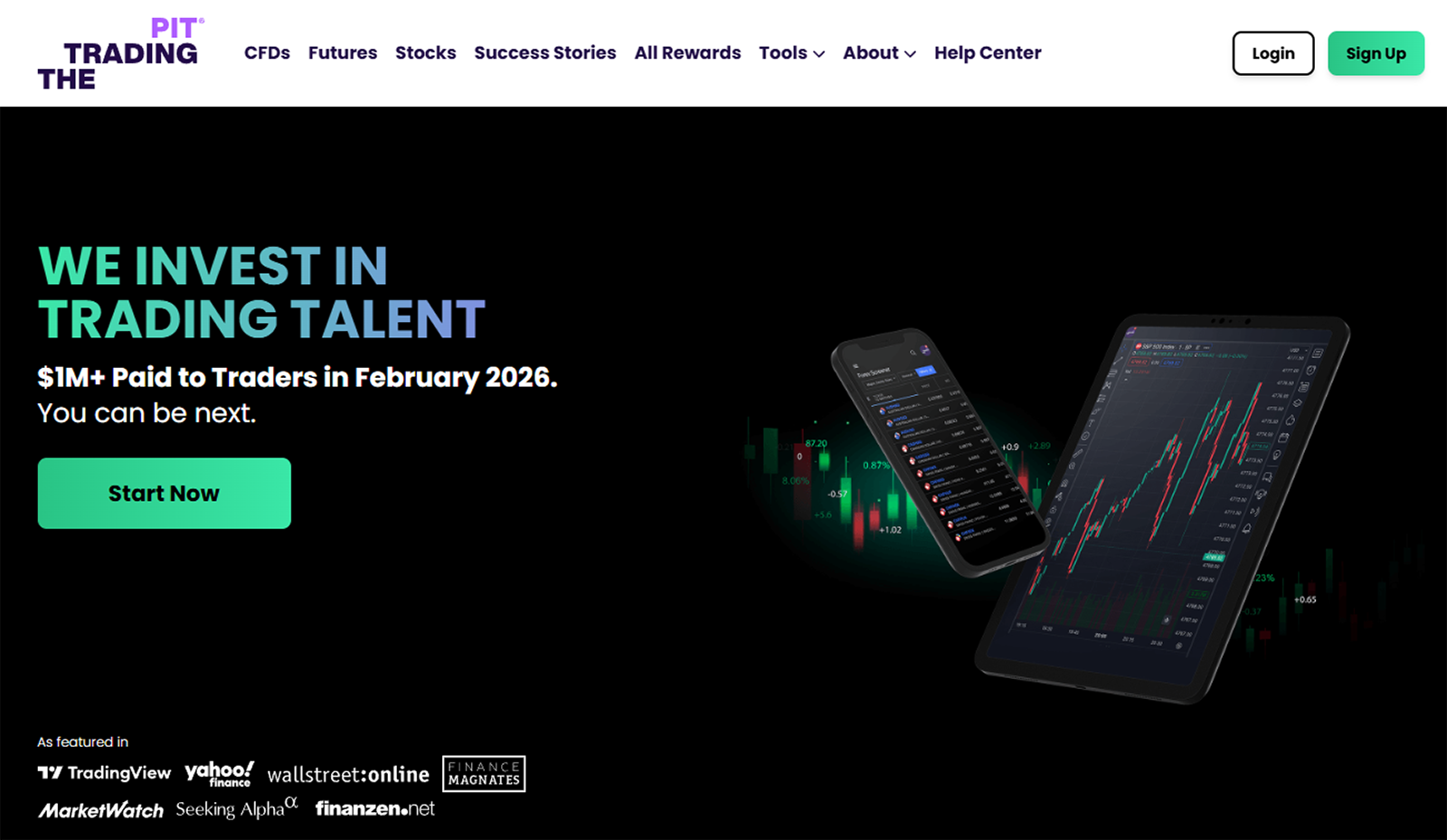
As regards reviews, traders talk about fast payouts (often processed within 6 hours of approval), clear rules, the LiveSquawk integration, and the multi-asset offering. They also complain about the consistency rule causing confusion, strict news trading enforcement on CFD accounts, and occasional support response delays during high-volume periods.
The Trading Pit is the only major prop firm offering CFDs, futures, and stocks challenges under one roof. While most firms specialize in a single asset class, The Trading Pit lets traders choose between forex/CFD evaluations, CME/EUREX futures challenges, and a dedicated stocks program, all from the same account. The firm has paid $14M+ in rewards, and operates a unique "Signal Provider" agreement model where funded traders provide signals rather than trading with firm capital directly. This review covers every program, rule, platform, and pricing detail for 2026.
What Is The Trading Pit?
The Trading Pit (TTP) is a proprietary trading firm founded in 2021 and headquartered in Vaduz, Liechtenstein. The firm is led by CEO Thomas Heyden and operates through multiple legal entities: The Trading Pit AG, The Trading Pit Challenge GmbH (FL-0002.693.417-1), The Trading Pit Champions GmbH, The Trading Pit Limited (Cyprus), and TTP Trading (Seychelles). The Liechtenstein incorporation places the firm under the jurisdiction of the Financial Market Authority (FMA), a regulatory environment rarely seen in the prop trading space.
TTP reports over 10,000 active monthly accounts, 450,000+ trades executed per month, $14M+ in total rewards paid, and availability in 180+ countries. Also, the EUR 10 million funding round from Pinorena Capital provides financial backing that most standalone prop firms lack. The firm's partnership with over 25 institutional brokers and regulated exchanges (CME, EUREX) adds a layer of infrastructure credibility. The combination of Liechtenstein registration, institutional funding, and multi-exchange access puts TTP in a distinct category.
The Signal Provider Agreement Model
This is the structural detail that most competitor reviews mention only in passing. When traders pass a challenge at The Trading Pit, they do not receive a "funded account" in the traditional sense. Instead, they sign a Signal Provider Agreement (SPA). Under this model, the trader provides trading signals that The Trading Pit and its partner brokers replicate. The trader receives a share of the profits generated from those signals.
The legal distinction matters. In a standard prop firm model, the trader operates a simulated account and receives performance-based rewards. Under the Signal Provider framework, the trader's role is formally defined as providing a service (signal generation) to the firm.
This structure was designed with input from capital markets law experts and has not faced regulatory challenges to date, according to The Trading Pit's public disclosures. For you as a trader, the practical experience is similar to other prop firms: pass the challenge, trade the earning account, receive payouts. But the legal framework underlying it is different.
Free LiveSquawk Integration
When you purchase a challenge from The Trading Pit, you receive free access to LiveSquawk, a professional real-time audio news service. LiveSquawk delivers live audio streams of breaking economic news, market-moving events, and key data releases with near-zero latency. The service also includes a text newsfeed and daily morning/afternoon summary reports.
LiveSquawk typically requires a paid subscription that costs hundreds of dollars per month. TTP includes it at no extra cost for all challenge holders, accessible directly from the client area. This is a genuine edge for traders who react to news flow. LiveSquawk is used by institutional trading desks and professional CTAs, making its inclusion in a prop firm challenge a standout feature that no other major firm currently matches.
1. CFD Challenge Programs: Select Your Model
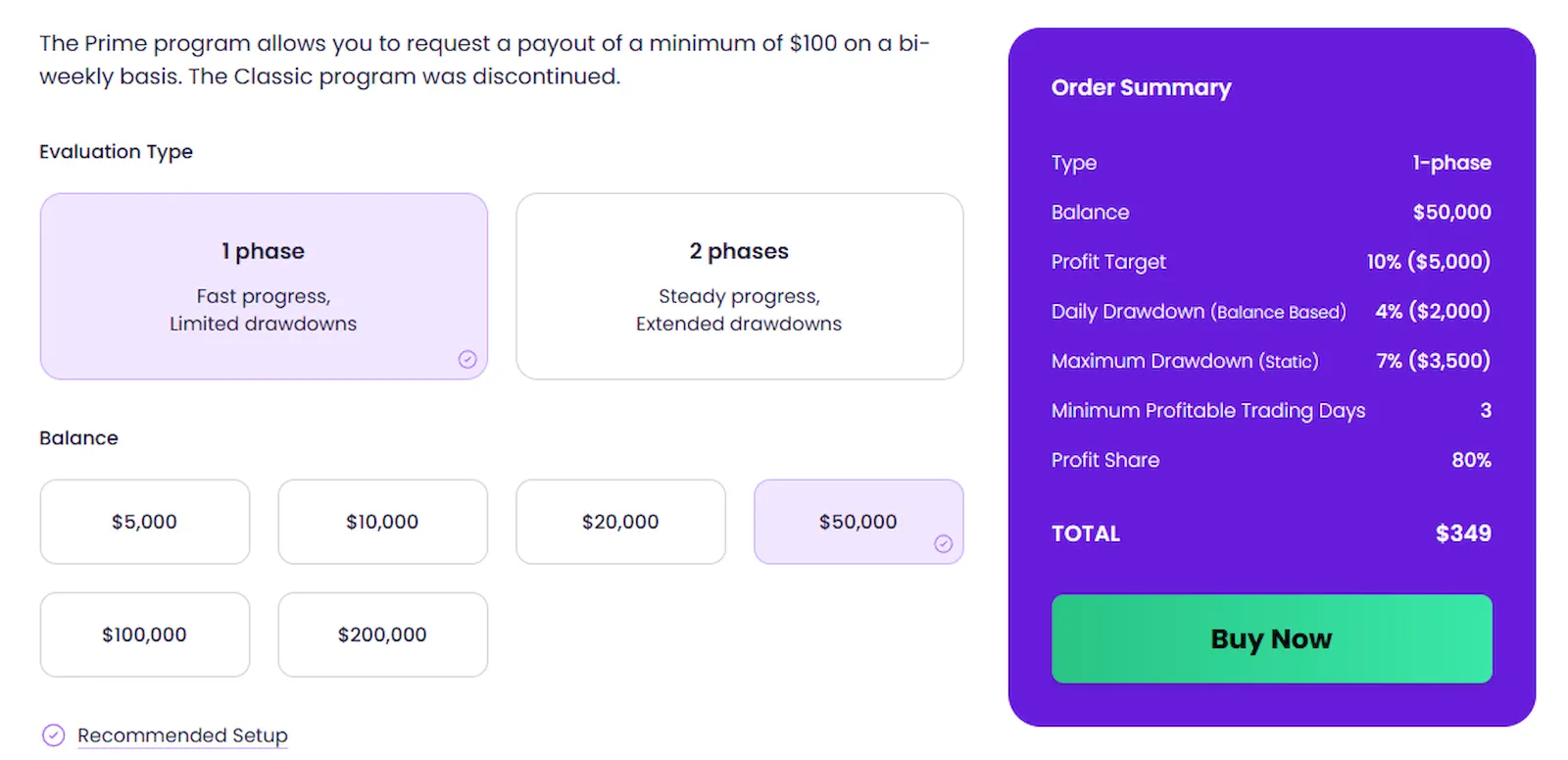
TTP's CFD program offers both 1-Phase and 2-Phase evaluations under the "Prime" model. The discontinued "Classic" program is no longer available for new purchases. CFD challenges cover forex, indices, commodities, crypto, and stock CFDs.
✔️ For traders comparing CFD evaluations across firms, see our forex prop firm challenges page.
CFD Prime 1-Phase
The 1-Phase CFD challenge requires hitting the profit target in a single evaluation stage. Daily drawdown is equity-based. Maximum drawdown is trailing on highest equity. Leverage is 1:50 for forex, 1:10 for indices/commodities, 1:2 for crypto/stocks. There is no time limit on CFD challenges. Minimum 3 trading days. Profit split is 80%.
CFD Prime 2-Phase
The 2-Phase challenge splits the evaluation into two stages with targets of 8% and 5%. Daily drawdown is balance-based. Maximum drawdown is static (does not trail). This static drawdown is more forgiving than the trailing model on the 1-Phase. For a comparison of how these drawdown types work, see our guide to trailing drawdown vs. EOD drawdown. Minimum 3 profitable days (0.5% per day). Leverage up to 1:50. Profit split is 80%.
CFD Challenge Pricing
|
Account Size |
1-Phase Fee |
2-Phase Fee |
Daily / Max DD |
|
$5,000 |
$49 |
$49 |
4% / 6% (trail) |
|
$10,000 |
$99 |
$99 |
4% / 6% (trail) |
|
$20,000 |
$149 |
$149 |
4% / 7% (trail) |
|
$50,000 |
$299 |
$299 |
5% / 10% (static) |
|
$100,000 |
$569 |
$569 |
5% / 10% (static) |
|
$200,000 |
$1,139 |
N/A |
5% / 10% (static) |
Verify before investing: Pricing and drawdown parameters differ between 1-Phase and 2-Phase and vary by account size. Smaller accounts ($5K-$20K) use trailing max drawdown. Larger accounts ($50K+) use static max drawdown on 2-Phase. Verify exact figures at thetradingpit.com/cfds-prop-trading before purchasing.
2. Futures Challenge Programs: Choose Your Challenge
TTP's futures program runs separately from CFDs and uses exchange-traded contracts on CME, CBOT, COMEX, NYMEX, and EUREX. Two program types are available: Futures Prime and Futures Classic (Classic is discontinued for new purchases). US and Canadian traders can participate in futures challenges but not CFDs.
✔️ For comparisons with other futures evaluation firms, see our futures prop firm challenges page.
Futures Prime
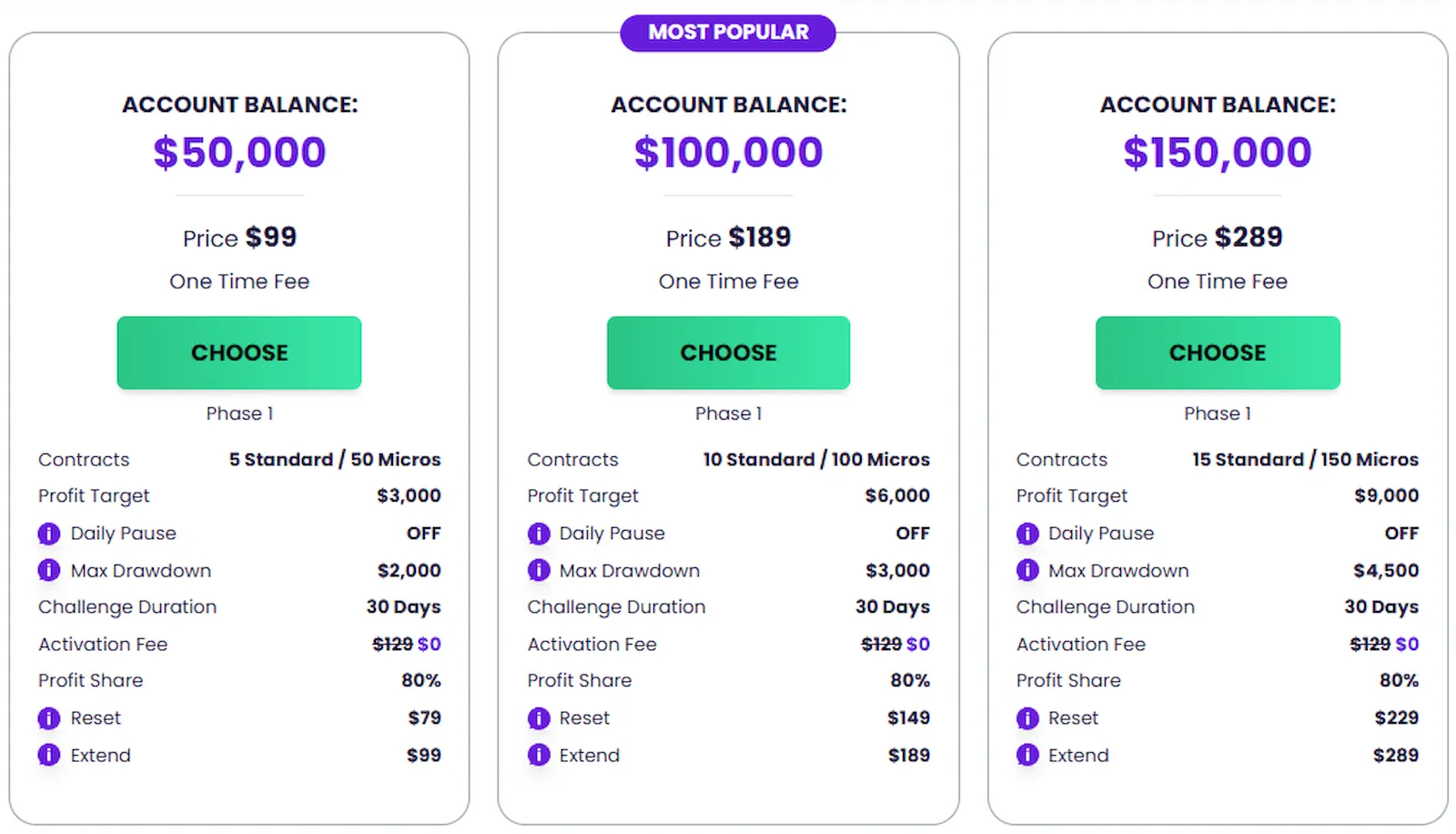
Futures Prime is a 1-phase evaluation with a 30-day challenge duration. Three account sizes are available:
- $50K ($99 + $129 activation fee),
- $100K ($189 + $129 activation),
- and $150K ($289 + $129 activation).
The activation fee is a one-time cost paid when advancing to the earning phase.
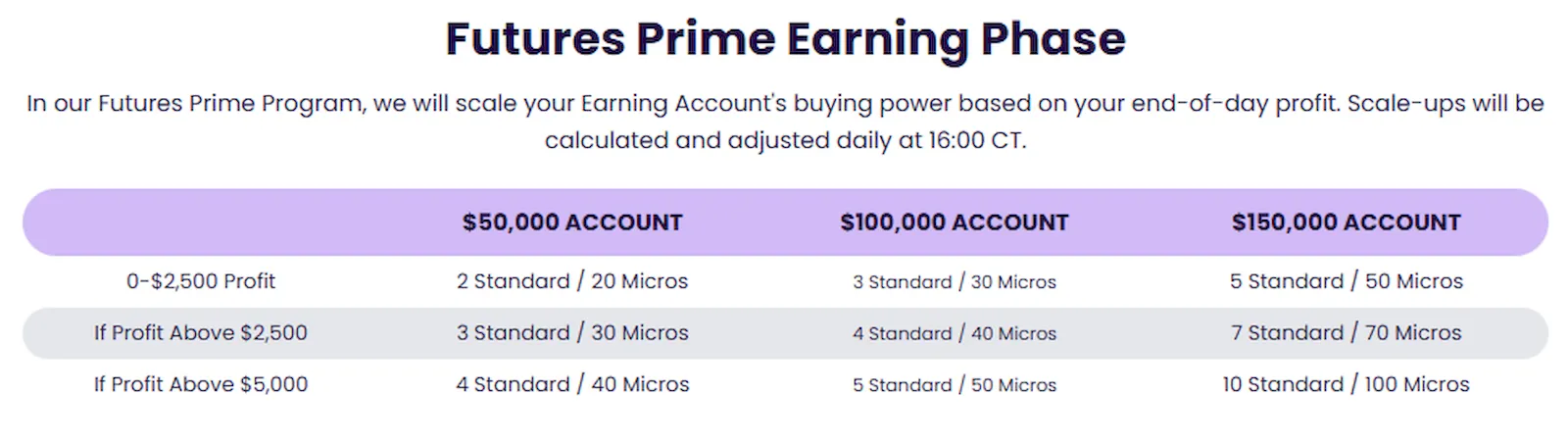
Futures Prime uses a "Daily Pause" system instead of traditional daily drawdown. When the daily loss limit is reached ($1,000 for $50K, $2,000 for $100K, $3,000 for $150K), positions are liquidated and trading is paused until the next session. The account is not terminated. This is a meaningful safety feature that most competitors do not offer; at most firms, hitting the daily loss limit is an immediate breach.
⚠️ Per BestPropFirms.com, the Daily Pause feature was turned OFF for accounts created after March 6, 2026. Verify the current status at thetradingpit.com before purchasing.
Some rules and parameters:
- Max drawdown trails on the highest end-of-day balance until it reaches the starting balance and then it locks.
- Minimum 3 trading days.
- 40% consistency rule applies (no single day can exceed 40% of the profit target).
- Profit split is 80%.
- All positions must close by 3:55 PM CT.
- Overnight holding is not permitted.
- News trading is permitted on Futures Prime accounts, though you should be aware of increased volatility risk.
Platforms Available to Trade Futures
TTP supports a broad range of futures platforms: Tradovate, TradingView (via Tradovate), NinjaTrader, ATAS, Quantower, VolFix, VolSys, and Rithmic/R Trader Pro. Both Rithmic and DxFeed data feeds are available. This platform selection competes with the widest offerings from firms like Take Profit Trader, which also supports 15+ platforms.
3. Stocks Challenge: Select Your Stock Challenge
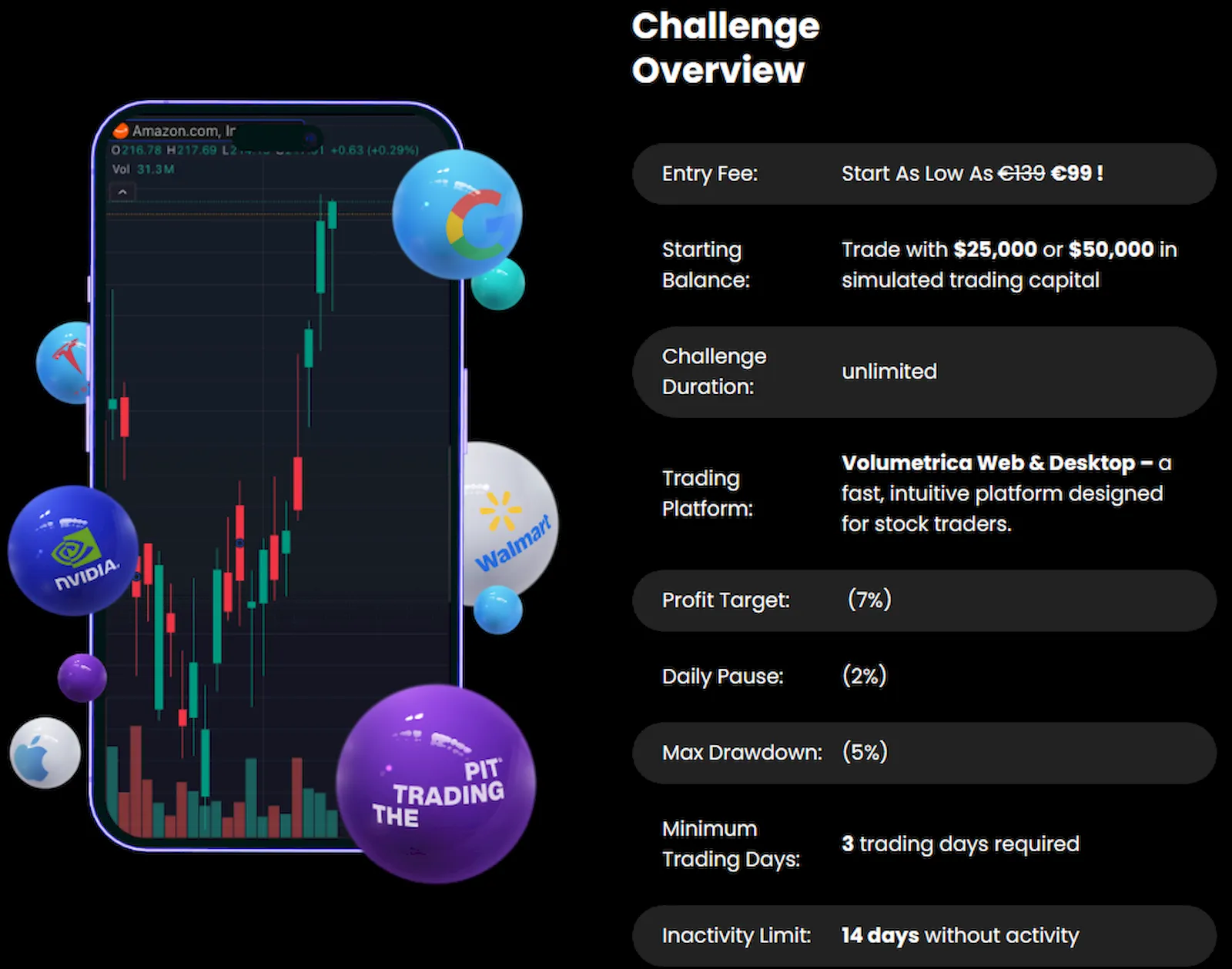
TTP launched a Stocks Challenge in 2025, making it one of the only prop firms offering dedicated stock trading evaluations. The Stocks Challenge is a $25K account with a 70% profit split. It uses the Volumetrica Web and Desktop platform.
⚠️ Note that Stocks challenges are not available to US or Canadian residents.
The Stocks program requires 3 profitable trading days with at least $100 profit per day for the first payout. Positions are forcibly liquidated 10 minutes before market close. This program targets traders with stock-specific strategies who want evaluation-based funding without using CFDs or futures as a proxy.
Trading Rules and Restrictions
News Trading
News trading rules vary by program. CFD accounts ($100K and $200K) restrict trading 2 minutes before and after high-impact news events. CFD accounts under $100K allow news trading. Futures Prime permits news trading. Futures Classic prohibits it within the same 2-minute window.
Scalping and HFT
Scalping is allowed on CFD Prime accounts. On CFD Classic, trades must be held for at least 1 minute (soft violation). High-frequency trading (HFT) is prohibited across all programs. EA usage is permitted but EAs must not execute scalping under 1 minute, arbitrage, or third-party signal copying.
Consistency Rule
A 40% consistency rule applies during the challenge phase on Futures Prime and Stocks challenges. No single trading day can contribute more than 40% of the total profit target. Exceeding 40% adds the excess to the profit target. On a $100K Futures Prime account with a $6,000 target, a $3,500 day would push the target to $7,100.
Hedging and Copy Trading
Hedging (opposing positions across separate accounts) is prohibited. Copy trading is allowed between a trader's own accounts (up to 5 on futures). Copying from other traders or external sources is not permitted.
Weekend and Overnight Holding
CFD Prime accounts allow overnight and weekend holding. Futures Prime accounts must close all positions by 3:55 PM CT daily. No overnight holding on futures. Futures Classic allows overnight holding but requires positions closed before 4:00 PM CT on Fridays.
Inactivity
Accounts with 21 consecutive days of no trading activity are closed with no refund. This applies across all challenge types.
Funded Account Conditions
Profit Split
CFD Prime and Futures Prime both offer an 80% profit split. The Stocks Challenge offers 70%. Classic programs (discontinued for new accounts) started lower at 50-60% and scaled to 70-80% across levels. TTP's 80% on Prime is competitive, though firms like FundedNext (up to 95%) and FTMO (up to 90%) offer higher rates.
Payout Schedule
CFD Prime payouts are available every 14 days for any amount above $100. Three profitable trading days (at least 0.5% per day) are required per payout cycle. Futures Prime first payout requires 3 trading days and 10 profitable days with $200+ profit. After the second payout, payouts are available every 7 days. Payouts are processed on Tuesdays and Fridays. For general tips on managing the evaluation process, see our guide on how to pass a prop firm evaluation.
Payout methods include cryptocurrency (USDT, USDC), bank wire transfer, Binance, BinancePay, PayPal, Apple Pay, Google Pay, and Perfect Money. Rise is also available. Challenge fees are refundable after the first payout.
Scaling Plan
CFD Prime scaling requires the account to be active for at least 2 months, receive at least 2 payouts, and accumulate 10% total profit. Meeting these criteria triggers a 25% increase in account balance. Every 4th scale-up establishes a new base balance for future increases.
Futures Classic (grandfathered accounts) uses a 10-level scaling plan where traders progress by hitting profit targets at each level. Account balance and profit split increase at each level, with balances scaling from $10K up to $1M and splits from 50% to 80%.
Account Limits
CFD: Up to 8 active earning accounts (all Prime). Maximum total allocation of $400,000. Futures: Up to 5 active earning accounts. One funded account per customer on the earning phase.
Platforms and Tradeable Instruments
CFD Platforms
CFD challenges run on MetaTrader 5 (MT5). Traders access forex majors/minors/exotics, indices (US30, NAS100, GER40), commodities (gold, silver, oil, natural gas), metals, energies, and cryptocurrencies (BTC, ETH, XRP). TTP partners with regulated brokers for execution.
Futures Platforms
Futures accounts support Tradovate, TradingView (with Tradovate), NinjaTrader, ATAS, Quantower, VolFix, VolSys, and Rithmic/R Trader Pro. Exchanges include CME, CBOT, COMEX, NYMEX, and EUREX. Free real-time data, LiveSquawk access, and platform licenses are included with futures challenges.
Pricing
All fees are one-time payments with no monthly subscriptions. Challenge fees are refundable after the first successful payout. TTP does not currently run promotional discounts on a regular basis. Check our prop firm deals page for any active offers.
|
Futures Account |
Challenge Fee |
Activation Fee |
Daily Pause |
|
$50K Prime |
$99 |
$129 |
$1,000 |
|
$100K Prime |
$189 |
$129 |
$2,000 |
|
$150K Prime |
$289 |
$129 |
$3,000 |
Payment methods include credit/debit cards, PayPal, Apple Pay, Google Pay, cryptocurrency, BinancePay, and online bank transfers (availability varies by region).
How to Sign Up for The Trading Pit
1. Visit thetradingpit.com and select a program (CFDs, Futures, or Stocks).
2. Choose the evaluation type (1-Phase or 2-Phase for CFDs; Prime for Futures).
3. Select an account size.
4. Complete payment via card, PayPal, crypto, or other available methods.
5. Receive login credentials and access the client area.
6. Connect to your preferred trading platform.
7. Trade the challenge: hit the profit target within the rules.
8. Pass the evaluation and sign the Signal Provider agreement.
9. Complete KYC verification (ID and proof of address).
10. Request payouts on the scheduled cycle (bi-weekly for CFDs, weekly for Futures after 2nd payout).
Who Is The Trading Pit Best For?
The Trading Pit is the strongest option for traders who want multi-asset access from a single firm. The ability to trade CFDs, exchange-traded futures, and stocks under one umbrella is a differentiator that no other firm in the best prop firms rankings matches. Traders who work across multiple asset classes can consolidate their funded accounts instead of splitting between specialized firms.
The Futures Prime program is competitive against dedicated futures firms. The platform selection (Rithmic, ATAS, Quantower, Tradovate, NinjaTrader) provides institutional-grade order flow tools. Firms like Apex Trader Funding and Earn2Trade focus exclusively on futures and offer different scaling models, but neither provides CFD or stock access alongside.
The free LiveSquawk access is a genuine advantage for news-aware traders. The Liechtenstein incorporation under FMA jurisdiction provides a regulatory framework that most offshore prop firms lack.
TTP is not available for CFD trading to US, Canadian, or Russian residents. US traders can access futures challenges only. The 80% profit split is lower than some competitors offering 90-95%. The 40% consistency rule on challenges and the contract limit reduction from challenge to earning phase on futures are both friction points that require careful planning.
The Trading Pit firm-wide rules
Rules that apply to every account regardless of size. 3 of 19 published by the firm.
| News trading | Not published by firm |
|---|---|
| Holding overnight | Not published by firm |
| Holding over weekends | Not published by firm |
| Consistency rule | Not published by firm |
| Scaling plan | Not published by firm |
| Payout schedule | Not published by firm |
| Minimum payout | Not published by firm |
| First payout eligibility | Not published by firm |
| Payout processing time | Not published by firm |
| Payout methods | Bank Wire Transfer, Crypto |
| Reset cost | Not published by firm |
| Platform fees | Not published by firm |
| Data feed fees | Not published by firm |
| Account type | Not published by firm |
| Restricted countries | Not published by firm |
| Consequence of a breach | Not published by firm |
| Max funded accounts | Not published by firm |
| Minimum trading days | 3 days |
| Maximum funding offered | $150,000 |
Pros
- Multi-asset prop firm offering access to Forex, Futures, and CFDs
- Static drawdown model used on several account types, protecting traders from trailing traps
- Earn up to an 80% profit split, with a clear path to scale through their levels
- Extensive platform support including ATAS, Rithmic, Quantower, and MetaTrader
- Evaluation fees are 100% refundable with the first successful payout
- No minimum or maximum trading day requirements on the latest evaluation models
- Official regulated broker partnership, providing a higher level of institutional trust
- Weekend and overnight holding permitted on specific 'Swing' account variations
Cons
- Evaluation process is level-based, meaning you must hit specific targets to advance allocation
- News trading restrictions apply during high-impact events on standard funded accounts
- Strict consistency rules apply to ensure traders aren't 'gambling' to hit targets
- Some platforms like ATAS require separate data feed or license fees depending on the challenge
- Maximum scaling is capped based on the specific path (Forex vs. Futures) chosen at checkout
- Automated trading (EAs) is allowed but subject to strict compliance reviews
Firms priced like The Trading Pit
Frequently asked questions
The Trading Pit details
- Headquarters Liechtenstein 🇱🇮
- Founded 2022
- Years in operation 3
- Markets Futures
-
Trading platforms







- Brokers Tradovate, DXFeed, Rithmic
- Payment methods Credit Card, Debit Card, Crypto, PayPal, Apple Pay, Google Pay, Skrill, Bank Transfer, Giropay, Neteller
- The Trading Pit social links
Affiliate Disclosure: We may receive a commission if you sign up via our link.
Data updated July 19, 2026.