Prop Firm Profit Split Explained: How Funded Traders Get Paid
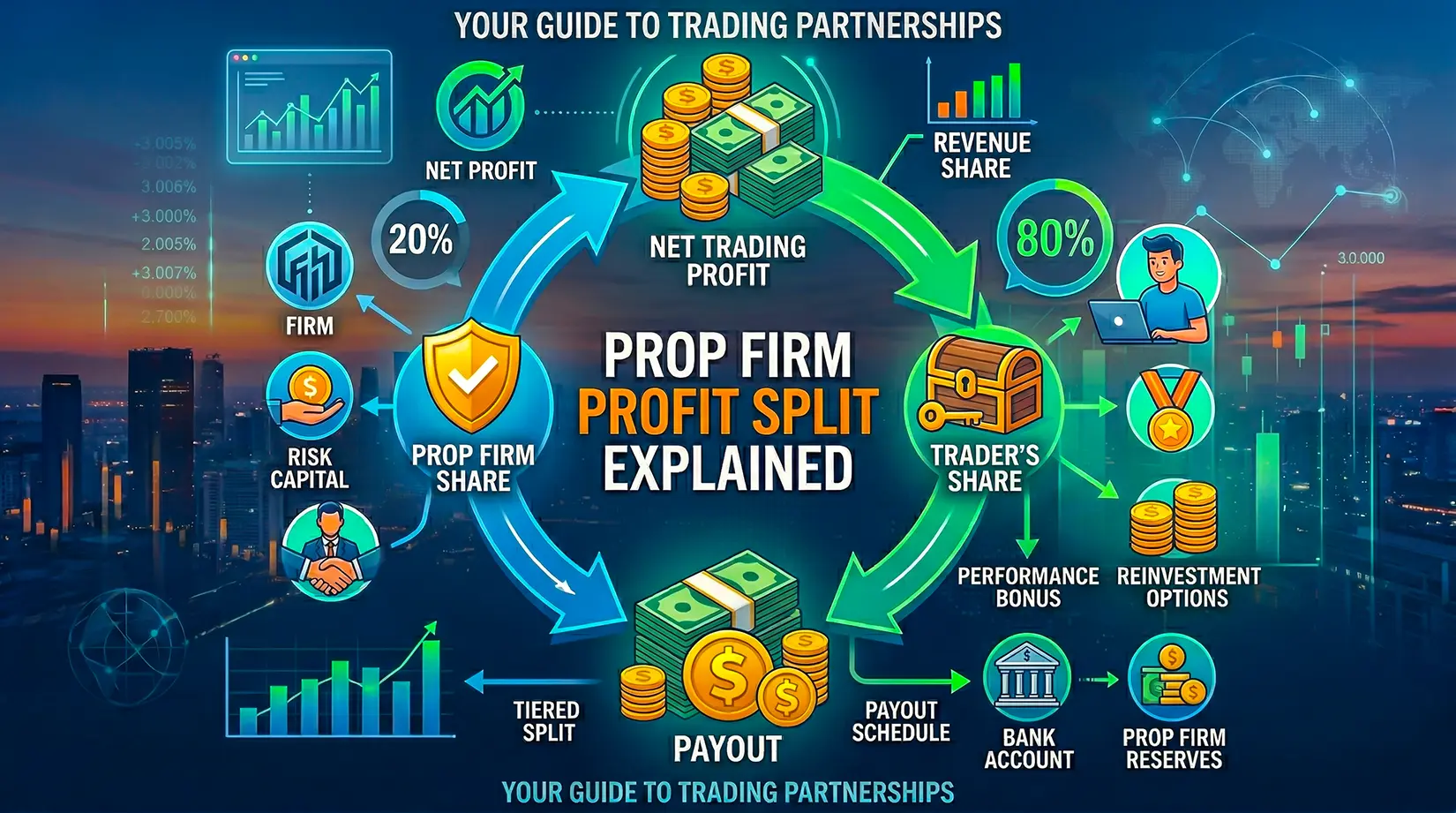
A prop firm profit split is the percentage of simulated trading profits a funded trader keeps, with the firm retaining the rest. Most prop firms offer splits between 70% and 90%, while some reach 100% after the trader hits performance milestones.
What Is a Profit Split in a Prop Firm?
When you trade a funded trading accounts provided by a proprietary trading firm, you don't keep all of the profits. The money is split between you and the firm. The firm provides the capital and the infrastructure. You provide the trading skill. The profit split determines how much of each dollar of profit goes to you.
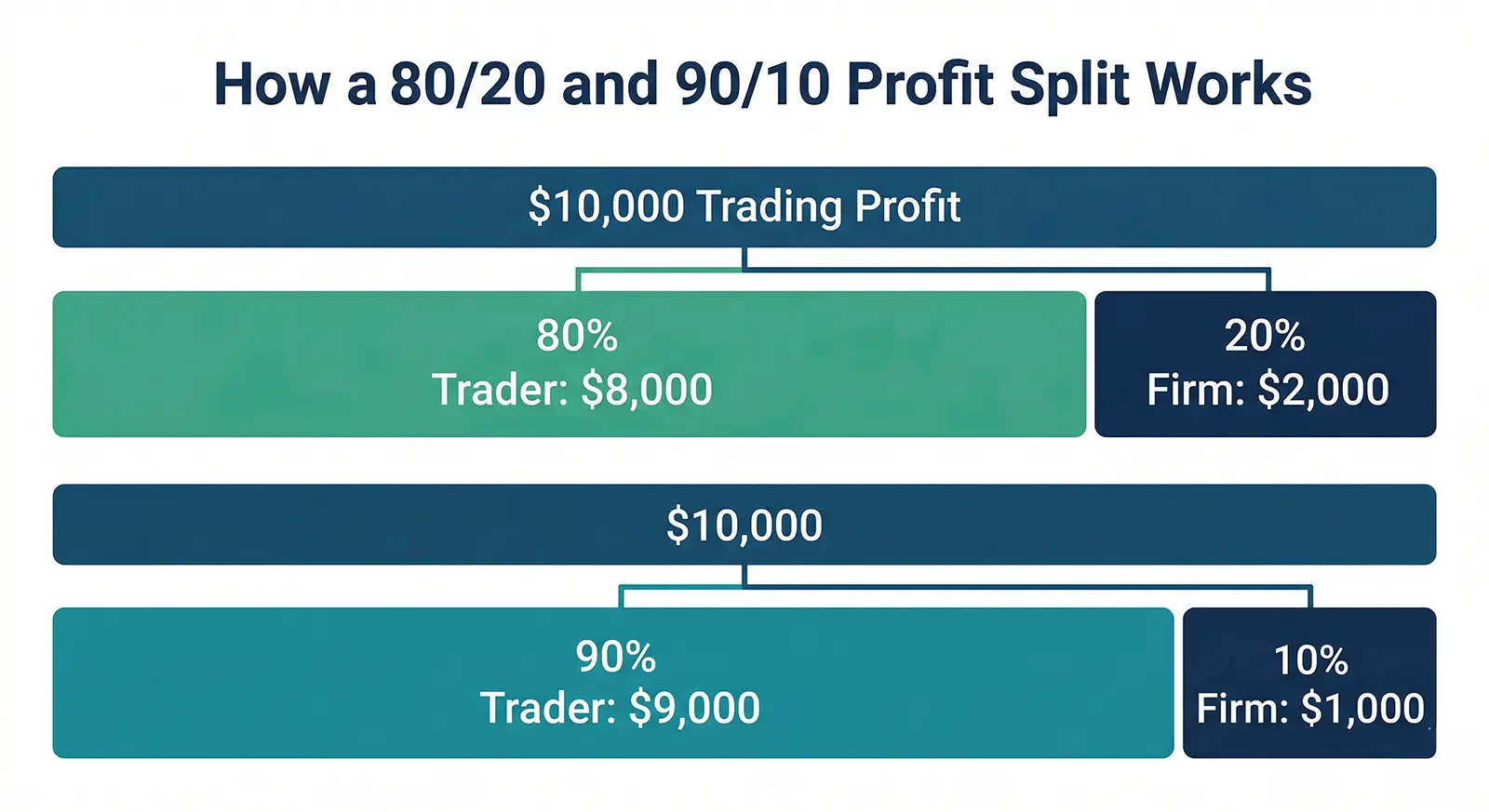
A 80/20 split means you keep 80% and the firm keeps 20%. On $10,000 of trading profit, you receive $8,000 and the firm takes $2,000.
This is not employment. You're not an employee of the firm. You're an independent contractor trading the firm's capital (or, at most modern firms, a simulated version of it). The profit split is the compensation mechanism for that relationship.
The firm's cut covers their operating costs: platform infrastructure, data feeds, customer support, and the losses they absorb from the much larger pool of traders who fail evaluations and funded accounts. The split is how the firm stays in business beyond evaluation fee revenue.
How Profit Splits Work Mechanically
When the Split Applies
The profit split applies only during the funded phase, not during the evaluation. During the evaluation, you're trading to pass. No money changes hands until you're funded and request a payout. For tips on getting through the evaluation stage, see our how to pass a prop firm evaluation guide.
Gross vs. Net Profit Calculation
Most firms calculate the split on gross profit: the total P&L from your closed trades. Commissions are usually deducted before the split calculation, but swap fees, data feed charges, and platform fees are typically charged separately. This means the advertised split is applied to gross profit, but your actual take-home is lower once all fees are subtracted.
A few firms calculate the split on net profit after all fees. This is less common but more transparent. Always check the firm's terms to understand which calculation method they use.
Per-Payout vs. Lifetime Tracking
At most firms, the profit split calculation resets after each approved payout. Only profits earned since your last withdrawal count toward the next payout calculation. This is important because it affects consistency rule calculations and tier progression at firms with performance-based splits.
What Counts as "Profit"
Profit is your net P&L on closed trades. Open (unrealized) gains don't count until you close the position. At some firms, swap charges on overnight positions reduce your realized P&L. The profit figure used for the split calculation is always based on closed, settled trades.
Common Profit Split Structures
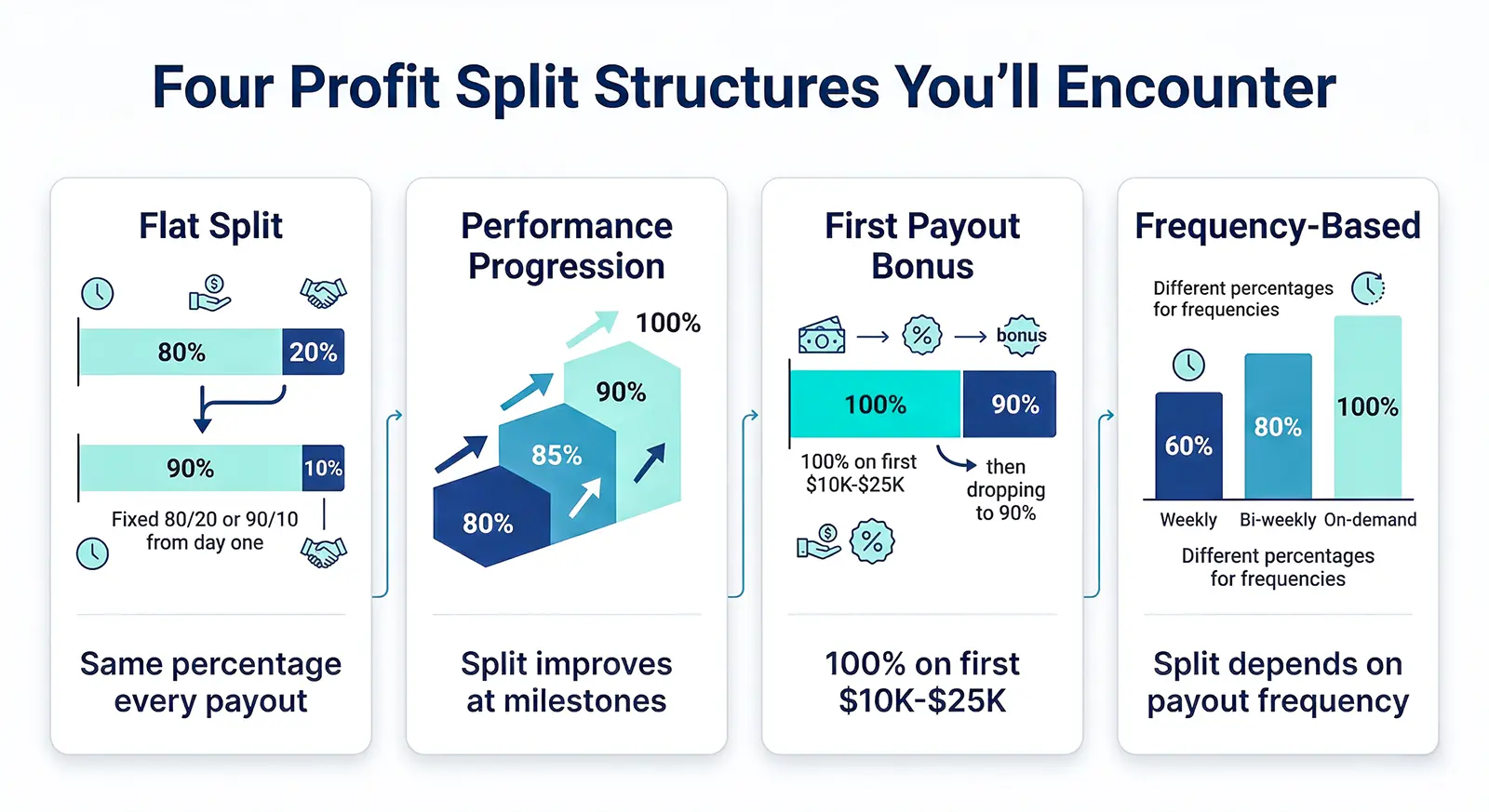
Not all profit splits work the same way. Here are the main structures you'll encounter.
Flat 80/20 Split
The most common starting point across the industry. You keep 80% from day one, the firm takes 20%. This structure is standard at FTMO (2-Step), most futures firms at their base tier, and many forex prop firms. It's simple, predictable, and doesn't change unless you qualify for a scaling program.
Flat 90/10 Split
Some firms offer 90/10 as the starting split. This is increasingly common in 2026 as firms compete for traders. Topstep moved to a flat 90/10 for traders who joined after January 2026 (legacy traders still have the 100% first $10K structure). A few forex firms also start at 90/10 on their premium evaluation tiers.
Performance-Based Progression (80% to 90% to 100%)
Some firms increase your profit split as you hit performance milestones. FTMO starts at 80% on its 2-Step Challenge and moves to 90% through its Scaling Plan (requires 10% net profit over 4 months with no failed accounts). The 5%ers starts at 50% on some programs and scales to 100% as account size grows through milestone targets. Funded Trading Plus uses a progression from 80% to 90% to 100% based on cumulative profit thresholds.
This model rewards consistency and longevity. The higher tiers are earned, not given. The question to ask: what are the specific milestones, and how long does it realistically take to reach them?
First Payout Bonuses
Several futures firms front-load the split. Apex Trader Funding gives 100% on the first $25,000 per account. Topstep (legacy accounts) gave 100% on the first $10,000. Tradeify offers 100% on initial payouts up to $15,000. After the bonus amount, these firms revert to a 90/10 split.
The strategic implication: withdraw early and aggressively during the 100% window. Every dollar withdrawn during the bonus phase is worth more than dollars withdrawn later at 90%.
Frequency-Based Splits
A newer model: the split changes based on how often you withdraw. FundingPips, for example, offers 60% on weekly payouts, 80% on bi-weekly, and 90-100% on on-demand (less frequent) payouts. This structure rewards patience. Traders who wait longer between withdrawals keep more per dollar.
The Path to 100% Profit Split
What "100% Profit Split" Actually Means
At a 100% split, the firm takes nothing from your trading profits at that tier. This sounds too good to be true, and there are conditions. Firms offering 100% typically make their revenue from evaluation fees, activation fees, and the retention of profits from traders at lower tiers. The 100% tier is a reward for top performers, not the default.
How Performance Milestones Trigger Tier Upgrades
The criteria vary by firm. At FTMO, reaching 90% requires the Scaling Plan or Premium Programme. At The 5%ers, reaching 100% requires scaling through multiple account size increases. At Apex, the 100% window is the first $25,000 per account, not a milestone but a front-loaded bonus.
The key detail: some firms lock you into the higher tier permanently once you reach it. Others reset the tier if you have a losing period or if you take a payout. Check whether the progression is permanent or conditional.
Do Withdrawals Affect Progression?
At some firms, yes. If the tier upgrade is based on cumulative profit (lifetime total), withdrawals reduce your running total and can delay the upgrade. At other firms, the milestone is based on account growth regardless of withdrawals. This distinction is worth clarifying with the firm before you plan your payout strategy.
How to Calculate Your Real Profit Split
Advertised Split vs. Effective Split
The number on the firm's marketing page is the advertised split. Your effective split is what you actually take home after all fees are deducted. These are rarely the same number.
Fees That Reduce Your Real Split
Several costs erode the advertised percentage:
Data feed fees (futures only): $55 to $135/month depending on platform.
Platform fees : some platforms charge monthly subscription fees on top of data.
Commissions : per-trade costs that reduce gross profit before the split is applied.
Swap/overnight charges (forex): fees for holding positions overnight. These compound for swing traders.
Activation fees : one-time charges ($0 to $130) when you receive the funded account.
Payout processing fees : some firms charge $5 to $30 per withdrawal via certain methods.
Worked Example: Effective Split Calculation
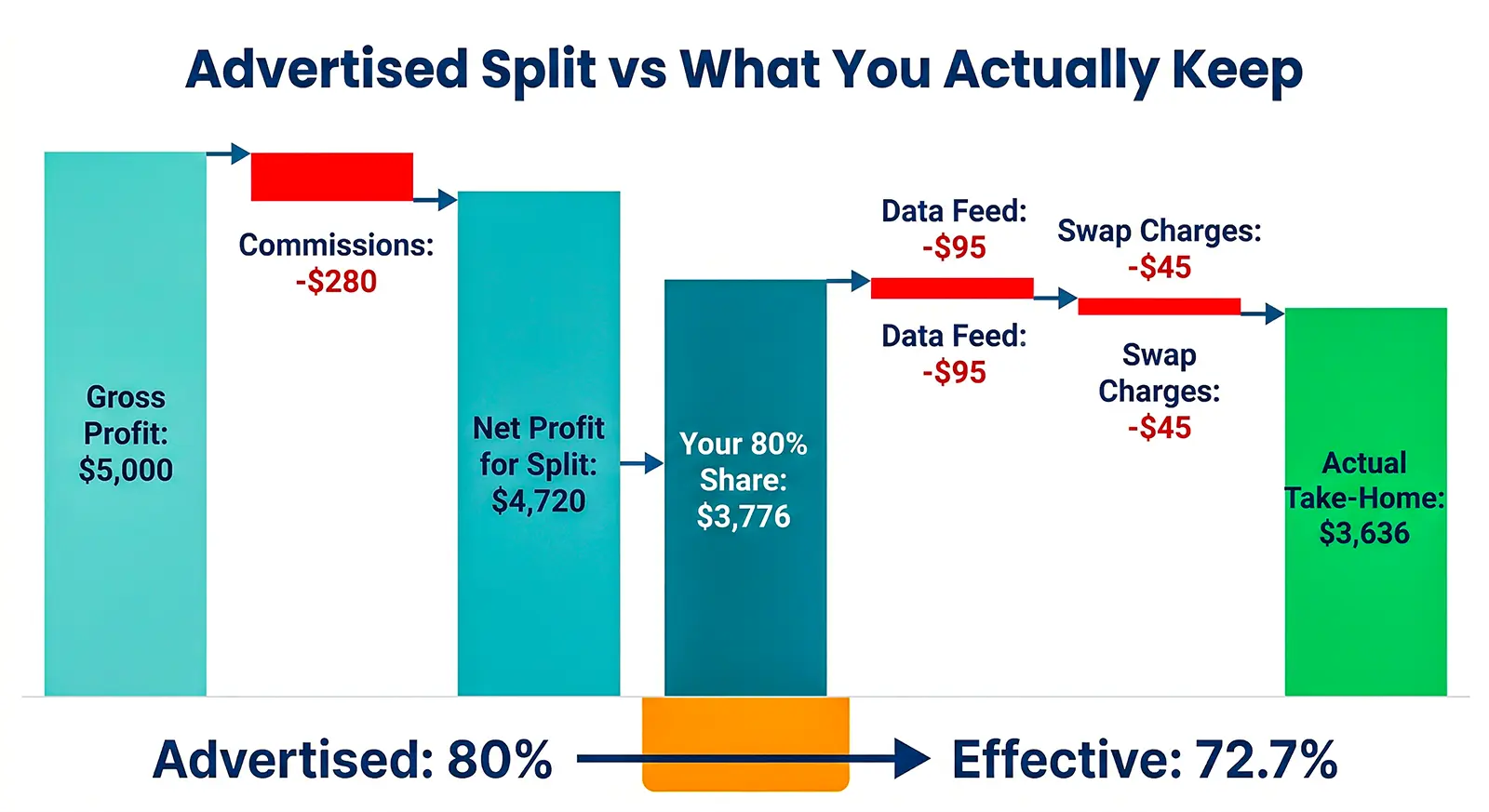
Scenario: $100K funded account, 80/20 advertised split, one month of trading.
Gross trading profit: $5,000
Commissions deducted: -$280
Net profit for split: $4,720
Your 80% share: $3,776
Minus data feed: -$95
Minus platform fee: -$0 (included at this firm)
Minus swap charges: -$45
Actual take-home: $3,636
Effective split: 72.7% (not 80%)
The gap between 80% and 72.7% is $364/month. Over a year, that's $4,368 in fees that the headline number doesn't show. Always calculate your effective split before comparing firms.
Profit Split vs. Other Compensation Structures
Profit Split vs. Traditional Trading Desk Employment
At an institutional trading desk (Jane Street, Citadel, Two Sigma), traders earn a salary plus a performance bonus. The bonus is typically 10-30% of profits generated, far lower than prop firm splits. But the salary provides a baseline income regardless of trading performance, and the firm covers all costs. Prop firm traders have no salary and bear their own evaluation and data costs.
Profit Split vs. Broker Rebates
Some brokers offer cashback rebates per trade. This is not a profit split. Rebates are a fixed amount per lot traded regardless of profitability. A trader generating $5,000 in profit might earn $50 in rebates. Not comparable to an 80% share of $5,000.
What to Watch For in Profit Split Terms
Consistency Rules That Affect Payout Eligibility
Some firms won't let you request a payout unless your profit distribution meets a consistency threshold. At Apex, no single day can account for 50% or more of your total profit. This doesn't change the split percentage, but it delays when you can access it. A consistency rule doesn't reduce your split. It controls when you receive it.
Hidden Fees That Erode the Split
Watch for firms that advertise a high split but charge fees that bring the effective number down. Data fees, swap charges, and payout processing fees are the most common. A firm offering 90% with $135/month in data fees may give you less take-home than a firm offering 80% with $0 in data fees, depending on your monthly profit.
Tier Resets
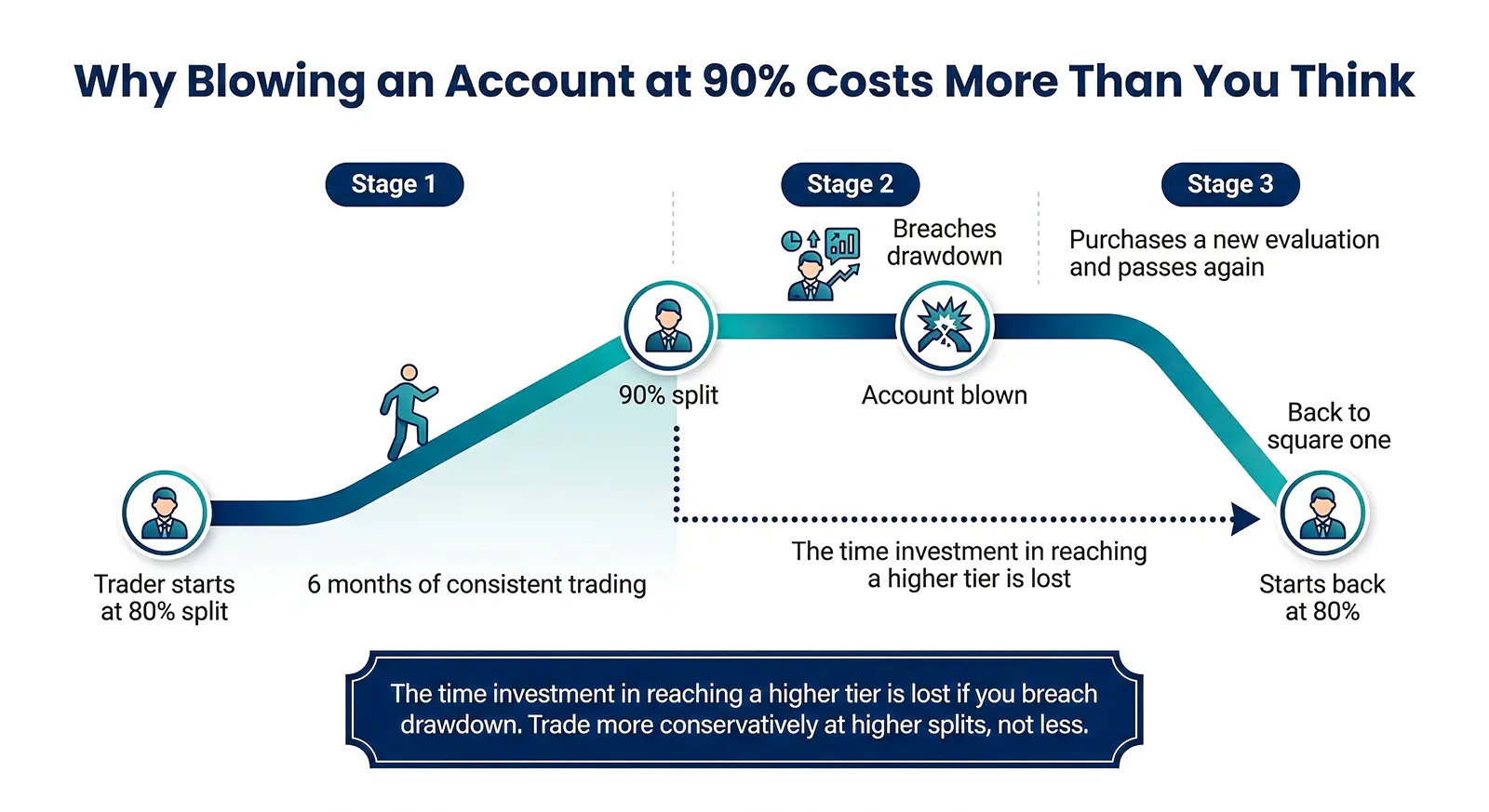
If you reach a higher split tier and then blow the account, does the tier persist on your next funded account? At most firms, no. You start over at the base tier. This means the time investment in reaching 90% or 100% is lost if you breach drawdown. Protecting the account at higher tiers is worth trading more conservatively for.
Our trailing drawdown guide explains how drawdown mechanics work and how to manage them.
Changes After You Sign Up
Firms occasionally change their profit split structures. Topstep changed from 100% on the first $10K to a flat 90/10 in January 2026. Firms typically honor existing accounts under the old terms, but new accounts get the updated split. Always check the current terms, not a review written six months ago.
Profit Split and Taxes
This section is for general awareness only. It is not tax advice. Consult a licensed tax professional in your jurisdiction.
Is Profit Split Income Taxable?
Yes, in most jurisdictions. In the United States, prop firm payouts are classified as self-employment income, not capital gains. This means they're subject to both income tax and self-employment tax (15.3% on the first $168,600 of net self-employment income in 2026). The effective tax rate is higher than if you were trading your own capital in a personal brokerage account.
How Prop Firms Report Payouts
US-based firms may issue 1099 forms to traders who receive payouts above the reporting threshold. International firms (like FTMO, based in the Czech Republic) generally do not issue US tax forms, but the income is still reportable. Keep records of every payout you receive.
Profit Splits Across Major Prop Firms (April 2026)
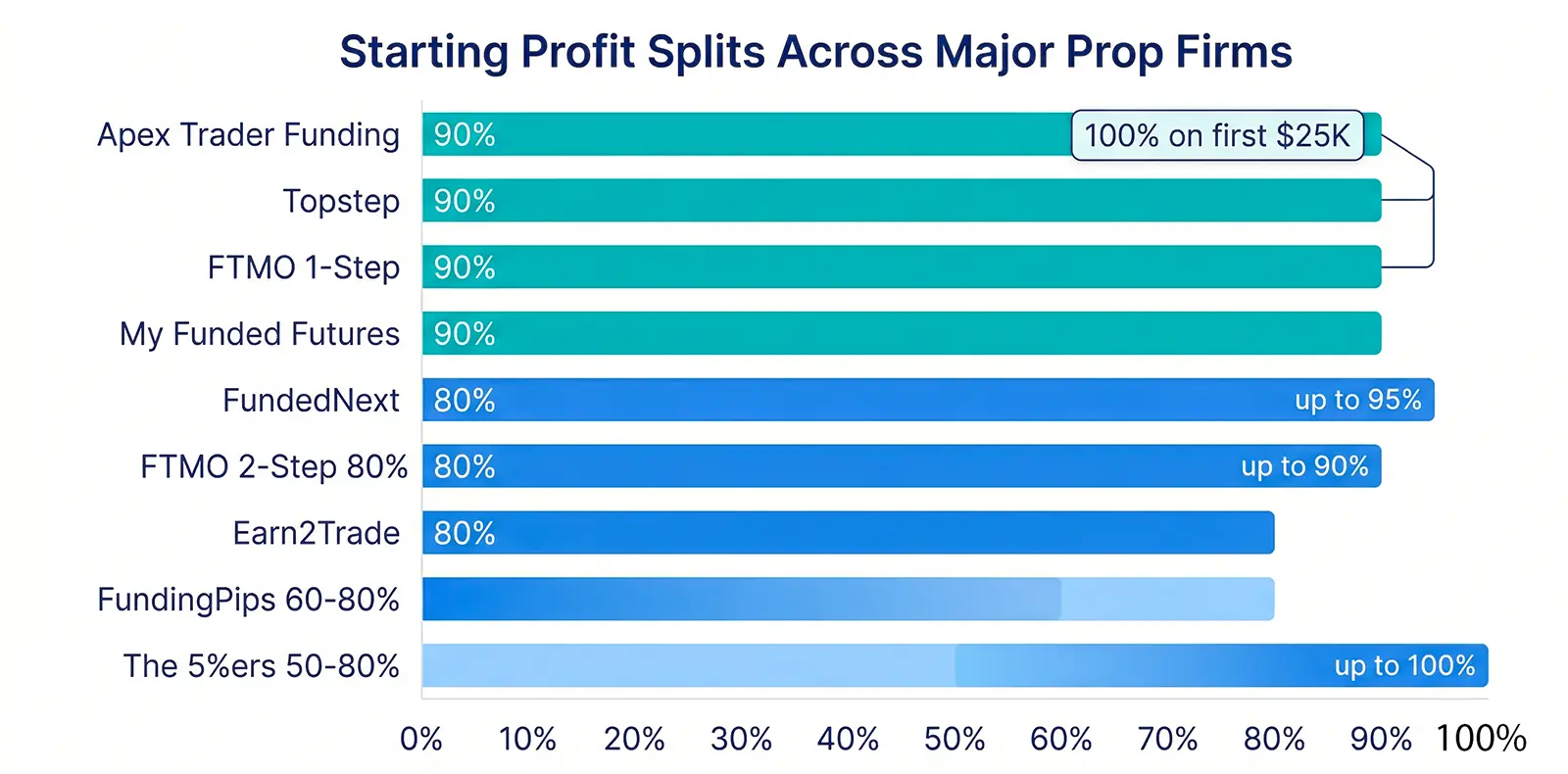
The following data reflects each firm's publicly stated profit split terms as of April 2026. Verify current terms on each firm's website before purchasing.
|
Firm |
Starting Split |
Max Split |
First Payout Bonus |
How to Reach Max |
|
Apex Trader Funding |
90/10 |
100% |
100% on first $25K |
Automatic on first $25K per account, then 90/10 |
|
Topstep (new accounts) |
90/10 |
90/10 |
None |
Flat split, no progression |
|
FTMO (2-Step) |
80/20 |
90/10 |
Fee refund on 1st payout |
Scaling Plan: 10% net profit over 4 months |
|
FTMO (1-Step) |
90/10 |
90/10 |
Fee refund on 1st payout |
Flat split from day one |
|
My Funded Futures (Rapid) |
90/10 |
90/10 |
100% on first $10K |
Automatic on first $10K, then 90/10 |
|
The 5%ers |
50-80% |
100% |
None |
Scale through milestone profit targets to $4M |
|
FundedNext (Stellar) |
80/20 |
95% |
15% during challenge |
Lifetime Payout Add-On or scaling milestones |
|
FundingPips |
60-80% |
100% |
None |
Reduce payout frequency (on-demand = highest split) |
|
Earn2Trade |
80/20 |
90/10 |
None |
Scaling plan milestones |
Across the firms we tracked for this guide, the most common starting split is 80/20, and the most common maximum is 90/10. A handful of firms reach 100% through either first-payout bonuses or long-term scaling milestones.
Common Misconceptions About Profit Splits
"Higher Profit Split Always Means More Money"
Not necessarily. A firm offering 90% with $600 evaluation fees and strict drawdown rules may cost you more (in failed attempts) than a firm offering 80% with $200 fees and generous drawdown. The split percentage is one variable. Total cost, pass rate, and payout reliability matter equally.
"100% Profit Split Is a Marketing Trick"
It depends. First-payout bonuses (Apex's 100% on first $25K) are genuinely valuable. A trader who withdraws $25,000 keeps every dollar. That's real money. But claims of permanent 100% splits deserve scrutiny. Ask how the firm stays profitable if they take nothing from funded traders. The answer is usually evaluation fees, which means the model works only as long as enough traders keep buying challenges.
"All Firms Calculate Profit the Same Way"
They don't. Some apply the split to gross profit (before commissions). Others apply it to net profit (after commissions and swap). Some include swap charges in the P&L. Others charge them separately. Two firms both advertising "80% profit split" can give you meaningfully different take-home amounts on the same trading performance.
"The Firm Is Your Trading Partner"
It isn't. At most modern prop firms, you're trading on a simulated account. The firm's revenue comes primarily from evaluation fees, not from sharing in your trading gains. The profit split on funded accounts is a secondary revenue stream. The firm's interests and your interests are aligned on paper (both benefit from profitable trading), but the business model doesn't depend on your success to be profitable.
For a broader look at how firms compare across all factors, visit our best prop firms rankings page.
Frequently Asked Questions
What is the highest profit split in a prop firm?
100%, offered by several firms either as a first-payout bonus (Apex: first $25K, Tradeify: first $15K) or as a milestone-based tier (The 5%ers at full scaling, FundingPips on on-demand payout frequency). The conditions to reach and maintain 100% vary significantly.
Do prop firms ever offer 100% profit split?
Yes, but always with conditions. Some offer it as a promotional first-payout bonus. Others require months or years of consistent performance to reach the 100% tier. No firm offers 100% as an unconditional default from day one.
How is profit split different from revenue share?
In practice, they're used interchangeably in the prop firm industry. Both refer to the percentage of trading profits the trader keeps. In other industries, revenue share typically applies to gross revenue, while profit share applies after expenses. In prop trading, the term "profit split" is standard.
When do I receive my share of the profit?
After you request a payout and it's approved. Payout schedules vary: Apex requires 5 qualifying trading days, Topstep offers daily payouts after milestones, FTMO processes on-demand within 1-2 business days. You receive your share minus the firm's cut, deposited via your chosen payment method.
Can a prop firm change my profit split after I'm funded?
Firms typically change terms for new accounts only, not retroactively for existing ones. But this isn't guaranteed. Always read the terms of service, which usually include a clause allowing the firm to modify terms with notice. If a firm changes splits on existing accounts without notice, that's a red flag.
Does the profit split apply during the evaluation phase?
No. At nearly all firms, no money is paid during the evaluation. You're trading to pass, not to earn. One exception: FundedNext offers a 15% profit share during the challenge phase on some evaluation types, which is unusual in the industry.
Why do firms take a percentage of profits at all?
The firm provides the capital (or simulated capital), the trading platform, the risk management infrastructure, and the payout processing. The firm's share covers these costs plus the losses absorbed from the majority of traders who fail. Without the profit split, the firm's only revenue would be evaluation fees.
Is the profit split negotiable?
No. Prop firm splits are standardized across all traders at each tier. You cannot negotiate a custom split. The only way to get a higher split is to meet the firm's tier progression criteria, choose a firm with a higher base split, or take advantage of first-payout bonuses.
What happens to the firm's share of the profit?
It goes to the firm's operating revenue. At most firms, the profit split revenue is a secondary income stream behind evaluation fees. It covers infrastructure costs, payout processing, customer support, and the firm's own profitability