Trading Psychology for Prop Firm Traders: How to Not Blow Your Evaluation Before Your Strategy Gets a Chance

Most prop firm evaluation failures are not strategy failures. They are psychology failures.
Data from Funded Trading Plus, which analyzed over 10 million simulated evaluations through their PropIQ engine, found that 80% of failures come from rule violations or poor emotional control, not from bad trading strategies. A separate finding from the same dataset: 43% of first-time failures were caused by traders breaking a rule they didn't fully understand.
The profit targets on evaluations are modest. On a $100,000 account, most firms ask for $6,000 to $10,000. That's 6-10%. The drawdowns are typically $2,500 to $6,000. The time limits are 30 days or more at most firms, and several have no time limit at all. If raw trading skill were the test, pass rates would be a lot higher than the industry-average 5-15%.
The evaluation is a discipline filter. Your strategy got you to the starting line. Your psychology determines whether you cross the finish.
Why Prop Firm Psychology Is Different From Personal Trading
When you trade your own capital, the emotional pressure comes from losing your money. When you trade a prop firm evaluation, the pressure is different, and in some ways worse. You're dealing with multiple layers of stress at the same time.
The sunk cost of the evaluation fee. You paid $150 to $500 for the challenge. That fee is psychologically tied to the outcome. Failing feels like losing the fee, which triggers irrational attempts to "save" it by trading more aggressively.
Self-imposed time pressure. Even on evaluations with no hard deadline, traders create their own: "I need to pass this month." That deadline doesn't exist in the rules. It exists in your head. And it distorts every decision.
Rule anxiety. Your personal trading account has no daily loss limit, no drawdown threshold, no consistency rule. An evaluation has all of these. Every trade carries rule-violation risk on top of financial risk. Our drawdown explained guide covers how these rules work mechanically.
Outcome orientation. Personal trading lets you focus on process. Evaluations force you to focus on a specific dollar target, and that target pulls your attention away from execution and toward the P&L number.
The result: traders who are profitable in their personal accounts routinely fail evaluations. The psychology of trading under prop firm constraints is its own skill, separate from trading ability.
The Six Psychological Traps That Blow Evaluations
1. Revenge Trading
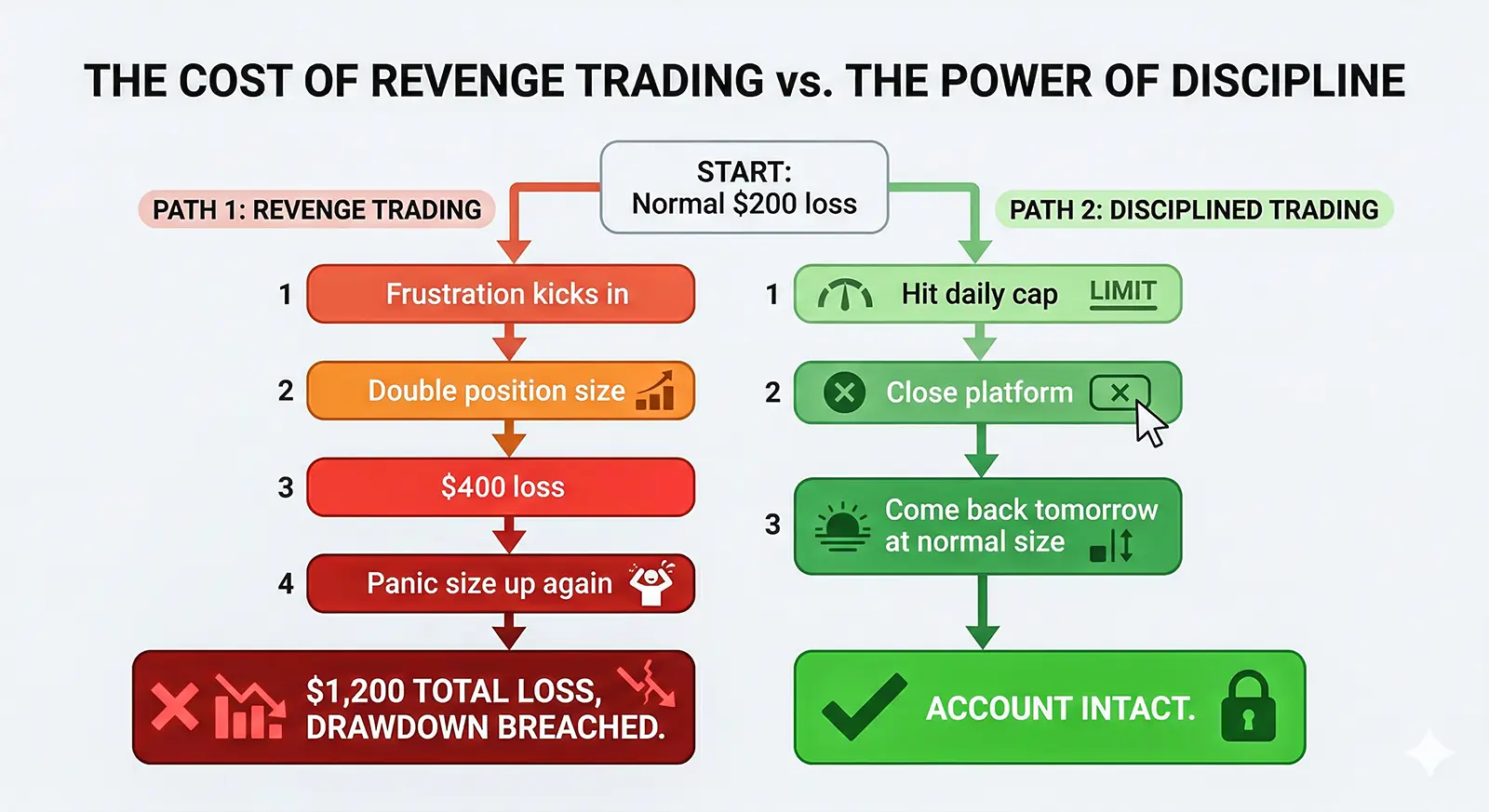
After taking a loss, you immediately enter another trade, often at a larger size, to recover what you lost. You're trading out of frustration, not from your setup.
During an evaluation, this is amplified. The loss feels like it threatens the entire challenge, not just your daily P&L. You rationalize the second trade as "getting back to even." But you're not making a trading decision. You're making an emotional one.
What it looks like in practice: you take a planned $200 loss at 10:30 AM. By 10:35 AM, you're in a new trade at twice your normal size, with a wider stop, chasing a recovery. That second trade loses $500. Now you're down $700 and your composure is gone.
The fix: Set a personal daily loss limit tighter than the firm's limit. Most firms allow $1,500 to $2,500 in daily losses. Your personal limit should be $400 to $600. When you hit it, close the platform. Not "take a break." Close it. Walk away. Physical separation from the screen is the only reliable fix when you're in an emotional state.
2. FOMO (Fear of Missing Out)
You see a setup forming that isn't your setup, or a move happening that you didn't take, and you enter the trade anyway because watching it go without you feels unbearable.
Evaluations amplify FOMO because they create a scarcity mindset. Every missed setup feels like a missed dollar toward the profit target. You start taking trades outside your plan because you feel behind.
What it looks like: your plan is to trade opening range breakouts on NQ. At 11:30 AM, you see a different setup forming on ES. You take it because "you need to make up ground." The trade loses because you haven't tested this setup under evaluation conditions.
The fix: Trade exactly one setup during the evaluation. Write it down before you start. When you see other setups, recognize the FOMO for what it is: an emotional reaction to artificial scarcity. Trades you didn't take cost you nothing.
3. Overtrading
Taking too many trades in a session, usually more than your strategy actually produces. You're trading because you're bored, anxious, or chasing the target.
Sitting and waiting feels like you're not making progress. Every minute of inaction feels like wasted time. So you force trades to feel productive. Your tested setup produces 2-3 valid entries per day. You take 8. Half of them are marginal. Those marginal trades lose money and drag your win rate below your edge.
The fix: Set a hard daily trade limit. If your strategy produces 2-3 entries per day on average, cap yourself at 4 trades maximum. After 4, you're done for the day. This forces trade selection and eliminates the "one more trade" spiral.
4. The Sprint Mentality
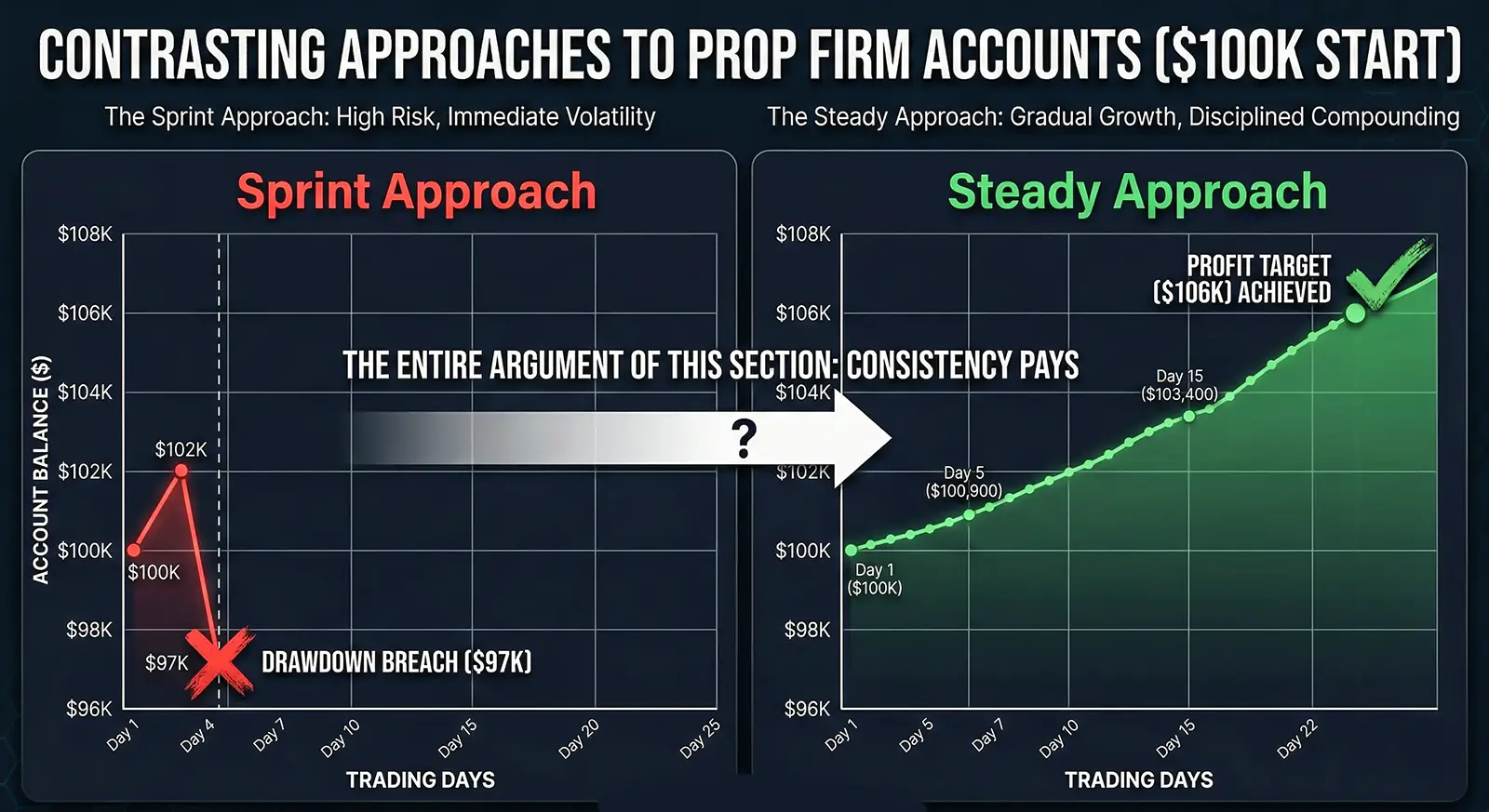
Trying to pass the evaluation as fast as possible. Sizing up, pushing for big daily gains, treating day 2 like it's the final day.
The psychological driver is simple: the sooner you pass, the sooner the stress ends. So you try to "finish it today." On a $6,000 target with 30 days, you decide to make $2,000 on day 2. You size up from 2 contracts to 4. A normal 15-tick adverse move on 4 ES contracts is $750. Two of those and you've lost $1,500 in a morning.
Data supports the opposite approach. Funded Trading Plus found that evaluations completed in 45-60 days show lower subsequent failure rates than those passed in under 30 days. Slower is safer.
The fix: Calculate your daily profit target ($6,000 / 22 trading days = $272 per day) and stick to it. If you hit $272 by 11 AM, stop. If you have a great day and make $600, take it and quit. Do not push for $1,000 because the market is moving. The anxiety is the enemy, not the timeline.
5. Tilting After a Losing Day
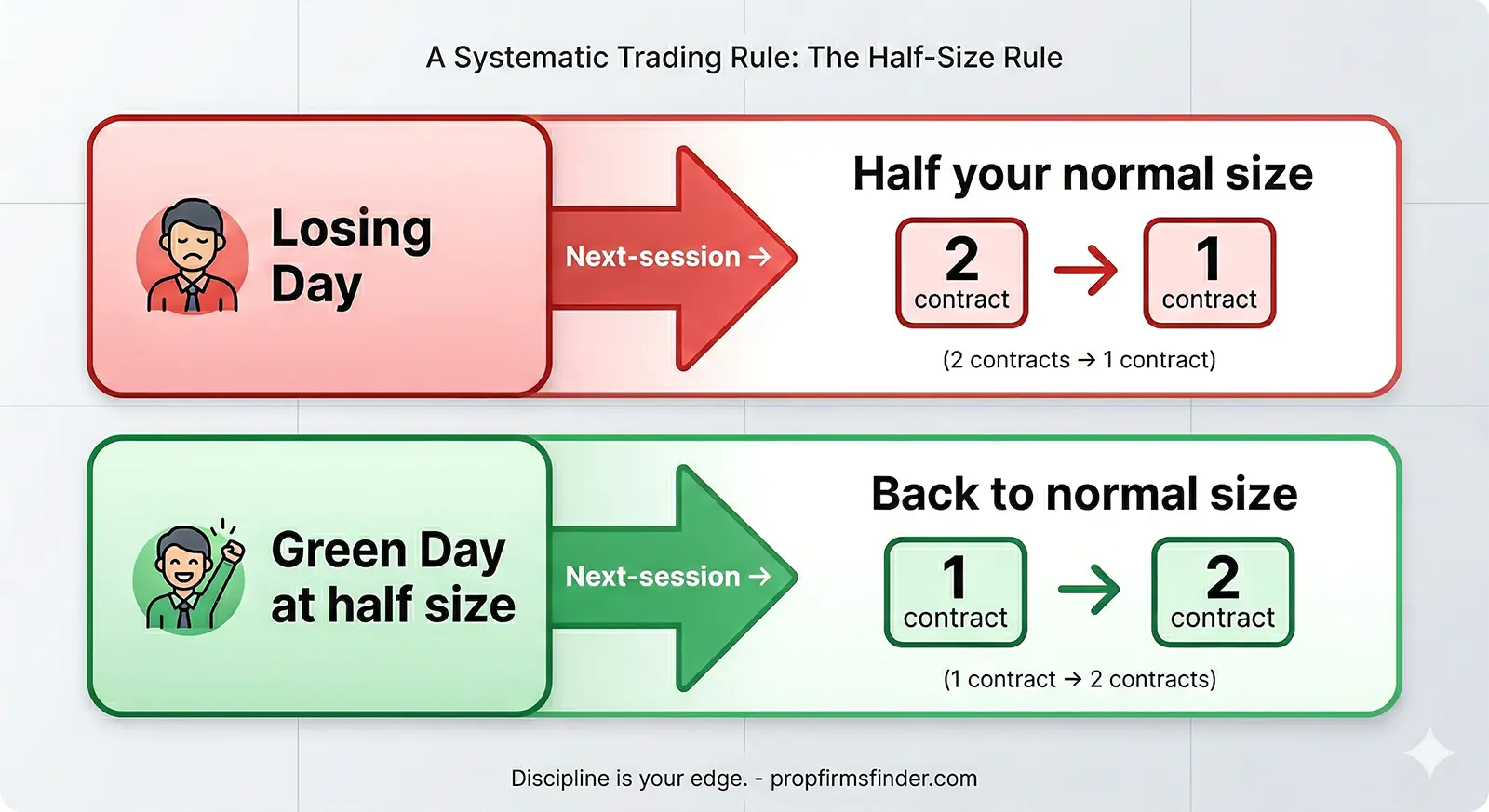
You have a losing day, come back the next morning, and trade erratically because the previous loss is still in your head. You skip your pre-market routine. You jump into the first trade you see. You size up because you need to "make it back."
What it looks like: you lose $400 on Tuesday. Wednesday morning, you go straight to the charts, take a trade in the first five minutes with 3 contracts instead of your usual 2, and lose another $600 before 10 AM.
The fix: After any losing day, the next session's maximum position size is half your normal size. If you normally trade 2 contracts, trade 1. If you normally trade 1, switch to micros. This breaks the tilt cycle by forcing smaller risk when your emotional state is compromised. Return to normal sizing only after a green day.
6. The Finish Line Panic
You're 80% of the way to the profit target with plenty of time left. Two things happen, and both are destructive: you either size up to "finish it" (greed), or you freeze up and trade too defensively out of fear of losing your progress.
The closer you get to passing, the more psychologically valuable the account becomes. The last 20% of the target is where the most evaluation accounts die.
The fix: When you reach 70% of the profit target, reduce your position size by 25-50%. Trade smaller, not larger. The goal shifts from maximizing profit to avoiding drawdown violations while completing the remaining target. A $200/day pace for 6 more days gets you there. You do not need a hero trade.
The Pre-Trade Mental Checklist
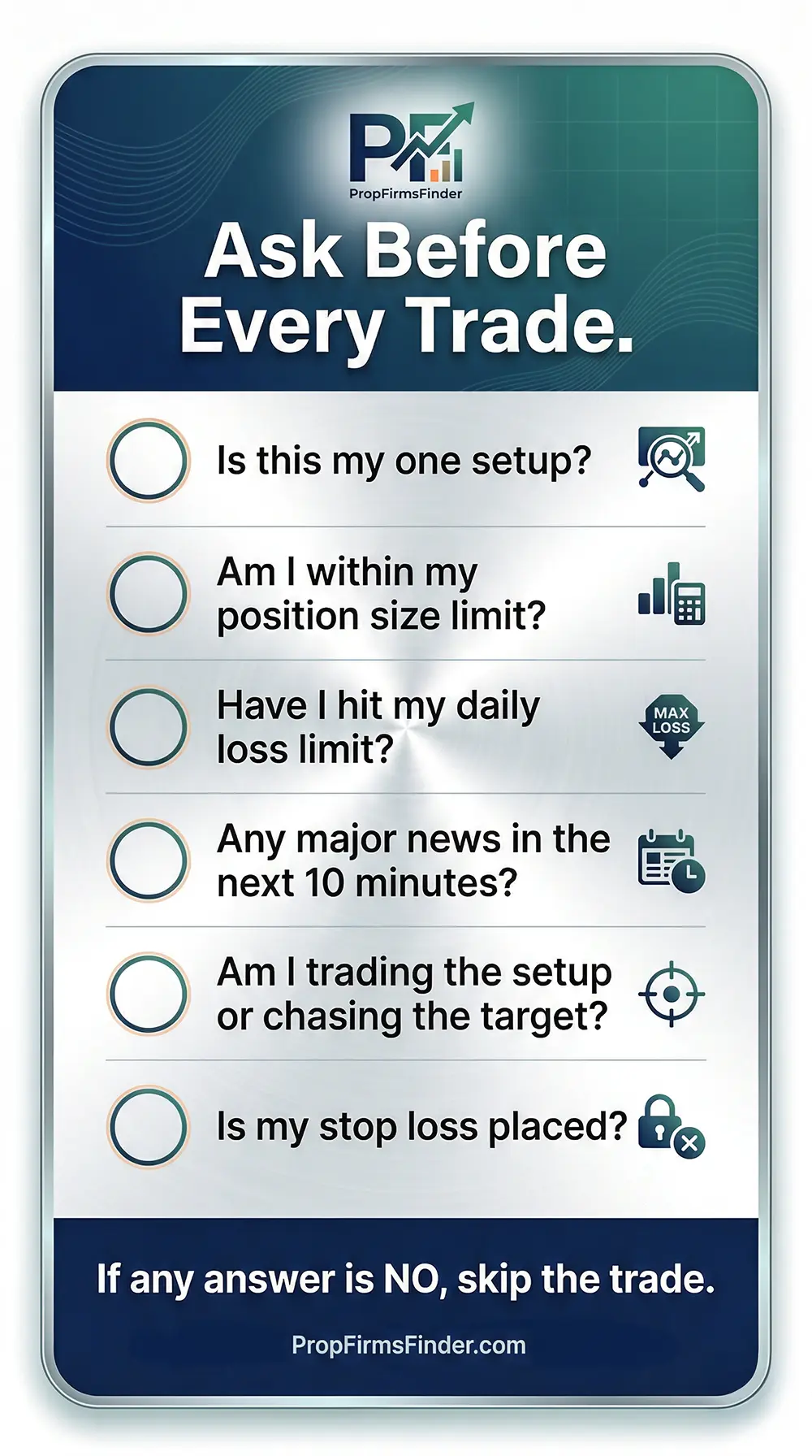
Before every trade during an evaluation, run through these questions. If the answer to any is no, skip the trade. The checklist above is in an image format which you can save to your device and using as the reference before each trade.
|
# |
Question |
|
1 |
Is this my one setup? If not, skip it. |
|
2 |
Am I within my position size limit for the day? |
|
3 |
Have I hit my daily loss limit? If yes, close the platform. |
|
4 |
Is there a major news release in the next 10 minutes? If yes, wait. |
|
5 |
Am I entering because of the setup or because I'm behind on the target? |
|
6 |
Is my stop loss placed before I enter? |
This takes 30 seconds. It prevents the majority of psychology-driven mistakes. Print it out or keep it on a sticky note next to your monitor.
Why a Trading Journal Is Not Optional During an Evaluation
Most trading journals are vague mood logs. That's not what this is. A proper evaluation journal tracks specific data that reveals patterns over time.
What to log after every trade: Trade number for the day (reveals overtrading). Entry time (reveals time-of-day patterns). Setup type (were you trading your one setup or improvising?). Position size (did you stick to your plan or size up?). Entry reason in one sentence. Exit reason (target, stop, or manual close). R-multiple. Emotional state before entry (calm, anxious, frustrated, FOMO). Did this trade follow your rules? Yes or no.
After 10 trading days, review the data. Look for patterns: are your afternoon trades losing more than your morning trades? Do trades taken when you rated yourself "anxious" underperform trades taken when you were "calm"? Are your rule-breaking trades winning or losing? What is your average R-multiple?
The journal tells you where your edge zone is. During an evaluation, you want to trade only inside that zone.
The Psychology Shifts When You Get Funded
The psychological challenges don't end when you pass. They change. During the evaluation, you're trying to grow an account. Once funded, you're trying to preserve one while earning payouts. Different objectives. Different pressure.
Payout anxiety: Every trade before a payout request feels weighted because you don't want to blow the account right before getting paid.
Drawdown creep: After the trailing drawdown locks (at most firms, once your threshold reaches starting balance plus a small buffer), you have a hard floor. Losses feel permanent. There's no more cushion building.
Scaling pressure: Firms that scale your account size based on performance create pressure to trade more aggressively to unlock larger sizes faster.
Loss of the evaluation buffer: During the evaluation, failure meant buying a new challenge ($150 to $500). Post-funding, failure means losing the funded account entirely.
The same discipline principles apply, with one addition: treat every funded trading day like day one. The account you're protecting today is not the account you passed with. It's a new account. Trade it accordingly.
For the rules and mechanics of payout eligibility, including consistency requirements, check our consistency in prop trading guide.
How Different Firms Create Different Psychological Pressure
The firm you choose affects which traps you're most likely to encounter. The rules shape the pressure.
|
Firm |
Rule That Creates Pressure |
Psychological Effect |
|
Apex Trader Funding |
Choice between EOD and intraday trailing drawdown |
Reduces anxiety if you pick the model matching your style. EOD is more forgiving for volatile intraday traders. |
|
Topstep |
Monthly subscription (ongoing cost) |
Creates urgency to pass fast to stop the billing. Can trigger sprint mentality. |
|
FTMO |
No strict time limits on many programs |
Removes sprint pressure. But can enable procrastination if you lack self-imposed structure. |
|
Tradeify |
Microscalping rule (50%+ of trades held >10 seconds) |
Prevents impulsive one-tick revenge scalps. Forces you to hold positions. |
|
My Funded Futures |
Plan-specific drawdown types (EOD on eval, intraday on Rapid sim funded) |
Different pressure at different stages. Need to understand the shift before transitioning. |
If you're prone to revenge trading, a firm with a strict consistency rule will punish it harder because your big recovery trades create uneven daily P&L that blocks payouts.
If you're prone to the sprint mentality, Topstep's monthly subscription model will amplify it. A one-time fee model (like Apex Trader Funding's current structure) removes the ongoing cost pressure. Read our Apex Trader Funding review for a full breakdown of their rules and pricing.
Compare all firms on our prop firm rankings page to find the structure that fits your psychology.
Frequently Asked Questions
Is trading psychology more important than strategy for prop firm evaluations?
For evaluations specifically, yes. The profit targets are low enough that any competent strategy can reach them. The rules are strict enough that psychological mistakes destroy accounts before the strategy gets a fair shot. A trader with an average strategy and strong discipline will pass more consistently than a trader with a great strategy and poor discipline.
How do I stop revenge trading?
Physical separation from the platform. When you hit your daily loss limit, close the platform, leave the room, and do something that takes at least 30 minutes away from the screen. Mental willpower alone is not reliable when you're in an emotional state. You need to physically remove yourself from the ability to trade.
What if I keep failing evaluations even though I know these rules?
If you know the rules and keep breaking them, the problem is execution under pressure, not knowledge. Three options: (1) trade a smaller account size to reduce the stakes, (2) demo trade the evaluation conditions for 30 days before attempting another paid challenge, or (3) take a 2-4 week break to fully reset. Some traders also benefit from working with a coach or trading psychologist who specializes in performance under constraints.
How is funded account psychology different from evaluation psychology?
Evaluation psychology is about getting through a specific test. Funded account psychology is about sustainable performance month after month. The tactical adjustments are the same (daily limits, one setup, trade journaling). The time horizon is different. Evaluation traders need short-term discipline. Funded traders need habits that hold up indefinitely.
Should I meditate or do breathing exercises before trading?
Some traders find it helps. The evidence on measurable performance improvement is mixed. What works more reliably: a structured pre-market routine that puts you in the same mental state every day before you trade. Whatever that routine is (coffee, chart review, economic calendar check, meditation), do the same thing in the same order every morning. The routine is more important than any single element in it.
Does the choice of firm affect my psychology?
Absolutely. A monthly subscription creates different pressure than a one-time fee. Intraday trailing drawdown creates different anxiety than EOD trailing. A firm with no consistency rule creates less stress than one with a 30% threshold. Match the firm's rules to your psychological profile, not just your trading style. Our how to pass a prop firm evaluation guide covers the tactical side alongside these psychological principles.
The Short Version
Prop firm evaluations are discipline tests disguised as trading challenges. The strategy bar is low. The psychology bar is high.
To protect your evaluation from yourself:
|
1 |
Set a personal daily loss limit tighter than the firm's limit |
|
2 |
Trade one setup only, no exceptions |
|
3 |
Cap your trade count per day |
|
4 |
Calculate your daily profit target and respect it |
|
5 |
Reduce position size after any losing day |
|
6 |
Reduce position size when you approach the target |
|
7 |
Keep a data-driven trading journal |
|
8 |
Run the pre-trade checklist before every entry |
The traders who pass are not the best traders. They are the most disciplined traders. Build the discipline during the evaluation and it carries into the funded account.
If you're choosing your first evaluation, browse our best futures prop firms and best forex prop firms pages to find a firm that matches your trading style and psychological tolerance. And check our prop firm deals page for current discounts.