How Funded Trading Accounts Work: A Step-by-Step Guide
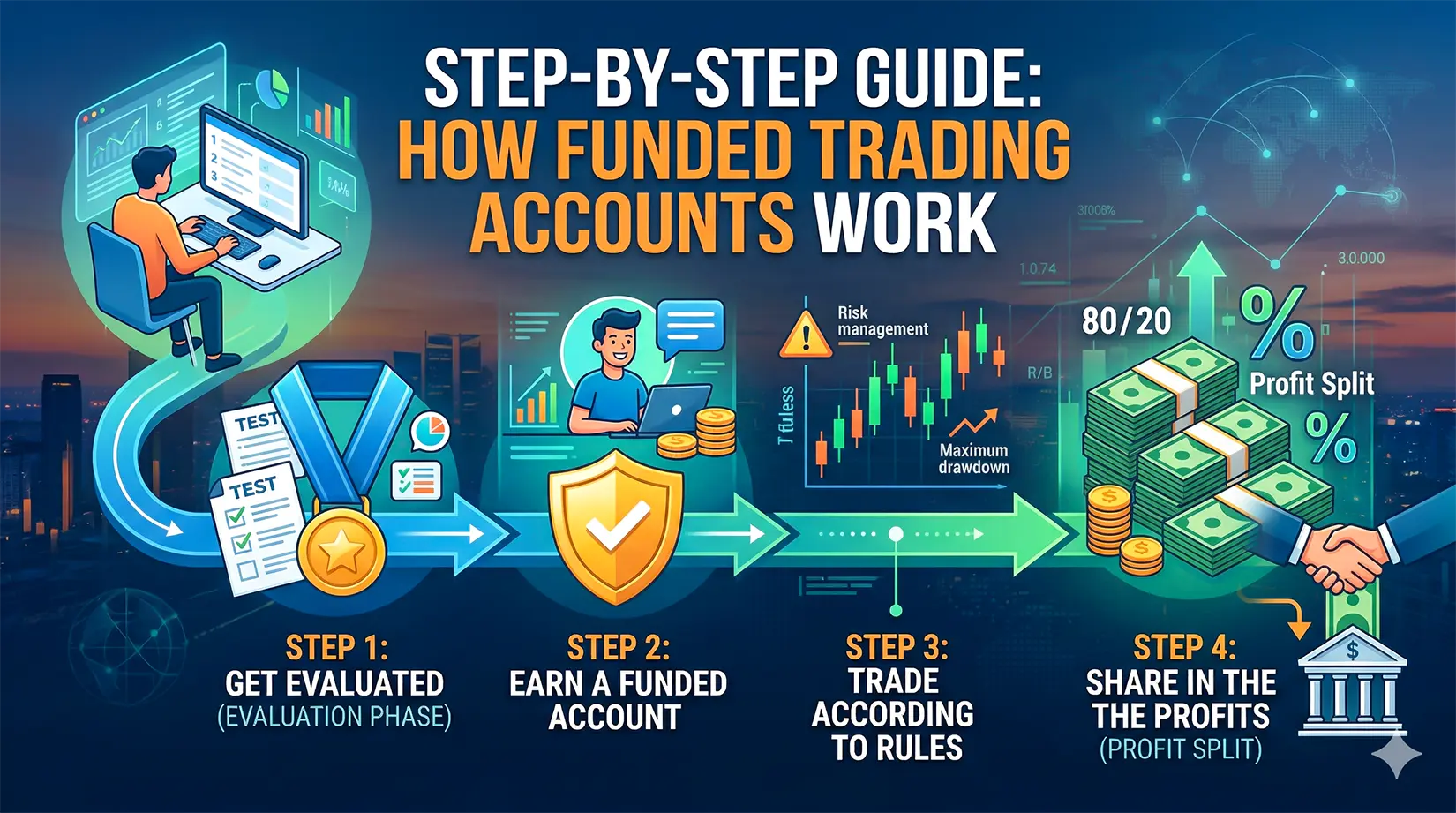
A funded trading account gives a trader access to a prop firm's capital after passing an evaluation. The trader hits a profit target without breaking drawdown or loss rules, then trades the funded account and keeps 70 to 100 percent of profits as real payouts.
What Is a Funded Trading Account?
A funded trading account is a trading account where you use capital provided by a proprietary trading firm instead of your own money. The firm provides the capital. You provide the trading skill. Profits are split between you and the firm.
The word "funded" is slightly misleading. At most modern prop firms, the account is simulated. You trade on a demo server that mirrors real market conditions. But the payouts are real. When you generate profit and request a withdrawal, you receive actual money via bank transfer, Deel, Rise, or cryptocurrency.
The process has a clear lifecycle: you sign up, pass an evaluation, receive a funded account, trade it, request payouts, and potentially scale to a larger account. This guide walks through each step.
The Funded Account Lifecycle: An Overview
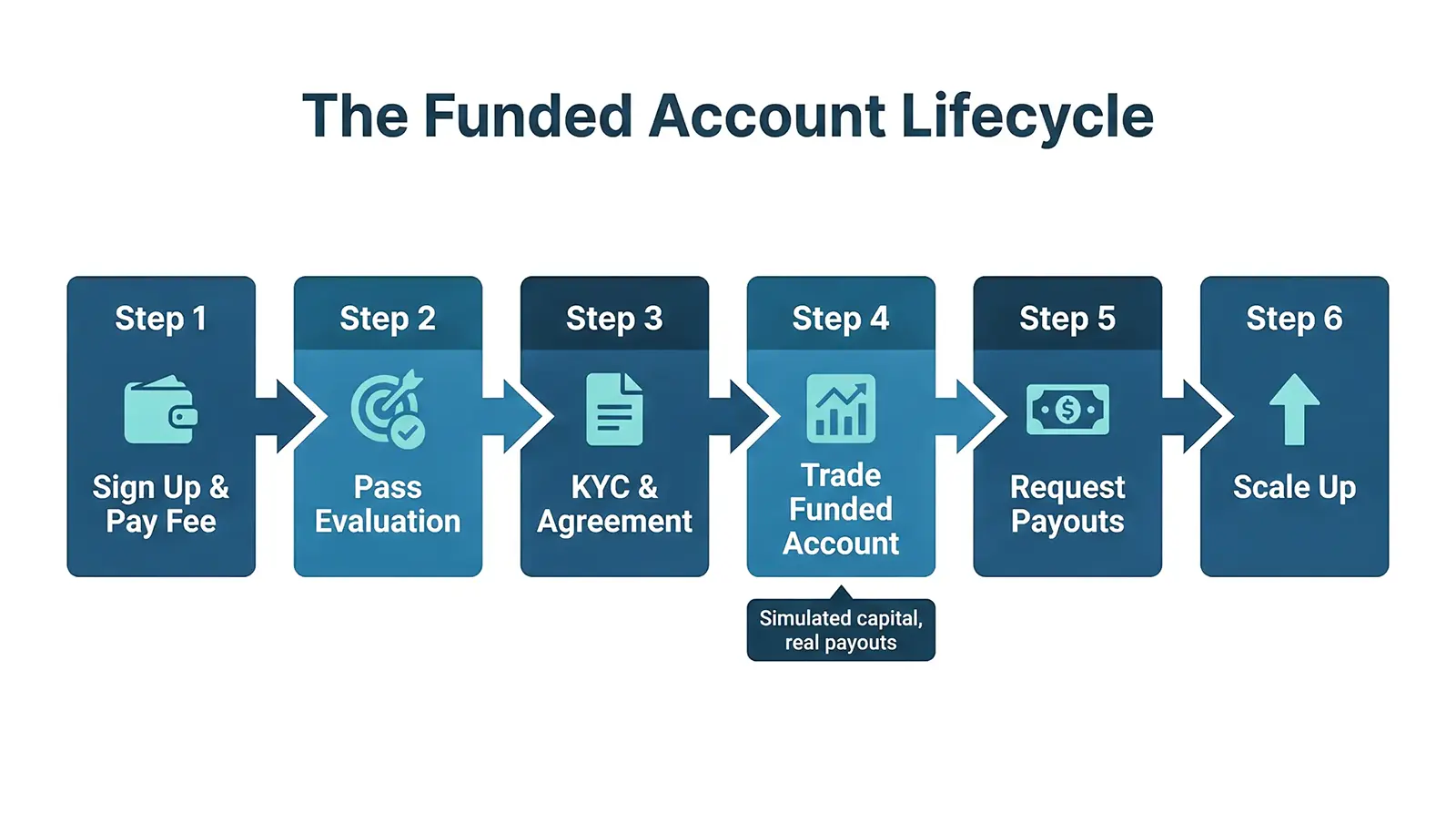
Every prop firm follows this same basic sequence, with variations in the details. The steps are:
1. Signup and account selection - Choose a firm, account size, and evaluation type. Pay the fee.
2. Evaluation - Trade a simulated account. Hit the profit target without breaking the rules.
3. Pass and verify - Complete KYC, sign the trader agreement, receive funded account credentials.
4. Funded trading - Trade the funded account under the firm's rules. Generate profits.
5. Payouts - Request withdrawals on the firm's schedule. Receive your profit split.
6. Scaling - Meet performance milestones to unlock larger account sizes.
Each step has specific mechanics worth understanding before you spend money on an evaluation.
Step 1: Signing Up and Choosing an Account
Instant Funding vs. 1-Step vs. 2-Step Evaluations
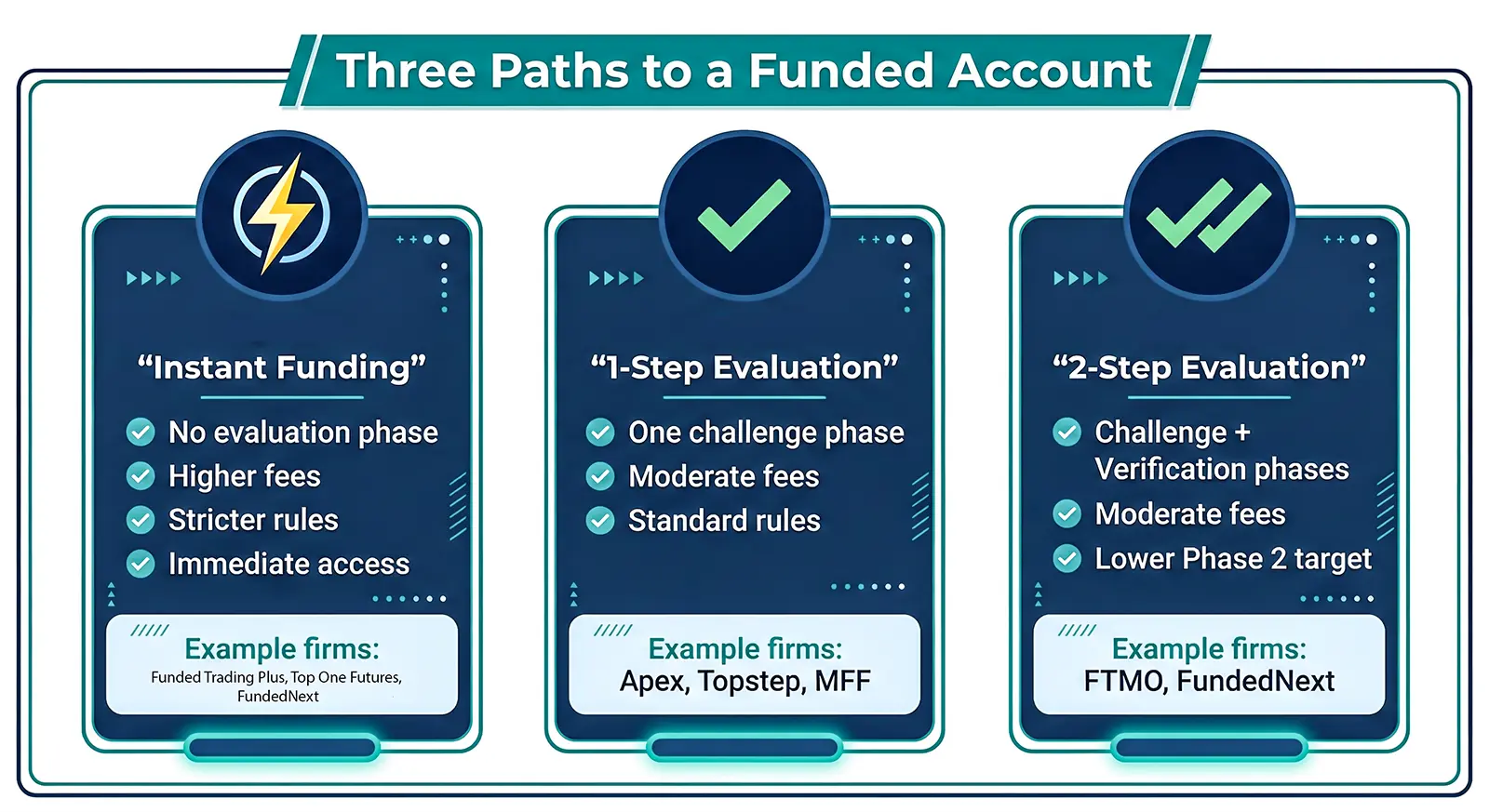
Prop firms offer different paths to a funded account. A 1-step evaluation has a single challenge phase. A 2-step evaluation splits the test into a challenge and a verification phase (the verification typically has a lower profit target). Instant funding skips the evaluation entirely and gives you a funded account immediately, though the rules tend to be stricter and the fees higher.
For most traders, a 1-step evaluation is the simplest path. Firms like Apex Trader Funding, Topstep, and My Funded Futures all use 1-step models for their primary products. FTMO offers both 1-step and 2-step options.
Choosing an Account Size
Account sizes typically range from $10,000 to $300,000. Larger accounts have higher profit targets, larger drawdown cushions, and higher evaluation fees. If you're new to prop firm evaluations, starting with a smaller account ($25,000 to $50,000) reduces the fee and the pressure.
A common mistake: choosing the largest account because it sounds impressive. The account size should match your trading style and typical position sizing. A trader who normally trades 1 ES contract doesn't need a $300,000 account.
Paying the Evaluation Fee
Evaluation fees vary by firm and account size. Across the firms we track, fees for a $50,000 account range from about $150 to $350. For a $100,000 account, fees range from $200 to $550. Some firms charge a one-time fee. Others charge a monthly subscription that continues until you pass or cancel.
Some firms refund the evaluation fee with your first funded payout. Others do not. This is worth checking before you buy.
Selecting a Trading Platform
Futures firms typically offer NinjaTrader, Tradovate, TradingView, or Rithmic. Forex firms offer MetaTrader 4/5, cTrader, or DXtrade. Your platform choice sometimes affects the evaluation fee and the data costs. Pick the platform you already know.
Step 2: The Evaluation Phase
The evaluation is where you prove you can trade profitably under rules. Here are the rules you'll encounter at most firms.
Profit Targets
The amount you need to earn to pass. Typically 6% to 10% of the account balance. On a $100,000 account with an 8% target, you need $8,000 in net profit. Some firms have lower targets: Apex Trader Funding uses a 6% target on their new accounts.
Daily Loss Limits
A cap on how much you can lose in a single trading session. If you hit the daily loss limit, your trading pauses for the day (at some firms) or the evaluation fails entirely (at others). Daily loss limits range from $500 to $2,500 depending on the account size. Some firms, like Apex Trader Funding's intraday accounts, have no daily loss limit during evaluation.
Maximum Drawdown (Trailing vs. Static)
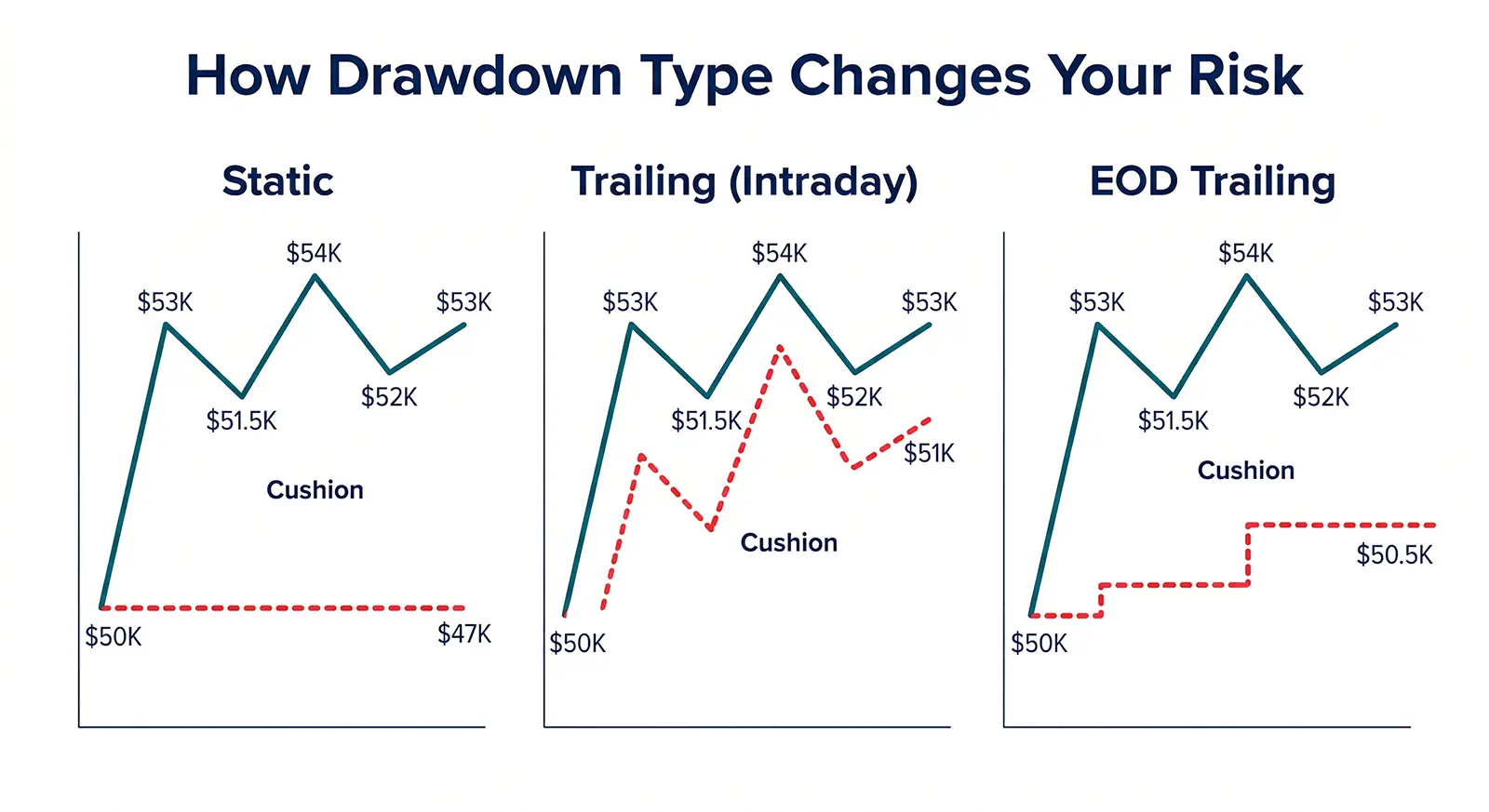
The total amount your account can decline before termination. This is the most important rule to understand. Drawdown comes in three types: static (a fixed floor that never moves), trailing (moves up as your equity increases, never moves down), and end-of-day trailing (recalculates only at market close).
The type of drawdown your firm uses changes how you need to manage every trade. Intraday trailing drawdown is the strictest because unrealized gains move the floor up in real time. If your account peaks at $52,000 during a session and then pulls back to $51,000, you've permanently lost $1,000 of drawdown cushion even though you're still profitable.
We cover the mechanics and trade-offs in detail in our trailing drawdown comparison.
Consistency Rules
Some firms limit how much of your total profit can come from a single day. This prevents traders from passing with one lucky trade. Apex uses a 50% rule (only on funded accounts, not evaluation). Other firms use 30% or 20%. Some have no consistency rule at all.
We explain the different thresholds and which firms enforce them in our consistency in prop trading guide.
Minimum Trading Days
Some firms require you to trade a minimum number of days before you can pass. This ranges from zero (Apex allows passing in one day) to 10+ days at other firms. The purpose is to prevent traders from passing on a single large trade.
What Happens If You Break a Rule
Breaching the maximum drawdown terminates the evaluation immediately. There is no recovery. You buy a new evaluation if you want to try again. Hitting a daily loss limit may pause trading for the day or fail the evaluation, depending on the firm. Breaking a consistency rule delays your payout but typically does not end the account.
For strategies to avoid these traps, see our how to pass a prop firm evaluation guide.
Step 3: Passing the Evaluation
KYC and Identity Verification
After passing, most firms require Know Your Customer (KYC) verification before activating your funded account. This involves submitting government-issued ID, proof of address, and sometimes tax documentation. KYC is standard across the industry and required for payout processing.
Receiving Your Funded Account
Once KYC is complete, you receive login credentials for your funded account. Some firms charge an activation fee at this point ($0 to $130 depending on the firm). The activation window is typically 7 days from passing.
The Trader Agreement
You'll sign a trader agreement or terms of service that outlines the funded account rules, profit split, payout schedule, and conditions for account termination. Read this document carefully. The rules on the funded account are often different from the evaluation.
Step 4: Trading the Funded Account
Are Funded Accounts Real or Simulated?
This is the most important disclosure in prop trading, and the industry is not always clear about it.
The majority of funded accounts in 2026 are simulated. Your trades execute on a demo server, not on a live exchange. The firm does not place real orders based on your positions. Your P&L is tracked in a simulated environment.
Your payouts, though, are real money. When you request a withdrawal and it's approved, you receive actual cash. The firm pays you based on your simulated performance.
A small number of firms transition traders to live accounts after meeting certain milestones (for example, Phidias moves traders to live after 3 payouts or $75,000 in total payouts). But the starting point at nearly every firm is a simulated environment.
How the Firm Tracks Your Performance
Firms monitor your account balance, equity, and drawdown in real time through their dashboard. Automated systems enforce the rules: if your account hits the drawdown threshold, positions are liquidated and the account is terminated. If you hit a daily loss limit, trading pauses automatically. There is no manual review or human intervention for rule enforcement.
Rules That Change Between Evaluation and Funded Phase
This catches a lot of traders off guard. The funded account often has different rules than the evaluation. Common changes include: reduced contract/position size limits, the addition of a consistency rule (Apex has none during eval but enforces 50% on the funded account), tighter or different drawdown mechanics, payout ladder caps that limit how much you can withdraw per payout, and minimum daily profit thresholds for qualifying trading days.
Always read the funded account rules before you start the evaluation. Understanding what the funded phase looks like prevents surprises after you've already paid and passed.
Step 5: Profit Split and Payouts
How the Profit Split Works
When you generate profit on the funded account, the money is split between you and the firm. The standard range is 70% to 90% in the trader's favor. Some firms offer 100% on an initial portion: Apex gives 100% on the first $25,000 per account. Topstep gives 100% on the first $10,000.
Flat Splits vs. Performance-Based Progression
Most firms use a flat profit split (for example, 80/20 or 90/10 from day one). A few use performance-based progression where the split improves as you trade longer or meet milestones. FTMO starts at 80% and moves to 90% through the Scaling Plan or Premium Programme.
Requesting Your First Payout
Payout eligibility typically requires meeting a minimum number of trading days (5 at Apex, varies at other firms), reaching a minimum profit amount ($200 to $1,000), and satisfying any consistency rules. You submit the request through the firm's dashboard, and the firm processes it according to their schedule.
Payout Methods and Processing Times
Common payout methods include bank wire transfer, Deel, Rise, PayPal, and cryptocurrency. Processing times vary by firm. Based on publicly available data: FTMO averages about 1-2 business days. Apex processes within 5-8 calendar days. Topstep offers daily payouts after certain milestones. Faster processing generally comes from firms with automated payout systems rather than manual review.
Tax Reporting
Funded account payouts are taxable income in most jurisdictions. In the United States, prop firm income is treated as self-employment income, not capital gains. Firms may issue 1099 forms to US traders. International traders should consult a local tax professional. Self-employment tax (15.3% in the US) applies on top of income tax. Set aside 25-35% of every payout for taxes.
Step 6: Scaling the Account
How Scaling Plans Work
Some firms increase your funded account size as you demonstrate consistent profitability. FTMO's Scaling Plan increases account size by 25% every 4 months if you meet performance criteria. The 5%ers scales accounts up to $4 million based on milestone profits. Apex does not have a traditional scaling plan but allows up to 20 simultaneous accounts.
Maximum Account Sizes
Maximum funded capital varies widely. FTMO caps at $2 million through scaling. The 5%ers scales to $4 million. FundedNext scales to $4 million. Apex's 20-account limit at $150K each gives a theoretical maximum of $3 million in combined capital, though payout caps limit actual earnings.
What Happens If You Blow the Account?
Account Termination
Breaching the maximum drawdown ends the funded account immediately. Your open positions are liquidated. Any unrealized profits are forfeited. There is no recovery, no appeal, and no reset on a funded account.
Can You Retry?
Yes, but you start over. You purchase a new evaluation, pass it again, and activate a new funded account. The fee for the failed funded account is not refunded. This is the real cost of blowing a funded account: not just the lost profits, but the time and money needed to get funded again.
The Real Cost of Getting Funded
Total Fee Calculation
The true cost of a funded account is not the evaluation fee alone. It's:
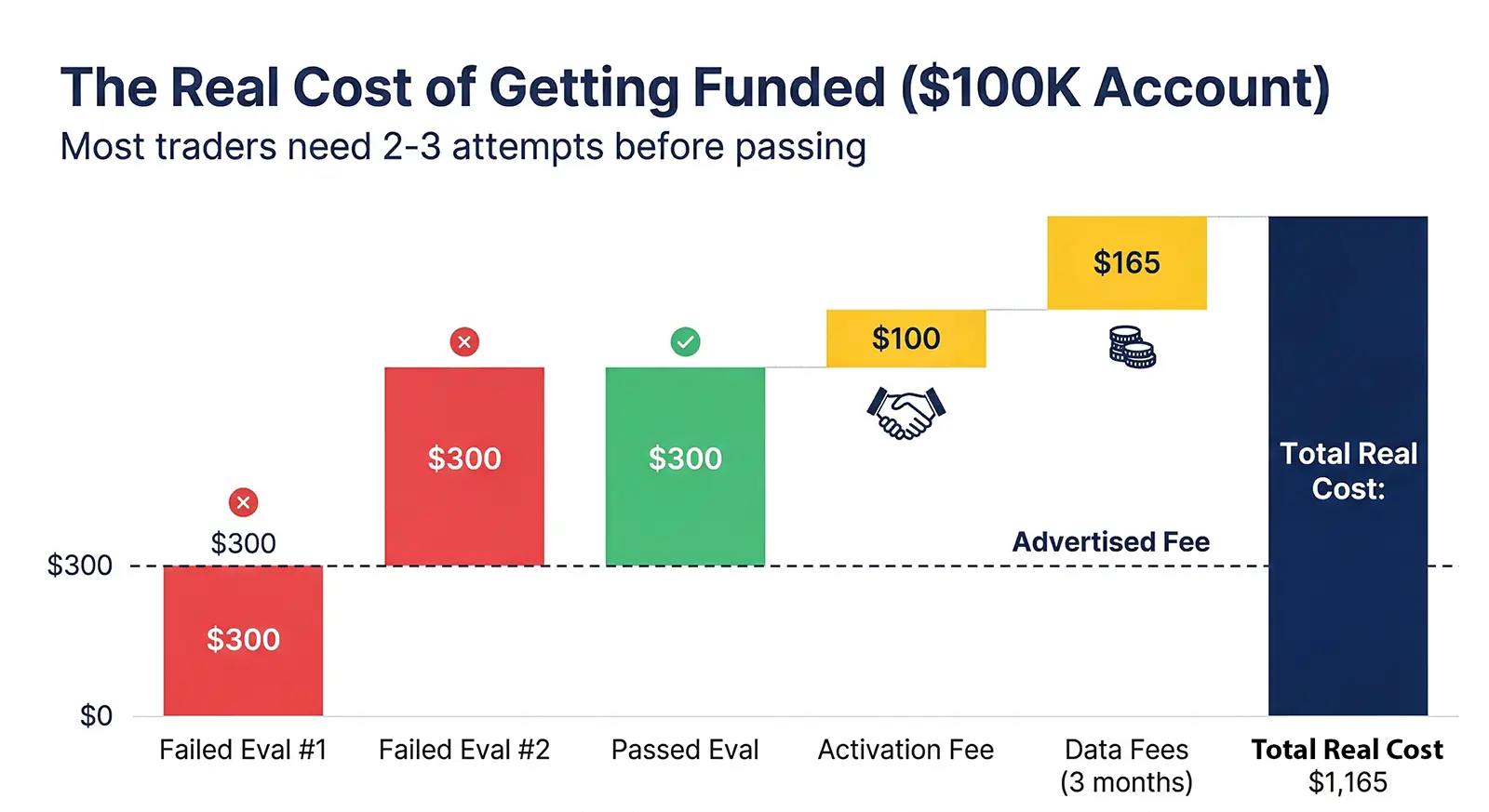
Evaluation fee (one-time or monthly) + activation fee (if applicable) + platform and data fees (futures only, $55-$135/month) + cost of failed attempts (most traders fail at least once).
Across the firms we track, evaluation fees for a $100K account range from $200 to $550. Activation fees range from $0 to $130. A realistic scenario: 2 failed evaluations at $300 each, 1 passed evaluation at $300, activation fee of $100, and 3 months of data fees at $55/month = $1,165 total. That's the real price of getting funded, not the $300 headline number.
Cost Per Funded Dollar
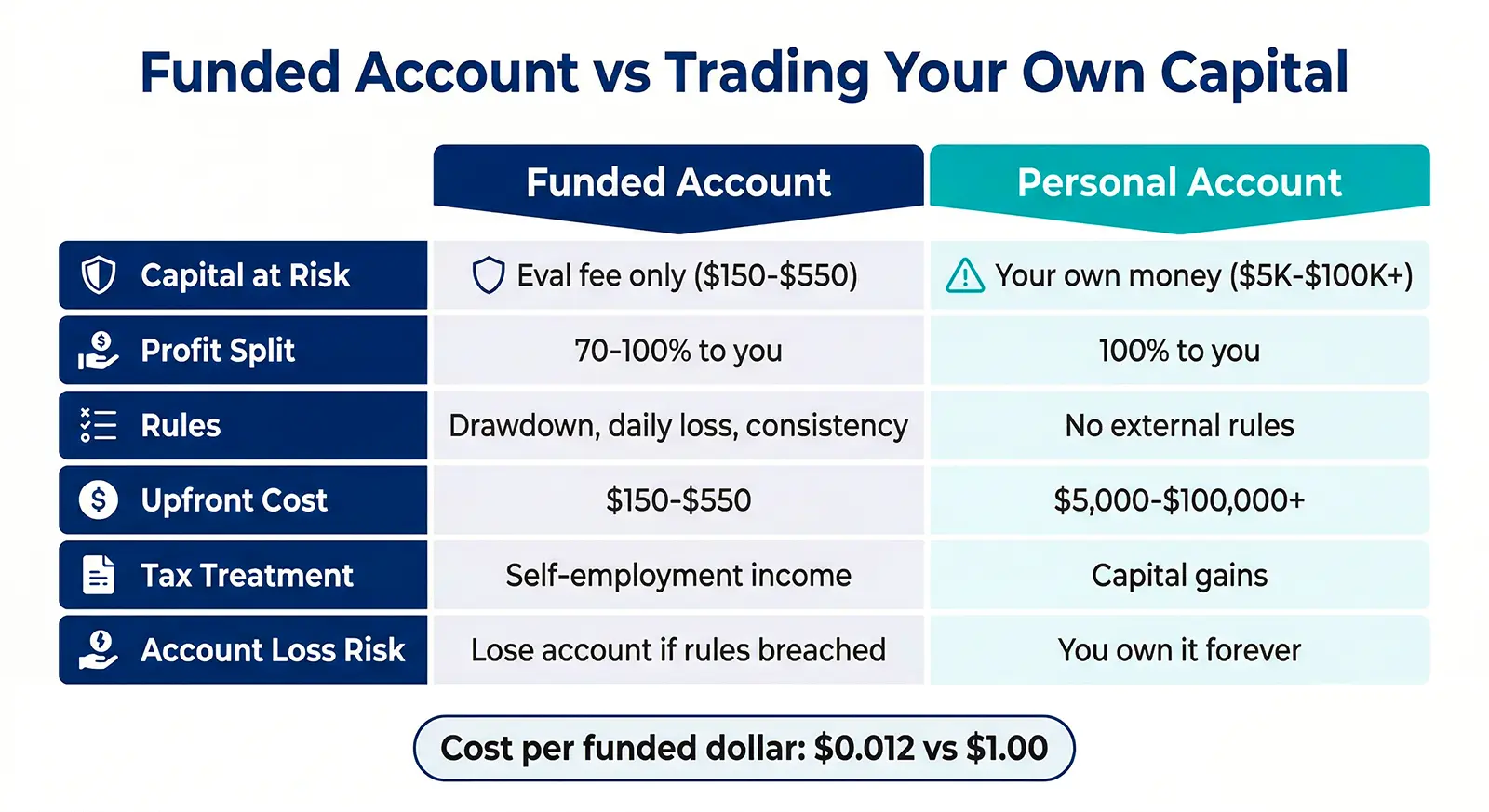
A metric we think more traders should calculate: total fees paid divided by the account size you receive. If you spent $1,165 to access a $100,000 funded account, your cost per funded dollar is $0.01165. That's 1.2 cents per dollar of trading capital. Compare this to depositing your own $100,000, which costs you $1.00 per dollar. The cost efficiency of prop firm funding is real, even when you factor in failed attempts.
Funded Accounts vs. Trading Your Own Capital
|
Factor |
Funded Account |
Personal Account |
|
Capital at risk |
Firm's capital (or simulated). You risk the eval fee only. |
Your own money. Full personal risk. |
|
Profit split |
70-100% to you, rest to firm |
100% to you |
|
Rules |
Drawdown limits, daily loss caps, consistency rules, position limits |
No external rules |
|
Upfront cost |
$150-$550 eval fee |
$5,000-$100,000+ deposit |
|
Account termination risk |
Lose the account if you break a rule |
No termination. You own the account. |
|
Tax treatment |
Self-employment income (US) |
Capital gains (US) |
Funded accounts work best for traders who have a tested strategy but lack the personal capital to trade meaningful size. Personal accounts work best for traders with sufficient capital who want full control and no external rules.
Compare the top firms on our best prop firms rankings page to find the right fit.
Common Misconceptions About Funded Accounts
"It's Free Money"
It isn't. You pay an evaluation fee, possibly an activation fee, and ongoing data costs. If you fail the evaluation, you lose the fee. If you blow the funded account, you lose your unrealized profits and need to pay again to start over. The capital is the firm's, but the costs are yours.
"You Get a Real Brokerage Account"
At most firms, no. The majority of funded accounts are simulated. Your trades don't execute on a live exchange. Payouts are real money based on simulated performance. A small number of firms offer live accounts after meeting milestones, but this is the exception.
"There Are No Rules Once You're Funded"
The opposite is often true. Some firms add rules after funding that didn't exist during the evaluation: consistency requirements, reduced position sizes, payout ladders, inactivity rules, and safety net minimums. The funded phase has more restrictions at many firms, not fewer.
"Most Traders Make a Living From This"
Industry data from FPFX Tech shows that only about 7% of traders who purchase an evaluation ever receive a payout. The opportunity is real for disciplined traders with tested strategies. But framing prop trading as a reliable income stream for the average participant is not supported by the data.
Frequently Asked Questions
How long does it take to get a funded account?
From purchasing an evaluation to receiving funded account credentials: it depends on how quickly you pass. Some firms allow passing in a single day. Others require 4-10 minimum trading days. KYC verification adds 1-3 business days after passing. Total timeline can be as short as 3 days or as long as 60+ days.
How much money can you make with a funded account?
It depends on your account size, profit split, and trading performance. A trader making 4% per month on a $100,000 account with a 90% profit split earns $3,600. Some firms allow multiple simultaneous accounts (up to 20 at Apex), which increases the ceiling. But most traders earn modest amounts, and most evaluation attempts end in failure.
Are funded trading accounts legal?
Yes. Funded trading accounts are legal in all major jurisdictions. Most prop firms operate outside traditional financial regulation because they use simulated accounts and don't manage client funds. Firms that route live orders may need specific licenses depending on the jurisdiction.
Do you need to be a professional trader to get funded?
No formal qualifications are required. Anyone can purchase an evaluation. But passing requires a tested trading strategy and the discipline to follow rules under pressure. The 5-15% pass rate reflects the difficulty.
What happens to your profits if the firm shuts down?
If a prop firm closes, any unrealized profits or pending payout requests are typically lost. Between 2023 and 2024, an estimated 80-100 prop firms shut down. This is a real risk. Choosing established firms with long track records and verified payout histories reduces this risk.
Can you withdraw the starting capital?
No. The starting balance belongs to the firm. You can only withdraw profits above the starting balance (minus the firm's split). The starting capital is not yours to take.
Do funded accounts count as employment?
At most firms, no. Funded traders are classified as independent contractors, not employees. You don't receive benefits, salary, or employer tax contributions. In the US, this means you pay self-employment tax on your payouts. Consult a tax professional for your specific situation