Prop Firm Scaling Plans Explained: How Funded Accounts Grow Over Time
A prop firm scaling plan increases a funded trader's account size after hitting performance milestones, usually a set profit percentage. Scaling plans let traders grow a $50,000 account to $200,000 or more over time, with drawdown limits and rules adjusting at each step.
What Is a Scaling Plan in a Prop Firm?
A scaling plan is a mechanism that grows your funded trading accounts balance over time as you demonstrate consistent profitability. Instead of staying on the same $50,000 account forever, you hit a profit milestone, the firm increases your account size, and you trade a larger balance with proportionally larger earning potential.
Scaling exists because prop firms want to retain profitable traders. A trader who makes money month after month is valuable to the firm. Giving that trader more capital keeps them from leaving for a competitor. It also lets the firm deploy more of its capital (or simulated capital) toward traders with a proven track record.
Not every firm offers a scaling plan. Some provide a fixed account size with no growth path. If long-term capital growth is important to your trading career, the scaling plan should be part of your firm selection criteria. For tips on getting through the evaluation to reach the scaling stage, see our how to pass a prop firm evaluation guide.
How Scaling Plans Work Mechanically
The Trigger: Profit Milestones
Most scaling plans are triggered by reaching a specific profit percentage on your current account balance. The most common trigger is 10% net profit. At FTMO, you need 10% net profit over a 4-month period (with at least 2 months being profitable). At The 5%ers, milestones vary by program, with some doubling the account at each 10% profit target.
Some firms use a fixed dollar target instead of a percentage. Others tie the trigger to a combination of profit, number of payouts completed, and time funded. The trigger conditions are the first thing to check in any scaling plan.
The Growth Increment
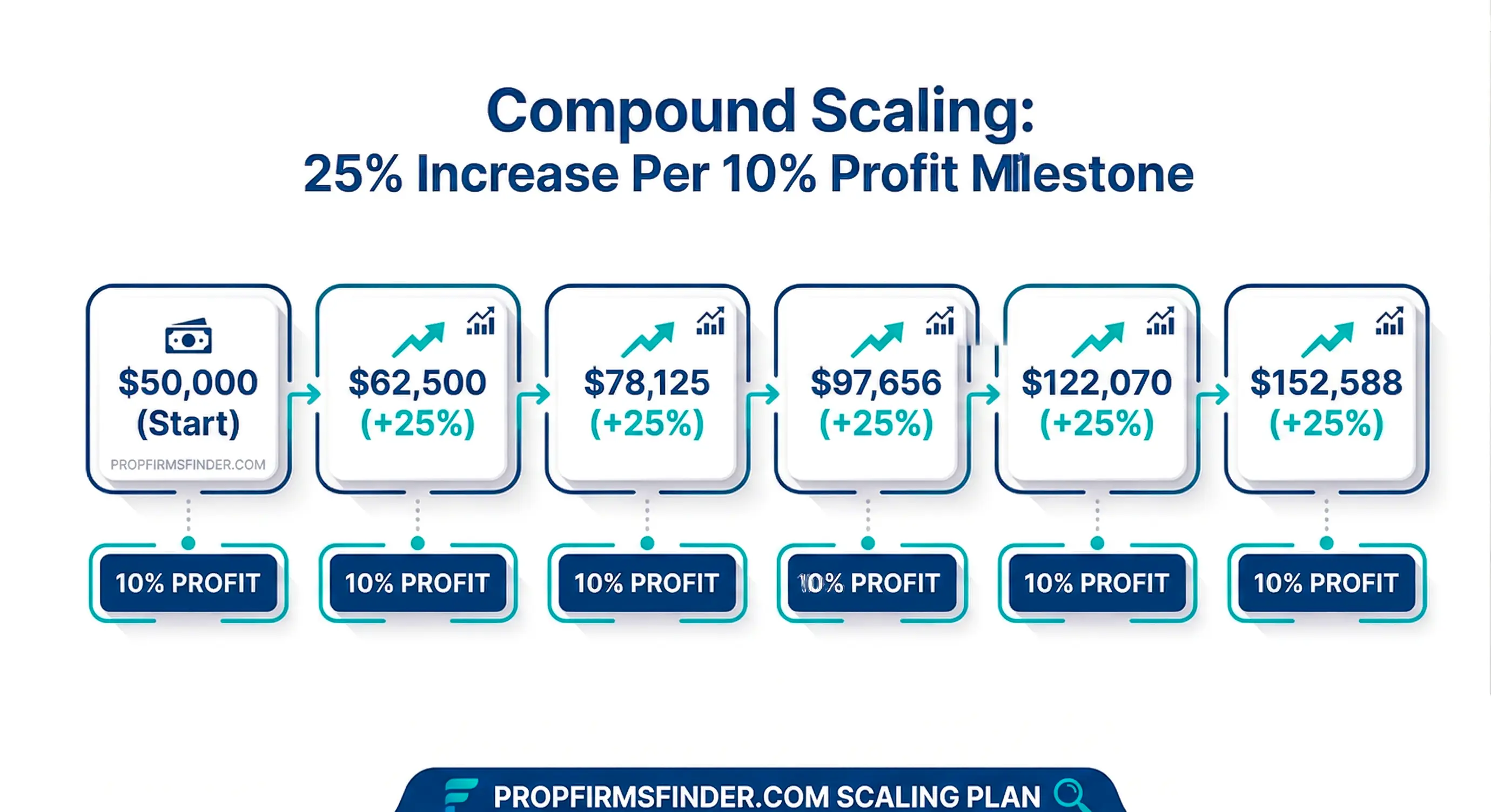
When you hit the milestone, the firm increases your account by a set amount. The most common increment is 25% of the current balance. A $50,000 account becomes $62,500. The next scale takes $62,500 to $78,125. And so on.
Some firms use larger increments. The 5%ers doubles the account size at certain milestones. Others use fixed dollar amounts (e.g., +$25,000 per scale). The increment determines how quickly the account grows and how many milestones it takes to reach the ceiling.
The Ceiling (Maximum Allocation)
Every scaling plan has a cap. FTMO caps at $2,000,000. The 5%ers caps at $4,000,000. FundedNext caps at $4,000,000. Topstep does not have a traditional scaling plan on individual accounts but allows up to five Express Funded Accounts. Apex Trader Funding allows up to 20 simultaneous accounts at $150,000 each (a combined $3,000,000 theoretical cap), but this is multiple accounts rather than scaling a single one.
The ceiling matters because it determines the upper limit of your earning potential with a given firm. A trader making 3% per month on a $2,000,000 account at 90% split earns $54,000/month. The same trader on a $200,000 account earns $5,400/month. Scaling is how you bridge that gap.
How Scaling Is Requested and Processed
At most firms, scaling is not automatic. You need to verify your eligibility and either request the scale through the dashboard or contact support. FTMO requires that you've had no failed accounts in the prior 4 months and that you've achieved the profit target across a specific number of reward cycles. Some firms process the increase within 24-48 hours. Others take up to a week.
Drawdown Adjustment at Each Tier
This is the detail that separates informed traders from those who get burned after scaling.
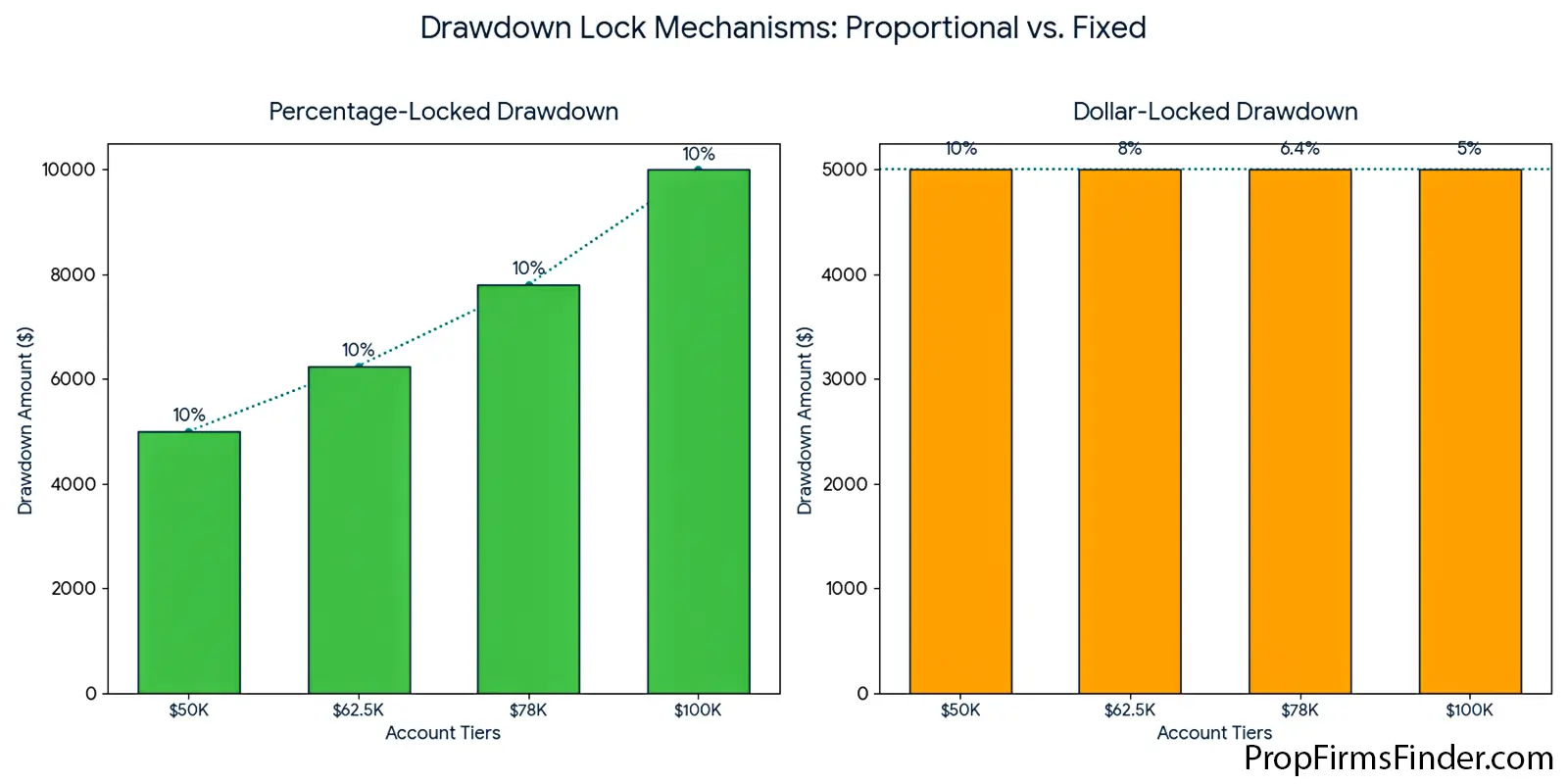
At some firms, the drawdown dollar amount grows proportionally with the account. A $50,000 account with $5,000 drawdown scales to $62,500 with $6,250 drawdown. Your risk as a percentage stays the same.
At other firms, the drawdown dollar amount stays fixed even as the account grows. A $50,000 account with $5,000 drawdown scales to $62,500, but your drawdown is still $5,000. The percentage of room you have to be wrong shrinks at every tier. This makes higher tiers progressively harder to maintain.
Always check whether drawdown is percentage-locked or dollar-locked before counting on a scaling plan. For a deeper look at drawdown mechanics, see our trailing drawdown comparison.
Common Scaling Plan Structures
Percentage-Based Milestones
The most common model. Hit 10% profit, receive a 25% account increase. FTMO uses this: 10% net profit over 4 months with at least 2 profitable months triggers a 25% balance increase and an upgrade from 80% to 90% profit split. This cycle repeats until you reach the $2,000,000 ceiling.
Fixed-Dollar Increments
Some firms add a fixed amount at each milestone rather than a percentage. For example, +$25,000 per scale regardless of current balance. This is linear growth rather than compound, and it takes longer to reach higher tiers compared to percentage-based models.
Milestone-Based Doubling
The 5%ers uses a model where the account doubles at certain profit targets. A $20,000 account becomes $40,000, then $80,000, then $160,000, and so on up to $4,000,000. The profit target at each stage varies, but the doubling mechanic means the account grows much faster in the early stages and reaches large sizes more quickly than a 25% increment model.
Multi-Account Scaling
Some futures firms don't scale a single account but let you run multiple accounts. Apex Trader Funding allows up to 20 funded accounts. Topstep allows up to 5 Express Funded Accounts. This is scaling by multiplication rather than by growth. Each account has its own drawdown, rules, and payout cycle.
No Scaling (Fixed Account Size)
Some firms offer a fixed funded account with no growth path. You trade the same balance indefinitely. If your strategy works at that size, it works. If you want more capital, you buy additional evaluations. This is the simplest model, and for traders who prioritize consistency over growth, it can work well.
The Math Behind Scaling
Compound vs. Linear Growth
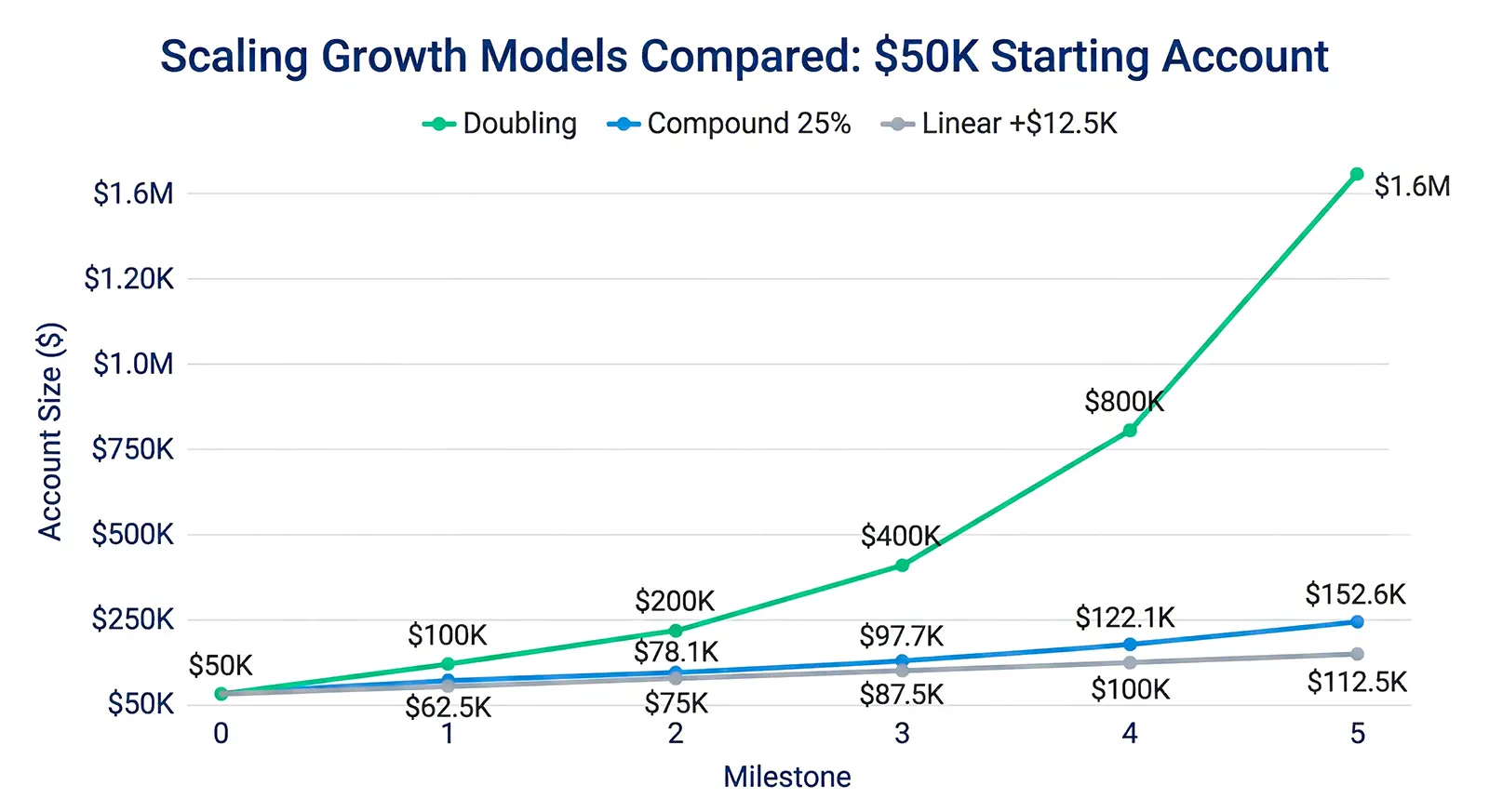
With percentage-based scaling, each increase applies to the current balance (compound). With fixed-dollar scaling, each increase adds the same amount to the original (linear). The difference is significant over time.
Example starting at $50,000:
|
Milestone |
Compound (25% increase) |
Linear (+$12,500) |
Doubling |
|
Start |
$50,000 |
$50,000 |
$50,000 |
|
1st |
$62,500 |
$62,500 |
$100,000 |
|
2nd |
$78,125 |
$75,000 |
$200,000 |
|
3rd |
$97,656 |
$87,500 |
$400,000 |
|
4th |
$122,070 |
$100,000 |
$800,000 |
|
5th |
$152,588 |
$112,500 |
$1,600,000 |
At milestone 5, the compound model is at $152K, the linear model at $112K, and the doubling model at $1.6M. The growth model matters more than almost any other factor in scaling plan design.
Realistic Time to Reach the Ceiling
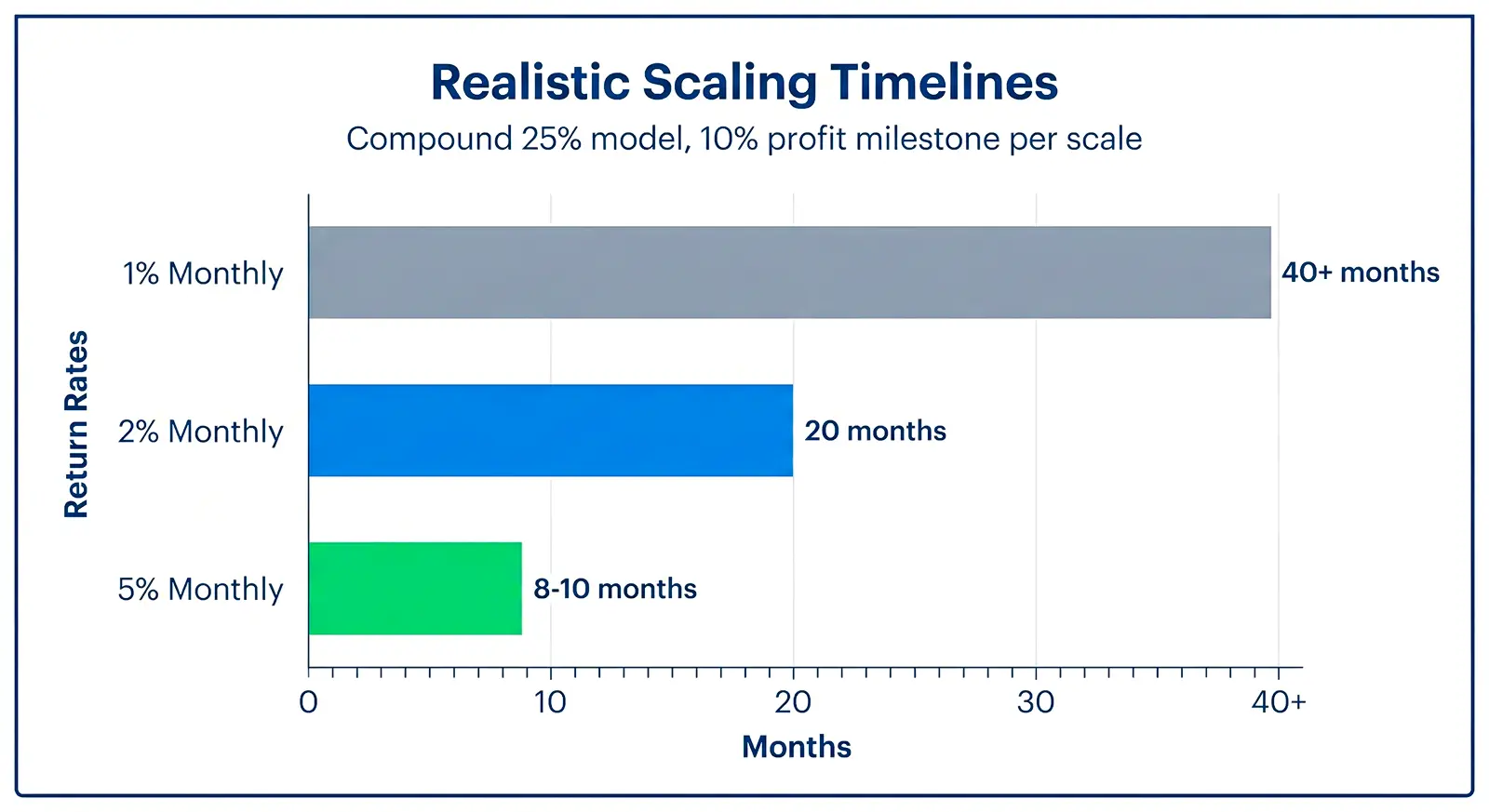
How long does scaling take? It depends on your monthly return. Here's the math for a compound 25% model (starting at $50K, ceiling at $200K, 10% profit milestone triggers each scale):
|
Monthly Return |
Months to First Scale |
Months to $200K |
Scales Required |
|
1% |
10 months |
40+ months |
6 |
|
2% |
5 months |
20+ months |
6 |
|
5% |
2 months |
8-10 months |
6 |
At a conservative 2% monthly return, reaching $200K from a $50K starting account takes roughly 20 months. That's almost two years of consistent, profitable trading without blowing the account. This is why scaling plans are a long-term play, not a short-term hack.
Scaling vs. Withdrawing Profits: The Trade-Off
Profits as Collateral for Scaling
At some firms, you need to keep profits in the account to hit the scaling milestone. If the trigger is 10% profit on a $50K account ($5,000), and you withdraw $3,000 before reaching $5,000, your progress resets or slows. The profits are effectively collateral for the scale.
Do Withdrawals Count Against Scaling?
This depends on the firm. At FTMO, the scaling calculation is based on net profit over a 4-month window, and withdrawals reduce the running total. At The 5%ers, milestones are tied to account growth targets, so withdrawals can delay scaling. At some firms, scaling is based on cumulative lifetime profit regardless of withdrawals.
Scale First or Withdraw First?
The trade-off: withdrawing gives you money now. Scaling gives you more money later.
A trader on a $50K account at 90% split making $2,000/month takes home $1,800. If that trader delays withdrawals for 5 months, hits the $5,000 milestone, and scales to $62,500, the same 4% monthly return now generates $2,500/month ($2,250 take-home). Over the next 12 months, the extra $450/month adds up to $5,400.
But those 5 months without withdrawals mean $9,000 in deferred income. The break-even point is about 20 months after the scale. This is the math every trader should run before deciding whether to prioritize scaling or withdrawals.
Maximum Account Sizes Across the Industry
Data reflects publicly stated terms as of April 2026. Verify current terms on each firm's website.
|
Firm |
Start Size |
Scale Trigger |
Increment |
Max Ceiling |
Drawdown Adjustment |
|
FTMO |
Up to $200K |
10% over 4 months |
+25% |
$2,000,000 |
Proportional |
|
The 5%ers |
$5K-$100K |
Varies by plan |
Doubling |
$4,000,000 |
Proportional |
|
FundedNext |
Up to $200K |
Performance milestones |
Tiered |
$4,000,000 |
Proportional |
|
Funded Trading Plus |
Up to $200K |
10% profit |
+25% |
$2,500,000 |
Proportional |
|
FundingPips |
Up to $200K |
Milestones |
Tiered |
$2,000,000 |
Varies |
|
Apex Trader Funding |
Up to $150K |
N/A (multi-account) |
N/A |
20 accounts ($3M combined) |
Per-account |
|
Topstep |
Up to $150K |
N/A (multi-account) |
N/A |
5 accounts ($750K combined) |
Per-account |
|
Earn2Trade |
Up to $200K |
Performance milestones |
Tiered |
$400,000 |
Varies |
The range is wide. The 5%ers and FundedNext offer the highest ceilings ($4M). Futures firms like Apex and Topstep take a multi-account approach instead of single-account scaling. FTMO and Funded Trading Plus sit in the middle at $2M to $2.5M.
Rules That Change as You Scale
Profit Split Progression
At several firms, the profit split improves alongside scaling. FTMO moves from 80% to 90% when you qualify for the Scaling Plan. The 5%ers increases the split at each milestone stage. These two mechanisms (bigger account + higher split) compound the earnings potential.
Consistency Rules at Higher Balances
Some firms tighten consistency requirements as accounts grow. The logic: a larger account with concentrated P&L represents more risk for the firm. If you're scaling from $100K to $200K, expect to see closer scrutiny on daily P&L distribution.
Contract or Position Size Adjustments
Futures firms that scale individual accounts typically increase the contract limit proportionally. A $50K account with 5 contracts scales to $100K with 10 contracts. Forex firms may adjust lot size limits at each tier. Check whether the position size increase matches the account size increase, or if you're getting a bigger account with the same position limit.
What to Watch For in Scaling Plan Terms
Hidden Cooldown Periods
Some firms require a minimum time between scale events (e.g., 4 months at FTMO). Even if you hit the profit target in month 2, you wait until month 4. This extends the timeline and should be factored into your break-even calculations.
Profit Targets That Reset
After a payout, does your scaling progress reset? At some firms, yes. The 10% milestone resets to zero after each withdrawal. At others, it's cumulative and doesn't reset. This single detail can add months to your scaling timeline.
Scaling Caps Disguised as "Unlimited"
Some firms market "unlimited scaling" but have practical caps. Check the terms for maximum allocation per trader, maximum combined account value, or maximum contract/position size at the highest tier. If the position size cap doesn't increase with the account, the effective scaling is limited even if the balance number keeps growing.
Changes to Scaling Rules After Signup
Firms modify scaling terms occasionally. Topstep changed its payout structure in January 2026. FTMO has adjusted its Scaling Plan criteria over the years. These changes typically apply to new accounts, not existing ones, but this is not guaranteed. Check the terms of service for a modification clause.
Scaling Plans and Taxes
This section is for general awareness only. It is not tax advice. Consult a licensed tax professional in your jurisdiction.
Does Scaling Trigger a Taxable Event?
No. Scaling your account from $50K to $62.5K does not create a taxable event. No money changes hands. The account balance increase is on paper only. You owe taxes when you receive a payout, not when the account scales.
How to Track Scaling for Tax Records
Keep a log of each scaling event: date, previous balance, new balance, and the profit that triggered it. This helps your tax professional understand the relationship between your funded account size and the payouts you received during the year.
Common Misconceptions About Scaling Plans
"Scaling to $2M Means Real $2M Capital"
At most firms, no. The $2,000,000 balance is simulated. You trade on a demo server with a $2M balance displayed on your dashboard. Your payouts are real money, but the underlying capital is not sitting in a brokerage account with your name on it. The distinction matters for understanding what you're actually managing.
"Scaling Is Automatic"
At most firms, scaling requires meeting the eligibility criteria and then requesting the upgrade. It's not applied automatically. If you hit the profit target and don't submit the request, your account stays at the current size. FTMO requires an active request and eligibility verification.
"I'll Reach the Maximum in a Year"
At a 2% monthly return with a 25% compound model starting at $50K, reaching $200K takes about 20 months. Reaching $2M takes years. A 5% monthly return cuts the timeline, but sustaining 5% per month without a drawdown breach is extremely difficult. Set realistic expectations based on the math, not the marketing.
"All Scaling Plans Are Equal"
They are not. A 25% compound model and a doubling model produce radically different outcomes. A firm that locks drawdown at the original dollar amount makes scaling progressively harder. A firm that scales drawdown proportionally keeps the difficulty constant. The structure matters as much as the ceiling number.
Is a Scaling Plan Worth It?
Who Benefits Most From Aggressive Scaling
Traders with a low-drawdown strategy and consistent monthly returns in the 2-5% range. If your strategy produces steady gains with shallow drawdowns, scaling lets you multiply your income over time without taking more risk per trade. The bigger account does the heavy lifting.
Who Should Prioritize Withdrawals Over Scaling
Traders who need income now. If prop trading is your primary income source, withdrawing monthly and accepting the slower scaling pace makes more sense than deferring income for a larger account in 18 months. The extra capital is only valuable if you're around to use it.
When to Stop Scaling
At some point, a larger account doesn't help if your strategy doesn't scale with it. A scalper who trades 1-2 ES contracts doesn't benefit from a $2M account because the position size doesn't need to increase. If your strategy has a natural size limit, the account growing beyond that limit adds no value. Scale until the account matches your strategy's capacity, then prioritize withdrawals.
Compare scaling plans alongside other factors on our best prop firms rankings page.
Frequently Asked Questions
How long does it take to reach the maximum scaled account size?
It depends on your monthly return, the scaling model, and the ceiling. On a compound 25% model starting at $50K with a $2M ceiling and 2% monthly return, expect 3-4+ years. With a doubling model (The 5%ers), the timeline can be shorter at the early stages but still requires years of consistent performance to reach $4M.
Does scaling increase my profit split?
At some firms, yes. FTMO moves from 80% to 90% when you qualify for the Scaling Plan. The 5%ers increases the split at each scaling tier. At other firms, the split stays flat regardless of account size. These are independent mechanisms that sometimes move together.
Can I lose my scaled balance if I breach a rule?
Yes. If you breach the maximum drawdown on a scaled account, the account is terminated. You lose the scaled balance and need to start over with a new evaluation. Scaling progress is not preserved across account failures.
Do I get real money when my account scales?
No. Scaling increases the simulated balance in your funded account. No money is deposited into your bank account when the scale happens. You get real money only when you request a payout.
What happens if I withdraw money before scaling?
At most firms, withdrawals reduce your running profit total, which can delay the scaling milestone. Some firms reset scaling progress after a payout. Others use cumulative lifetime profit. Check your firm's specific terms.
Is there a fee for scaling?
Most firms do not charge a fee for scaling. The scale is a reward for consistent performance. A few firms require you to sign an updated trader agreement at higher tiers.
What's the highest account size I can scale to?
As of April 2026, The 5%ers and FundedNext offer the highest published ceilings at $4,000,000. FTMO caps at $2,000,000. Most other firms cap between $200,000 and $2,500,000. These figures are simulated account balances, not real deposited capital.
Does scaling work differently on instant funding accounts?
Instant funding accounts typically have the same scaling mechanics as evaluation-based funded accounts, but they may start at lower profit splits or higher drawdown thresholds to compensate for the skipped evaluation. Check the firm's specific terms for instant funding scaling